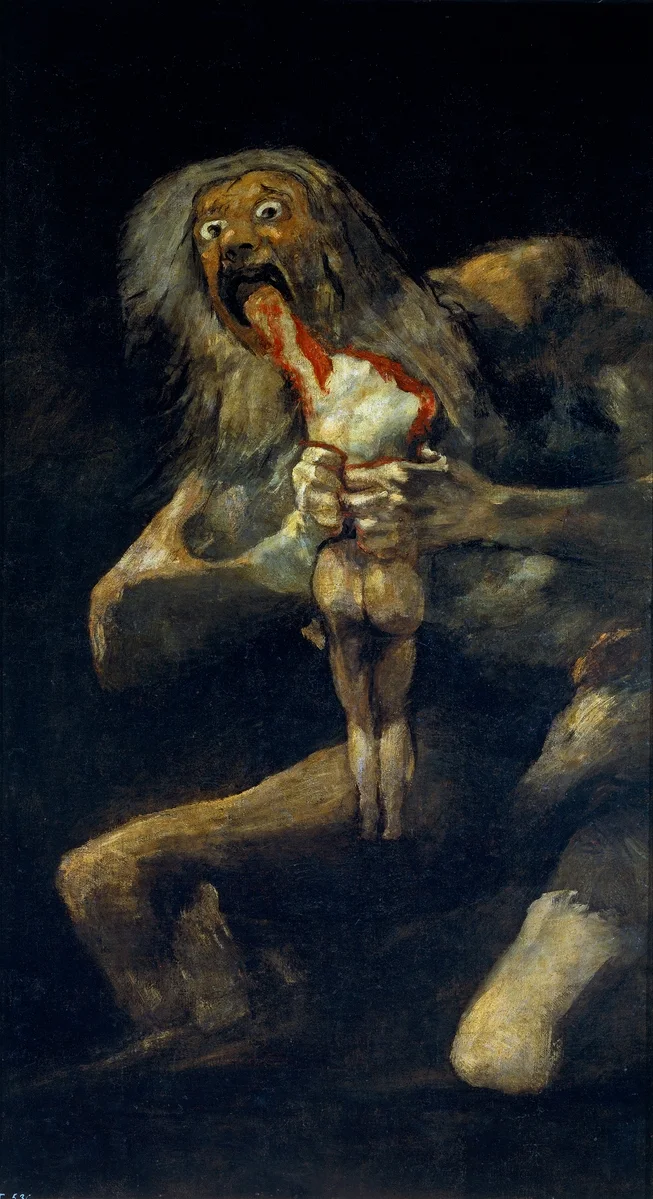
The temptation of the ready-made villain
When a manuscript stalls halfway through, the trouble often lies less with the hero than with what stands against them. An adversary who sneers, pounds the table and swears revenge makes the novel sag, because the reader senses the resistance is cardboard and the whole structure loses its tension.
The adversary simply received less care than the hero, and the author wrote them as an obstacle instead of making them a character, which has nothing to do with the evil they embody. A great antagonist acts as the hero's mirror, because they carry a truth about the hero that the hero can't see alone. Faulkner said the only thing worth writing about is "the human heart in conflict with itself," and a solid antagonist gives an outward face to that inner conflict.
This article offers a method for building that kind of adversary, illustrated by five literary figures who have outlived their era and who resemble each other in no way.
The principle of antagonism: why resistance makes the novel
The American screenwriting teacher Robert McKee put forward an idea many writers recite without really working through. In Story (1997), he calls it the principle of antagonism: the more powerful and complex the forces opposing a character, the more powerful and complex the character and the story must become to hold their own against them.
In that sentence, "complex" is the word that counts most. A very powerful but simple adversary, like a faceless dictator or an interchangeable killer, only forces the hero to be faster or craftier, without making them more interesting. For a hero to reveal their depth, they need an adversary who knows something they don't, who defends a coherent worldview and who, at the very moment we should hate them, tips the scales by a hair.
Three pillars: conviction, capability, contradiction
An antagonist works when they combine three qualities at once.
1. Conviction
Nobody gets up in the morning planning to do evil. The antagonist acts according to a worldview that justifies their actions, and that coherence has to be established in the book long before the last page. In Hugo, Javert believes in order: for him, the law is an absolute morality, and a man who stole at nineteen must pay for it all his life. Hugo takes the time to explain this conviction in the first half of the novel, through Javert's birth in prison, the shame he feels about his parents and his visceral need to prove that one can escape one's condition by siding with the Code.
If you ask your antagonist why they act, their answer should therefore begin with "because" and give a reason they consider just.
2. Capability
A convinced but ineffective adversary remains a colorful fanatic, whereas they need to be able to do real harm, whether physically, socially, intellectually, financially or symbolically. Hannibal Lecter, who appears in Thomas Harris's Red Dragon (1981) before becoming central in The Silence of the Lambs (1988), is locked up and can't strike anyone. His intelligence nonetheless surpasses that of most of the investigators who question him, and he uses it to take apart psychologically anyone who comes near his cell, which is more than enough to make him dangerous.
Your antagonist must therefore have ground on which they outmatch the hero, or the conflict shrinks to a formality.
3. Contradiction
This is the most neglected quality. A memorable antagonist carries a contradiction that makes them human, or inhuman in a coherent way. In Cormac McCarthy's No Country for Old Men (2005), Anton Chigurh is a hitman who sees himself as the instrument of fate. He stakes some victims' lives on a coin toss, leaving them a theoretical chance, and he returns the money from the case to a businessman to win his trust instead of keeping it. He keeps his word even in his promises to kill, and this twisted but very real ethic sets him apart from an ordinary killer. The reader doesn't know whether to see him as a psychopath or an allegory of death, and that uncertainty makes him unforgettable.
So look for a detail, a principle or a gesture that clashes with the rest of their profile, so they stand as a character instead of filling a function, without trying to humanize them on the cheap.
Five antagonists, five mechanisms
Each memorable antagonist is memorable in their own way. Here are five cases that cover most situations useful to a novelist.
Iago, the antagonist without a cause
In Othello (first performed around 1604), Shakespeare stages a character who has puzzled readers for four centuries. Iago wants to destroy Othello and succeeds, even though his motives, laid end to end, weigh little against what he accomplishes. He says he was passed over for a promotion and suspects Othello of having slept with his wife, but he tosses these reasons out in passing without ever exploring them.
In his lectures on Shakespeare in the winter of 1818-1819, Samuel Taylor Coleridge found a phrase that stuck: Iago embodies "the motive-hunting of motiveless malignity." The reading has been much debated, but the intuition is sound, since Iago destroys for the pleasure of exercising his intellectual superiority, and his coherence lies in that taste rather than in a cause.
What a novelist can take from this: an antagonist can do without a moral reason if their coherence lies elsewhere, in a way of acting, a pleasure or an obsession. The absence of a motive then becomes a motive in itself, as long as it's held to the end.
Javert, order turned deadly
In Les Misérables (1862), Hugo makes Javert the tragic antagonist par excellence. Far from being a sadist, Javert believes in the law as sincerely as Valjean believes in redemption, and the drama arises because these two convictions, each defensible, cannot coexist.
Hugo takes this logic all the way. When Valjean, who could kill Javert, saves his life instead, Javert's whole moral system collapses: if the law condemns a good man and a former convict can grant mercy, the certainties that carried him all his life no longer hold, and he throws himself into the Seine.
What a novelist can take from this: an antagonist who believes in something defensible, and who breaks on discovering that their conviction doesn't cover all of reality, overwhelms the reader. Javert is defeated by the complexity of the world far more than by the hero.
Cathy Ames, evil from birth
In East of Eden (1952), Steinbeck takes a risk few authors accept. He presents Cathy Ames, the monstrous mother of the Trask twins, as a moral "monster" born with a malformed soul, with no trauma to explain her, and he explicitly defends this idea in the chapters where the narrator steps in to comment on her.
This radical choice rules out the psychological explanation that would, in his view, have watered down the nature of evil, and makes Cathy a figure rather than a clinical case. Steinbeck nonetheless observes her throughout the novel with almost documentary precision: the way she manipulates, uses her beauty and lies with the exactness others reserve for the truth. The portrait terrifies because it stays precise from start to finish.
What a novelist can take from this: if you choose an antagonist beyond redemption, they must be even more precise than the others, because the coherence of their actions makes up for the lack of moral coherence.
Hannibal Lecter, the one who knows, behind the glass
Lecter appears only briefly in Red Dragon (1981), when Will Graham comes to consult him in his cell because nobody else thinks like him, and that position as an expert defines the whole character. When Harris brings him back in The Silence of the Lambs (1988), he puts him at the center, and this relationship becomes the heart of the novel: Clarice Starling learns to investigate by talking with Lecter, who demands a confidence in exchange for every answer, following the rule of quid pro quo.
Lecter works because he has something to offer the heroine, like an inverted mentor. The tension is less about his escape, which eventually comes, than about what Clarice is willing to give up to get his help.
What a novelist can take from this: an antagonist who shares something with the hero, a knowledge, a gift or a wound, creates a tension no simple opposition ever produces, because the hero can't destroy them without losing a part of themselves.
Anton Chigurh, fate made flesh
In McCarthy, Chigurh acts as a force more than as a villain. He hates no one and simply does his job, but he defends an idea: the deaths he causes are the victims' responsibility, because of the choices they made. The coin toss he offers them follows from this philosophical conviction, far from any whim.
McCarthy refuses to say whether Chigurh is a man or an allegory, and that refusal makes him one of the most discussed antagonists in recent American fiction.
What a novelist can take from this: an antagonist can resist all interpretation if every concrete detail of their behavior stays perfectly precise, because mystery is built with exactness.
Seven tests before sending out the manuscript
When you reread, put your antagonist through these seven questions. If they fail more than two, there's work left to do.
- The summary. Ask a reader to summarize your antagonist's moral position in two sentences. If they answer "he's evil" or "she wants power," that position still needs writing.
- The desire. What do they concretely want in each scene where they appear? They need a precise, checkable goal, far more telling than an abstract ambition like ruling the world.
- The missing scene. Write a scene where your antagonist is alone, even if it won't be in the book. If you have nothing to tell in it, the character doesn't exist beyond their function.
- The argument. If your hero and your antagonist debated for three hours, would the antagonist score at least one point? If they score none, the conflict is one-sided.
- The defeat. Beating the antagonist must cost the hero something, and if the hero wins without sacrificing anything, the stakes are too low.
- The portrait. Can you describe your antagonist without clichés (dark eyes, a scar, a nasty smile)? Their face has to be singular.
- The contradiction. Does a detail of their behavior clash with the rest, like an inner mystery rather than a wrong note? That detail is often what readers remember.
Mapping your antagonist before revising
Many writers build their antagonist as they go and discover on rereading an inconsistent character whose speech shifts, whose methods contradict each other and whose appearances are irregular. Revision then begins with a cold-eyed map.
In Extypis, story element sheets let you keep that map next to the text: a sheet devoted to the antagonist, where you note their conviction, their contradiction, their key scenes and their appearances chapter by chapter. Character mentions automatically complete every reference to your antagonist in the manuscript, and the frequency chart shows you whether they vanish for too long, which almost always signals a drop in tension.
You can perfectly well discover your antagonist while writing: this sheet is there to check, once the first draft is done, that the character who imposed themselves on you holds up.
What to remember
A memorable antagonist combines a defensible conviction, a real capacity to do harm and an inner contradiction. Iago holds through his taste for destruction, Javert through his moral rigidity, Cathy Ames through the precision of her inhumanity, Lecter through the knowledge he shares with the heroine, and Chigurh through the mystery surrounding him.
None resembles the others, but all were thought through with as much care as the hero they face, and that care is what separates a tense novel from one that sags.
Hubert Giorgi
Author
The writing studio novelists were missing
Outline, characters, places and objects, the links between them, mind map, scene board, export: everything lives in one place. Plus an AI that knows your story, whenever you want one.
Free to write and to export. No credit card asked.