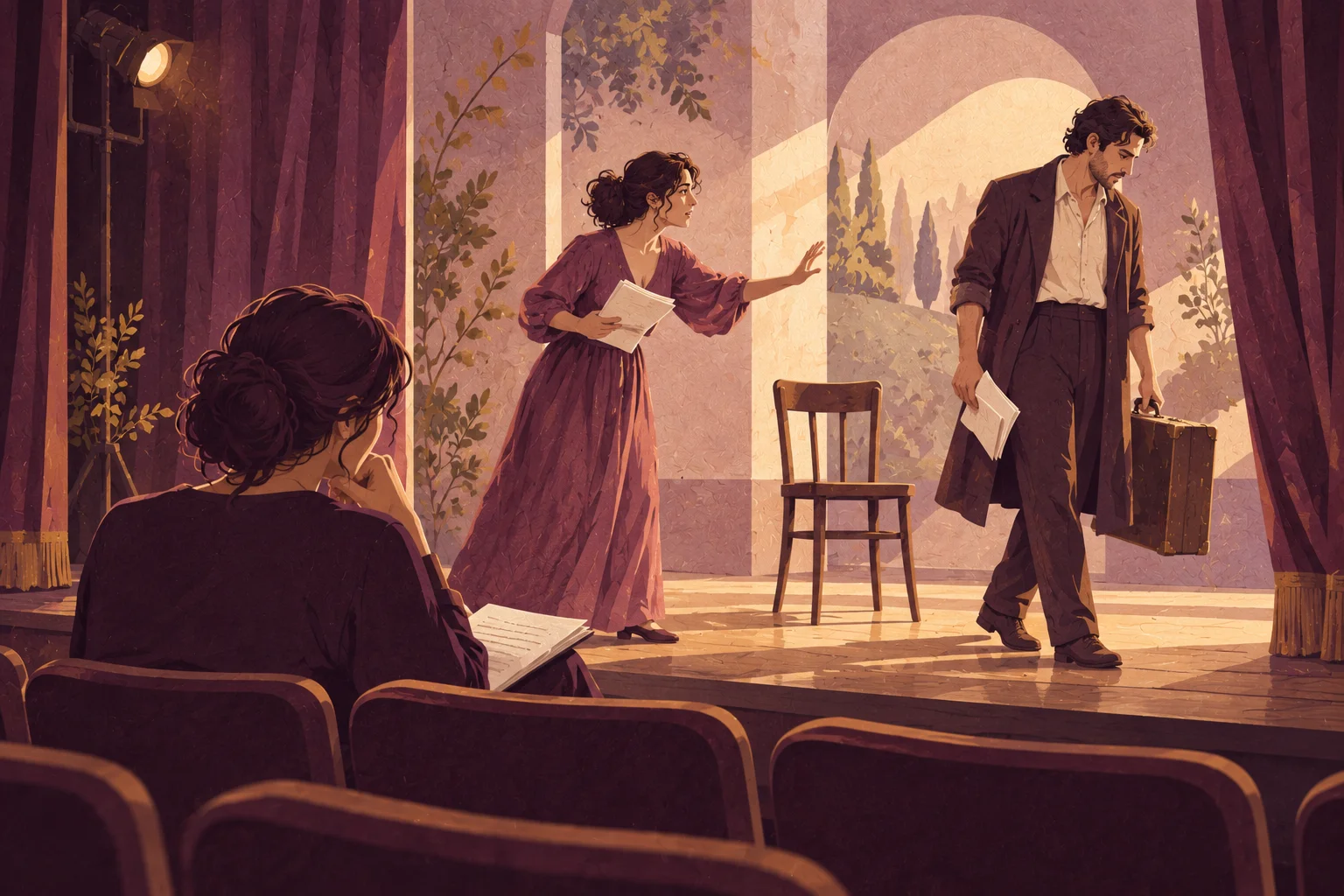
Writing a novel means building a world inside the reader's head, while writing a play means handing a text to bodies, in a space, in front of an audience.
That constraint changes everything. The theater offers no inner narration, no panoramic description and no "he thought that," so everything has to pass through dialogue and stage directions. Writing for the stage is at once more limited and freer than prose, because the stage fills in what the text leaves unsaid.
Here's how to structure, write and format a play, whether it's your first or your tenth.
Structure: acts and scenes
Two or three acts
Most contemporary plays have two or three acts. The five acts of classical tragedy (exposition, rising action, climax, falling action, resolution) have tightened, but the principle remains:
Act I, the exposition: the audience meets the characters, the place and the starting situation. The conflict takes shape, and a dramatic question appears: what is going to happen?
Act II, the conflict: tension rises, and the characters face obstacles, dilemmas and reversals. This is the heart of the play, the moment the audience holds its breath.
Act III, the resolution: the conflict is resolved, or left open, and the dramatic question gets its answer. The characters have changed, unless they have refused to change.
Scenes
By the classical rule, a scene begins when a character enters or exits. It stays useful even if you depart from it, because every entrance and every exit shifts the balance on stage.
A good scene has:
- an objective, what the scene's main character wants to get;
- an obstacle, what stands in their way;
- a change, since the situation at the end of the scene must differ from the one at the start.
A scene that leaves the conflict where it was is probably unnecessary.
Stage directions: few, and well chosen
Stage directions are the instructions in italics, often in parentheses, that describe movements, set, tone or lighting.
The classic trap is writing too many. A play leaves far more freedom than a screenplay, because the actor and the director will interpret your text, and that's their job. If you write "Marie stands up abruptly, knocks over her chair, turns to the window, clenches her fists and holds back a cry," you leave them no room at all.
What to indicate:
- characters' entrances and exits;
- set elements the text can't be understood without;
- pauses that matter (A silence.);
- actions that contradict the dialogue, like a character who says "I'm fine" while crying.
What's better left out:
- emotions the dialogue already conveys;
- obvious gestures, like "he picks up the phone" before a line that starts with "Hello?";
- detailed staging, which is the director's job.
Tennessee Williams excelled at poetic stage directions. In The Glass Menagerie, his directions read almost like lyrical prose, and they describe the atmosphere more than the gestures. Beckett, by contrast, was extremely precise, and in Endgame every movement is set. Both approaches work because each of these authors chose his own deliberately.
Giving each character their own voice
This is the central challenge of dramatic writing. A novelist can write that "his vocabulary betrayed his modest origins," whereas in the theater you have to make it heard in every line.
Several levers help.
Sentence length. A nervous character speaks in short sentences, an intellectual strings together subordinate clauses, and a shy one leaves sentences hanging.
Vocabulary. A doctor and a mechanic don't describe pain with the same words, and register (formal, standard, casual or slang) is your most powerful tool.
Verbal tics. One character says "actually" every third line, another asks rhetorical questions, a third never says "I." These habits make a character recognizable from the first word, even without reading the name above the line.
Subtext. Characters rarely say everything they think. Arthur Miller excelled at this: in Death of a Salesman, Willy Loman talks about success throughout the play, and each of his lines still lets failure show through, so the audience hears both at once.
The read-aloud test
You read a novel in silence, whereas a play is spoken and performed aloud. To find out whether your dialogue works, read it aloud: if you stumble over a sentence, your actor will too.
Have someone else read it as well, and you'll hear the wrong notes at once, the lines that run too long, the forced transitions and the sentences nobody would ever say in real life.
Standard formatting
To submit a play, the layout follows well-established conventions:
- the character's name, centered and in capitals;
- stage directions, in italics, in parentheses or indented;
- dialogue, under the character's name, indented;
- acts and scenes, centered and in capitals (ACT I, SCENE 3);
- font, traditionally Courier New at 12 points, or Times New Roman at 12 points;
- line spacing, single within a speech and double between two characters.
The list of characters, the dramatis personae, appears at the start of the document with a short description of each role.
Writing a play with Extypis
Extypis is a general-purpose writing app, different from specialized scriptwriting software such as Final Draft, and several of its features meet the needs of dramatic writing.
Acts and scenes. Chapters become your acts and sheets your scenes, which you rearrange by dragging them, so the tree reflects the structure of your play.
Character sheets. Extypis offers several types of story elements, and in the theater the character sheet becomes essential for noting a character's voice, tics, relationships and development. Character mentions in the text take you to it in one click.
Colored notes. You can anchor notes in several colors to the text and create your own code, for example yellow for lighting, blue for movement, green for tone and pink for props. A dedicated view gathers all your annotations.
Storyboard. Your acts and scenes appear as cards, with their summaries and labels, so you can see the whole structure at a glance.
Mention charts. They show how many times each character is named in each scene, and bring out imbalances, like a secondary character who disappears throughout act II or a lead who takes over all of act III.
PDF export. Export goes through LaTeX, with careful typography.
Where to start
To start a play, begin with the scene you can see most clearly, the one that obsesses you and whose lines you hear in the shower, even if it falls in the middle.
Write that scene, then ask yourself what led to it and what follows from it: the scenes before and after will come on their own.
If the blank page frightens you, remember what Tennessee Williams said:
"I try to work every day because you have no refuge but writing."
Hubert Giorgi
Author
The writing studio novelists were missing
Outline, characters, places and objects, the links between them, mind map, scene board, export: everything lives in one place. Plus an AI that knows your story, whenever you want one.
Free to write and to export. No credit card asked.