Your free writing app
Write and share your story, from the first chapter to a print-ready book.
Organize your scenes, develop your characters and keep your notes close at hand. Everything is in one place to write your book, with or without AI.
- Free to start, and to finish
- Go unlimited with Premium
- 50 free AI credits
Create, organize and develop your world across your books.
Gather your ideas, develop your characters' relationships and organize your story. Everything stays connected to your manuscript, so you can find the details you need and keep your world consistent across chapters and books.
Build
Develop your world with custom profiles and a relationship map.
Describe your characters, places and other story elements with the details that matter to you. Define their relationships to see them on a map, and attach research to the relevant profiles so you can find everything in one place.
- Categories and fields tailored to your world
- Relationships between profiles displayed on a map
- Photos, maps and PDFs attached to your profiles
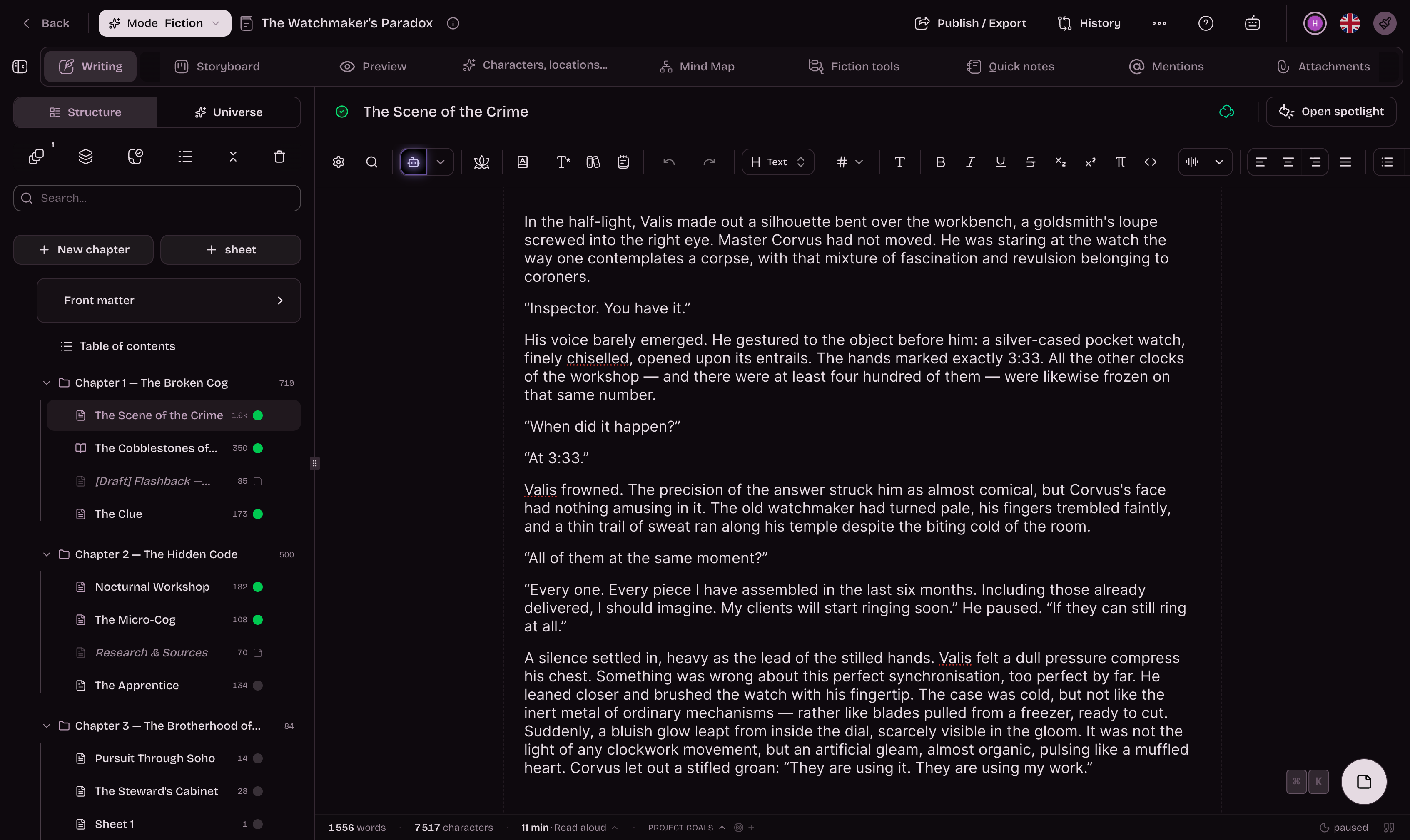
Organize your scenes on a scene board and write in the order that suits you.
The scene board gives you an overview of your story so you can choose which scene to write and review the chapter sequence. Move scenes to adjust your outline, then open passages side by side to check the transitions between them.
- Each scene's summary and opening lines at a glance
- Scenes you can move between chapters
- Passages side by side to check transitions
Maintain
Open profiles from your text and track your characters' appearances.
As you write, recognized names in your manuscript give you access to the matching profiles when you need to check a detail. Charts show where your characters and places are mentioned, helping you spot long absences and review their presence throughout the story.
- Names and nicknames recognized in your manuscript
- The distribution of mentions throughout your story
- A profile preview when you hover over a name
Book two, book twelve: the same world, never copied over.
A series shares its sheets across its books. The character you built in book one is there in book three, with everything that happened in between. And if a rewrite goes wrong, every chapter keeps its versions: you dare to rewrite, because nothing is lost.
- Sheets shared across every book of a series
- Every chapter keeps its versions: rewrite without fear
From the first sheet to a print-ready file, without changing tools.
The road a book travels through Extypis, in the order you live it. One step, one tool.
- Badges
Milestones worth keeping
Earned badges join your profile. Each requirement is listed before you start.
- Writing goals
Writing goals
Set targets in words, pages or time and track your progress.
- Writing Pomodoro
Writing Pomodoro
Choose 1 to 180 minutes of zen writing, with no early cancellation.
- Zen mode
Zen mode
Hide secondary UI and keep only the writing surface.
- Mind map
Mind map
A free canvas for your hypotheses, your sketches and your notes, cards and chapters side by side.
- Story timeline
Story timeline
Every plotline on its own lane, every event at its date in the story.
- Reader comments
Reader comments
Let your readers comment and react to your published chapters.
- Book export
Your book in the format you are asked for
Word for your publisher, print-ready PDF, an e-book for e-readers, and a file at Amazon KDP’s exact dimensions, ready to upload. One manuscript, no re-formatting.
And everything you expect from writing software
- Autosave
- Versions to compare and restore
- Chapters and scenes you can reorder
- Character, place and object cards
- Repetition detection
- Dictionary and thesaurus
- Notes in the margin
- Writing statistics
- Installable on desktop, tablet and phone
- Import a Word, PDF or EPUB manuscript
AI-free mode
Switch AI on. Switch it off whenever you like.
One switch removes every trace of AI: every button, every suggestion, every mention. You still have the full writing studio, with its outlining tools, scene board, profiles and exports. Some writers have to follow rules on original authorship; others simply prefer to write without AI. Either way, we've made room for you. It even costs less.
What about AI watermarks?
Since August 2026, AI models have embedded an invisible watermark in the text they generate, including the models we use. Anything you write yourself is never watermarked.

A “human origin” certificate if you want to attest that your book is authentic
AI detectors get it wrong too often. So Extypis uses another method to attest the human origin of your novel.
- Every character keeps its origin: typed, pasted and from which application, imported or written by Extypis' AI.
- The server timestamps your writing time, session after session.
- Your typing rhythm is read to spot mechanical input.
- You download a signed certificate, which a publisher or a jury checks with its QR code.
She closed the notebook and waited for the rain to stop. Far off, the bells of Saint-Malo were striking noon. She thought of her brother, gone three winters now, and of the letter he had never sent. The harbour smelled of salt and tar.
Free to start.
Free to finish. Go unlimited with a subscription.
Write, organize and export an entire book in your browser without paying a penny. A subscription removes the limits, gives you unlimited access to the full app, and adds AI that knows your project.
Everything our writing app puts in your hands
Five areas, from the first outline to the file ready to send: everything you ask of a writing app. Here is what each one covers.
Hold your story, from outline to final page.
Narrative tools you won't find elsewhere — turn a tangle of ideas into a structure that holds.
An AI that suggests, you decide
The AI permanently sees your whole project — outline, sheets, scenes already written. Every rewrite, every completion, every suggestion, every cover stays consistent with your entire work, and at no extra cost or setup. You approve every word.
Estimates if you only use this feature. Credits are shared across every AI tool.
Daily writing comfort
Everything that makes long-form writing sustainable: shortcuts, templates, anchored notes, versions, goals.
Listen to the editor's radio
The fifty tracks and nine ambient sounds of the editor, playable here without an account.
- 1
You write
About every 150 words, Extypis reads the passage before your cursor.
- 2
The passage's mood is recognised
Nine possible moods. The music only changes after two readings agree, so it does not jump at every line of dialogue.
- 3
The music follows
A four-second fade moves from one track to the next, and each track plays for at least a minute.
Prefer to choose yourself? Turn off automatic choice and the music stays put.
Pick a track from the list.
Background sounds
Analyse and refine your prose
Style tools that go beyond the spell-checker: readability, poetic meter, repetitions, connectors, passive voice.
Export a manuscript that is ready to send.
From manuscript to finished book: professional exports, academic citations, direct publishing.
Extypis versus the rest of the world.
One opponent at a time. We're keeping score, so take that into account. Scrivener beats us in two rounds, and both are there for you to see.
Extypis
The newcomer
Free, with a paid subscription available
WriteControl
The neighbor
Free, then €12.90 per month
What does it cost to finish a book?
Extypis
Free, with a paid subscription availableWriteControl
Free with Word export; €12.90 per month for PDF, EPUB and proofreadingCan I see my whole story on a board, scene by scene?
Extypis
Yes: each scene has a card with a summary, and you can drag cards to rearrange themWriteControl
Yes: tile view displays sections as blocks you can rearrangeDoes the app recognize a character when I type their name?
Extypis
Yes: it recognizes names and nicknames automatically, with no manual taggingWriteControl
No: you fill in profiles yourself; automatic detection uses AI and requires PremiumCan I connect my profiles and map my story world?
Extypis
Yes: you define each relationship, and the map shows the full networkWriteControl
Yes, on the mind map, which requires PremiumCan I publish my book here and share it with readers?
Extypis
Yes: your book gets its own reading page where readers can leave commentsWriteControl
No: community discussions take place on Facebook and Discord, outside the appDoes it take long to get started?
Extypis
No: create an account and start writingWriteControl
No: create an account, follow the built-in tutorial and start writingWill AI do the writing for me?
Extypis
No: it stays quiet until you ask, and you can switch it off entirelyWriteControl
On request, with monthly credits on Premium only; there is no setting to turn it offCan I write on the train without an internet connection?
Extypis
Yes, if the tab is already open: your text stays in the browser until you're back onlineWriteControl
Yes, and you can open the app offline tooWhich formats can I export my finished book in?
Extypis
Formatted PDF, DOCX and EPUB, all included in the free planWriteControl
Word on the free plan; print-ready PDF and EPUB with PremiumDo I own the software once I pay for it?
Extypis
NoWriteControl
No
You can write fully offline in WriteControl, even open it without a connection. With Extypis, a tab you've already opened keeps your text until you're back online, but you need a connection to open the app.
Prices and features checked on September 10, 2026, using the vendors' websites, FAQs and manuals. Every round we lose stays on the board and counts toward the score.
Four straight questions.
The four that come up most often before signing up. The answer fits in one word, the explanation in three lines.
Will AI write my book for me?
No. It stays quiet while you write and responds only when you ask. When you're deep in a chapter, it's easy to lose track of a character introduced three scenes ago or a detail you planted at the start. The AI keeps track: it knows your whole project and can offer suggestions, check details, rework a passage or help you get unstuck. You have the final say on every word. You can also switch it off completely.
Is my writing used to train AI?
No. Your writing is never sent to AI models for training. The providers Extypis uses only receive your content when needed to generate a response you request, and nothing is kept beyond what is strictly necessary.
Can I write a whole book for free?
Yes. You can use the writing app for free from start to finish. No stage requires a subscription: start your manuscript, write it, organize it and export it as PDF, DOCX or EPUB without reaching for your card. The free plan does have usage limits on projects, sheets per project and AI credits. A subscription removes those limits and gives you access to a more capable model for demanding writing tasks.
Is Extypis only for novelists?
No. Fiction gets most of the spotlight, and Extypis is particularly good at it. It works just as well for essayists, academics, poets, screenwriters and bloggers, with automatically numbered footnotes, a shared reference library (APA, MLA, Chicago, IEEE, Harvard, Vancouver), publication-quality PDF exports using LaTeX, and syllable counts for poetry. The interface adapts to your project type.
I built the writing app I always wished I had.
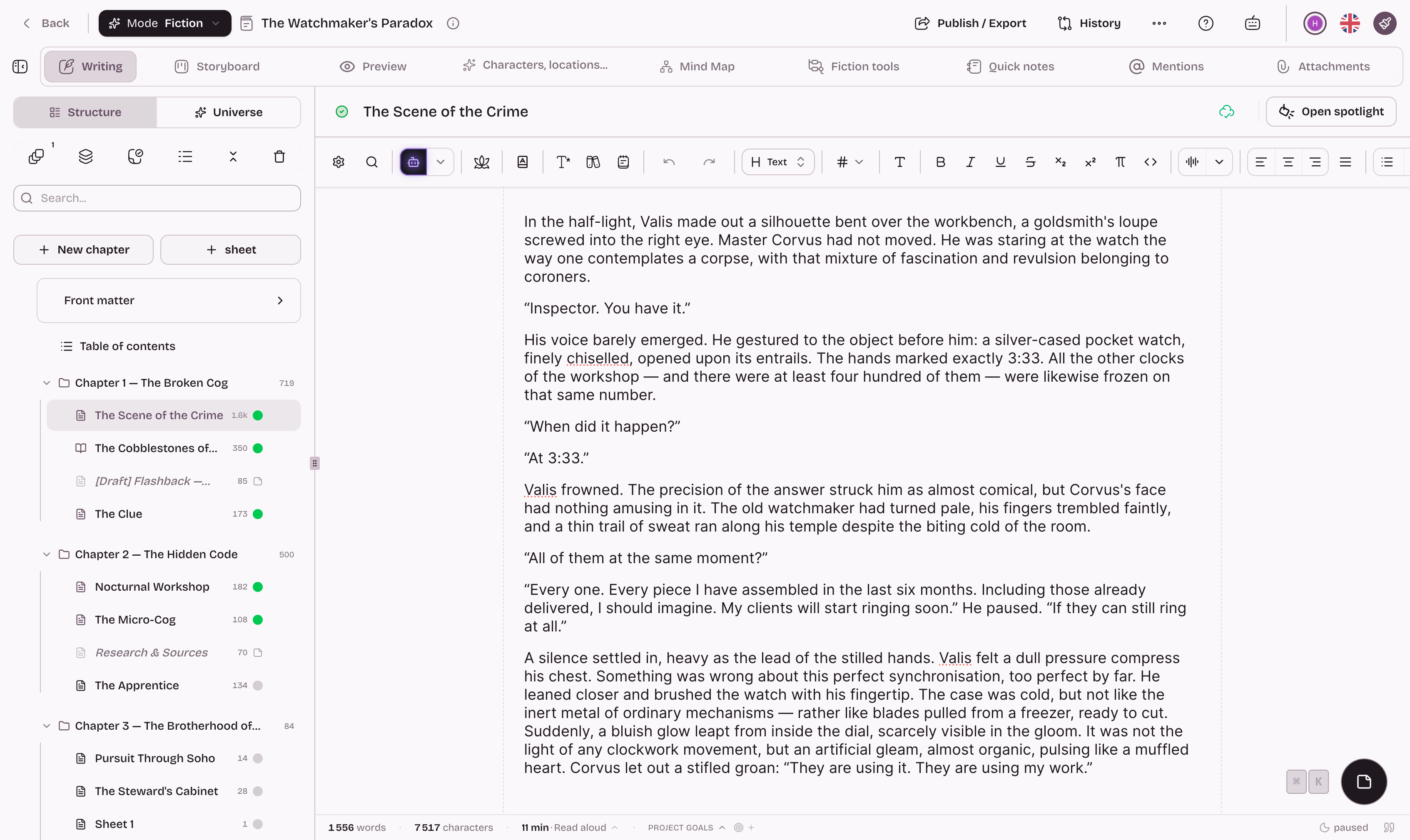
It took me several attempts to finish a novel. Meanwhile, the poems piled up over the years. They're all here, in Extypis. Those false starts taught me why I kept getting stuck: I'd lost track of where I was, what I'd already written and which chapter it was in. I had plenty of ideas. Extypis is the app I wish I'd had back then.