The best writing studio for long-form projects
Syllable Counter
An advanced syllable analyzer for poets, writers and lyricists.
Why use a syllable counter?
1. The Hiatus (The "Vowel Clash")
A hiatus occurs when two vowels appear in immediate succession between two words, with no consonant to separate them. In classical French poetry, hiatus was often forbidden as it was considered cacophonous.
Example: "Il alla à Arles" — three consecutive vowels at the junction of words create a hiatus.
2. The Hemistich and the Caesura
The hemistich refers to half a line of verse. In an alexandrine (12 syllables), there are two hemistichs of 6 syllables each. The caesura is the pause — the breath — that separates these two halves.
Example (Racine): "Le jour n'est pas plus pur // que le fond de mon cœur" — the caesura falls after "pur", dividing the line into 6 + 6.
3. Dieresis and Syneresis
Dieresis consists of pronouncing a vowel cluster as two separate syllables, while syneresis merges them into one. This choice can change the total syllable count of a line.
Example: "vio-lon" as syneresis (2 syll.) or "vi-o-lon" as dieresis (3 syll.) — depending on the meter the poet selects.
4. Elision (The mute "e")
This is the dropping of a final mute "e" before a vowel. Left unaccounted for, it skews the count by a full syllable per line.
Example: "la grand(e) armée" — the "e" in "grande" elides before "armée", yielding 4 syllables instead of 5. Our phonetic engine automatically handles these complex rules to provide you with a precise count.
Go further with Extypis
Extypis is a writing editor built for authors who care about every word. Built-in rhyme dictionary, repetition detection, readability analysis, zen mode, configurable typography — everything to go from analysis to creation, in one place.
76 features. Just enough.
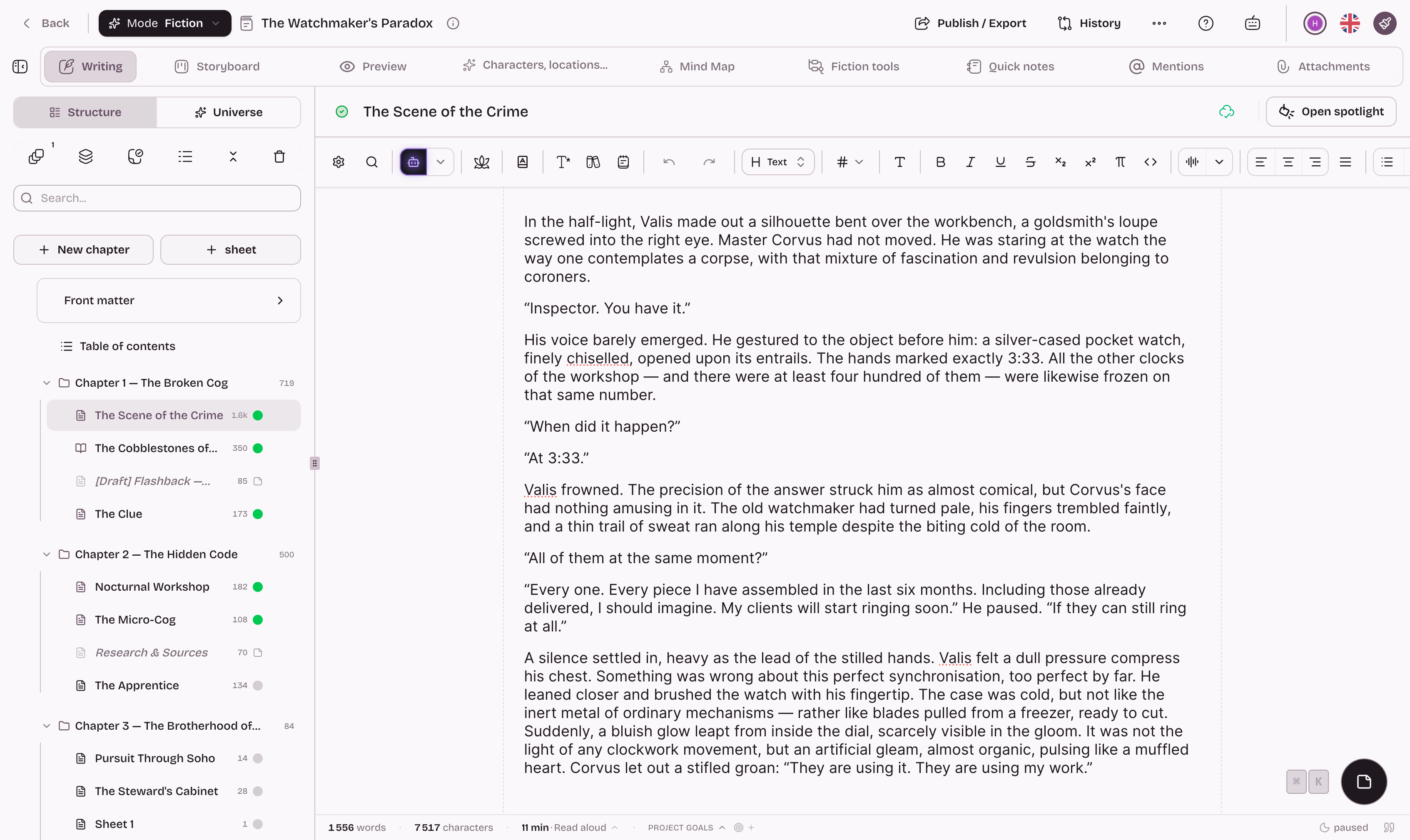
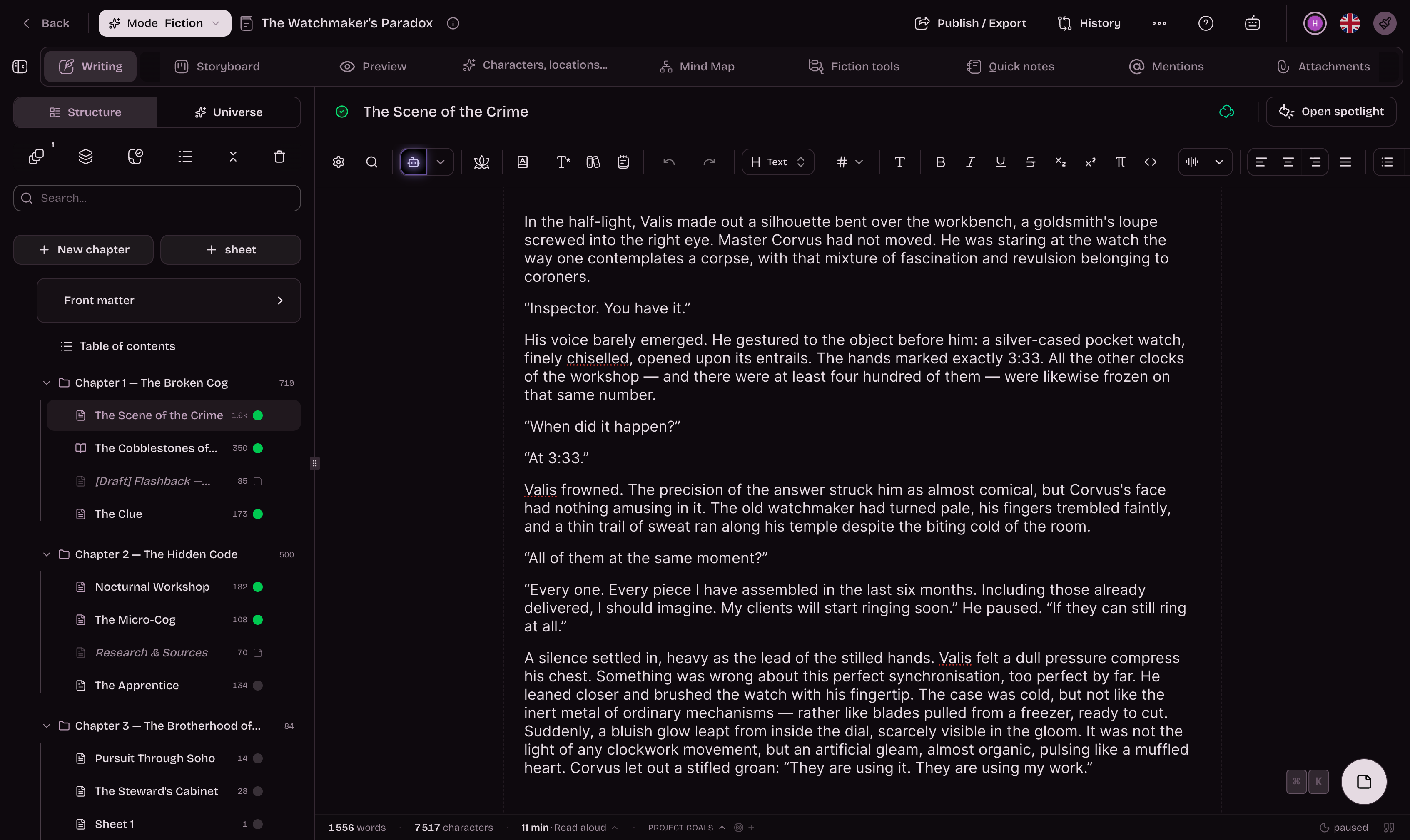
Ready to write?
Free signup, no credit card.
Everything our writing app puts in your hands
Five areas, from the first outline to the file ready to send: everything you ask of a writing app. Here is what each one covers.
Hold your story, from outline to final page.
Narrative tools you won't find elsewhere — turn a tangle of ideas into a structure that holds.
An AI that suggests, you decide
The AI permanently sees your whole project — outline, sheets, scenes already written. Every rewrite, every completion, every suggestion, every cover stays consistent with your entire work, and at no extra cost or setup. You approve every word.
Estimates if you only use this feature. Credits are shared across every AI tool.
Daily writing comfort
Everything that makes long-form writing sustainable: shortcuts, templates, anchored notes, versions, goals.
Analyse and refine your prose
Style tools that go beyond the spell-checker: readability, poetic meter, repetitions, connectors, passive voice.
What you write is what you export.
Your text is laid out as you type, in the format of your PDF. All that is left is to pick the file format, or to publish on Extypis.
Ready to write with the right tools?
Extypis is a free writing workshop with all these tools built directly into the editor. Create your account in 30 seconds.
Going further
The pages of the studio that carry this subject on.
And to hold the whole project: The software to write a book