The best writing studio for long-form projects
Show, don't tell — detector
Naming emotions instead of grounding them in the body? The AI spots your 'tell' passages and proposes two 'show' rewrites for each.
5 analyses/day without an account · 10/day with a free account · unlimited with a subscription.
Why hunt 'tell' in your prose?
Why it's so hard to spot in your own work. When you write, you know what your character feels. You have it in your head. So you write 'he was anxious' and move on. Six months later, rereading, you still don't see the problem — you have the memory of the emotion, so it feels present in the text. But it isn't. It's in your head.
What this detector does. You paste an excerpt (between 100 and 3000 characters). The AI spots 3-6 passages where you tell instead of show, quotes each verbatim, explains in one sentence why it's weak, and proposes two 'show' rewrites per passage — so you can choose the register. It closes with the guiding principle to apply to the rest of your text.
When to use it. On a first draft, before handing it to anyone. On a chapter that feels 'flat' without you knowing why. On a high-emotion scene where you sense the reader won't cry. On passages where you wrote 'he thought that', 'she felt', 'he wondered' — all the verbs that announce you're going to TELL instead of SHOW.
Limits of the tool. Show, don't tell isn't an absolute law. Some passages — transitions, summaries, omniscient narration — require telling quickly. The AI spots but doesn't judge global narrative relevance. You decide what serves your pacing.
Go further with Extypis
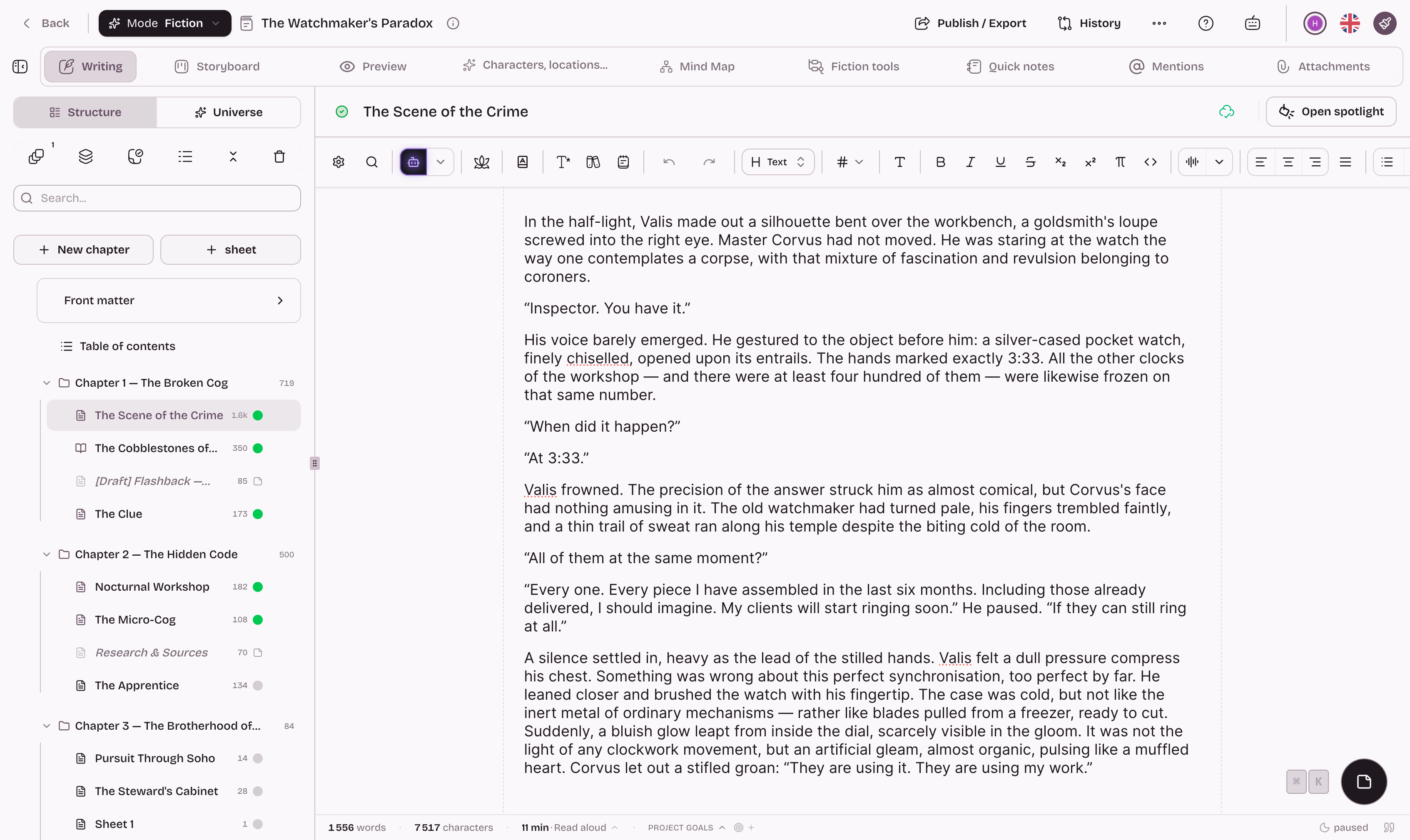
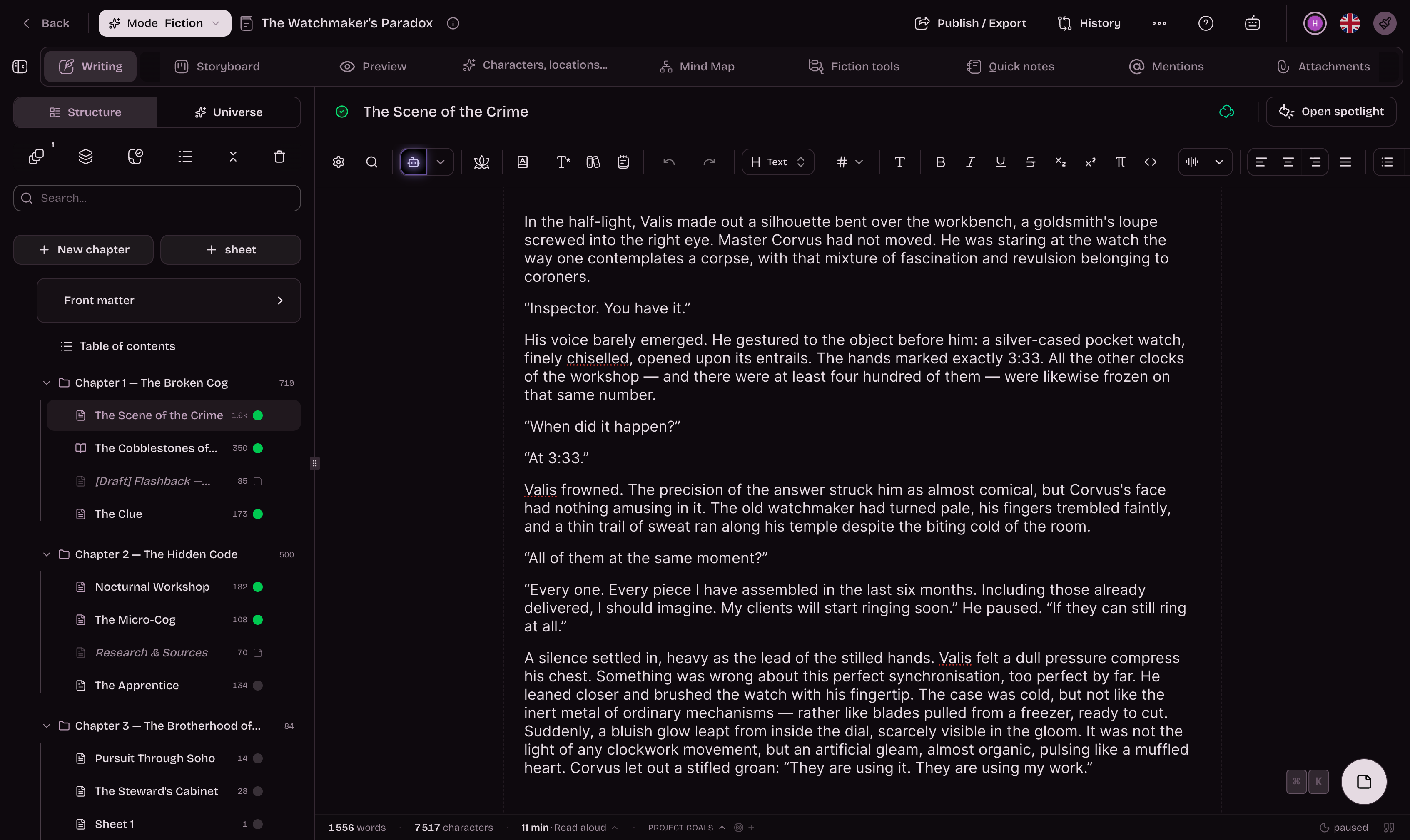
Going further: Extypis embeds this detector into the editor, scene by scene, on every save.
76 features. Just enough.
Ready to write?
Free signup, no credit card.
Everything our writing app puts in your hands
Five areas, from the first outline to the file ready to send: everything you ask of a writing app. Here is what each one covers.
Hold your story, from outline to final page.
Narrative tools you won't find elsewhere — turn a tangle of ideas into a structure that holds.
An AI that suggests, you decide
The AI permanently sees your whole project — outline, sheets, scenes already written. Every rewrite, every completion, every suggestion, every cover stays consistent with your entire work, and at no extra cost or setup. You approve every word.
Estimates if you only use this feature. Credits are shared across every AI tool.
Daily writing comfort
Everything that makes long-form writing sustainable: shortcuts, templates, anchored notes, versions, goals.
Analyse and refine your prose
Style tools that go beyond the spell-checker: readability, poetic meter, repetitions, connectors, passive voice.
What you write is what you export.
Your text is laid out as you type, in the format of your PDF. All that is left is to pick the file format, or to publish on Extypis.
Ready to write with the right tools?
Extypis is a free writing workshop with all these tools built directly into the editor. Create your account in 30 seconds.
Going further
The pages of the studio that carry this subject on.
- Word and character counter
- How to write a novel's opening line
- Character name generator
- How to write a book
- The free writing app
And to hold the whole project: The software to write a book