For poets
To carve each line without losing the breath.
Everyev-erysyllablesyl-la-bleappearsap-pearsinincolourcol-ourinsidein-sidethethelinelineasasyouyouwrite.write
A1Count,countmeterme-terandandrhymerhymeremainre-mainvisiblevis-i-bleininthetheeditor,ed-i-torthenthenthetheVersificationver-si-fi-ca-tiontabtabreadsreadsthethestructurestruc-tureofofthethewholewholecollection.col-lec-tion
B2- Free to start, and to finish
- Go unlimited with Premium
- 50 free AI credits
See the poem's structure in the editor, then the whole collection's.
Extypis does not send the analysis to a separate report. Syllables, meter and rhyme accompany every line while you write, while the Versification tab brings the same markers together across all your poems.
Compose
Read every syllable in colour where you are actually writing.
Syllable divisions appear beneath the words, with one colour per sound group. The count sits in the margin, the meter is named when recognised and the rhyme receives its letter on the right. Revise a line and see immediately what the change moves.
- Colour-coded syllable divisions directly beneath every line
- Count, meter, rhyme and line number inside the editor
- French elision and dieresis rules included in the analysis
Move poems around until you find the collection's right rhythm.
The card view shows titles, opening lines and the place of every poem. Try another order, bring two answering poems together and open several texts side by side before you commit.
- Every poem represented by its title and opening lines
- An order you can reshape without moving files
- Several poems open together so you can hear the transitions
Refine
Open the Versification tab and read the whole collection's structure.
The Versification view brings together line and stanza counts, meter, rhyme schemes, recognised forms and irregularities. Move from the coloured detail of one line to the whole collection without leaving the project.
- A Versification tab available from the main navigation
- Stanzas, meters and rhyme schemes gathered poem by poem
- Irregularities and repetitions found before final layout
Keep every draft so you can push a line as far as it needs to go.
A successful cut can make you forget the version that breathed better. Earlier drafts stay available poem by poem, while related collections can share motifs and notes without duplication.
- Earlier drafts of every poem, ready to restore
- Motifs and research shared across several collections
Write, listen, revise, then compose the collection.
Poetry advances through returns. Extypis keeps every stage together, from the first line to the typeset export.
- Badges
Milestones worth keeping
Earned badges join your profile. Each requirement is listed before you start.
- Writing goals
Writing goals
Set targets in words, pages or time and track your progress.
- Writing Pomodoro
Writing Pomodoro
Choose 1 to 180 minutes of zen writing, with no early cancellation.
- Zen mode
Zen mode
Hide secondary UI and keep only the writing surface.
- Mind map
Mind map
A free canvas for your hypotheses, your sketches and your notes, cards and chapters side by side.
- Story timeline
Story timeline
Every plotline on its own lane, every event at its date in the story.
- Reader comments
Reader comments
Let your readers comment and react to your published chapters.
- Book export
Your book in the format you are asked for
Word for your publisher, print-ready PDF, an e-book for e-readers, and a file at Amazon KDP’s exact dimensions, ready to upload. One manuscript, no re-formatting.
And everything you expect from writing software
- Autosave
- Versions to compare and restore
- Chapters and scenes you can reorder
- Character, place and object cards
- Repetition detection
- Dictionary and thesaurus
- Notes in the margin
- Writing statistics
- Installable on desktop, tablet and phone
- Import a Word, PDF or EPUB manuscript
Writing without AI
Your voice can be alone in the room.
One switch removes suggestions, rewrites and every feature connected to a model. Versification, the dictionary, version history, collection layout and exports remain available. You decide what enters the work of the poem.
What happens to my text?
In AI-free mode, no line is sent to a model. What you write stays within Extypis's ordinary saving and export flow.
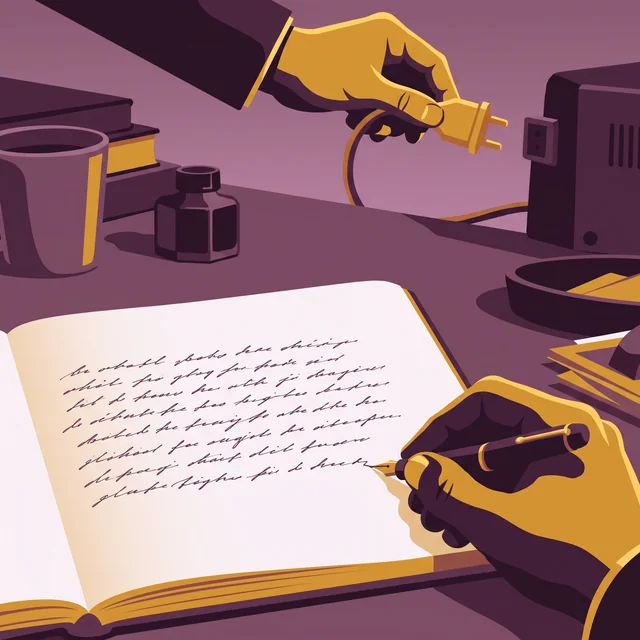


A “human origin” certificate if you want to attest that your book is authentic
AI detectors get it wrong too often. So Extypis uses another method to attest the human origin of your novel.
- Every character keeps its origin: typed, pasted and from which application, imported or written by Extypis' AI.
- The server timestamps your writing time, session after session.
- Your typing rhythm is read to spot mechanical input.
- You download a signed certificate, which a publisher or a jury checks with its QR code.
She closed the notebook and waited for the rain to stop. Far off, the bells of Saint-Malo were striking noon. She thought of her brother, gone three winters now, and of the letter he had never sent. The harbour smelled of salt and tar.
Free to begin, even to finish. Serious when the collection takes shape.
Meter, language and writing start without friction. Paid plans mainly extend AI credits, advanced analysis and depth as the collection grows.
What you actually open to work on a line.
The versification margin, the French dictionary, zen mode, recoverable versions: enough to chisel for hours without ever breaking the flow.
Compose the collection without freezing its order.
Motifs, poem cards and side-by-side views help you test the whole while it is still alive.
Ask for a variant without surrendering the voice.
Rewriting stays focused on the line or stanza you choose, and every proposal waits for your decision.
Estimates if you only use this feature. Credits are shared across every AI tool.
Make enough silence to hear the text.
Zen mode, adjustable typography, autosave and drafts move the mechanics out of sight.
Read the form once the ear can no longer count it alone.
Syllables, meter, rhyme, repetitions and the French dictionary support revision without standardising the poem.
Lay out the collection without undoing the lines.
Preview and exports preserve line breaks, indentation and the typographic rhythm of the text.
Extypis beside the two most common shortcuts.
A word processor remains hard to beat when you want a blank page in seconds, and a generator can produce a variant quickly. This board shows what each choice gives you and what it leaves out.
Extypis
The collection workshop
Free, then subscription
Word processor
The familiar page
Depends on the software
Can I begin on a familiar page without learning a new tool?
Extypis
An account and a short learning curveWord processor
Yes, if you already use itDoes the syllable count stay visible while I write?
Extypis
Yes, in the margin with meter and rhymeWord processor
Not without another tool or extra workCan I reorder the collection without moving pages by hand?
Extypis
Yes, every poem becomes a cardWord processor
It depends on the document outline and stylesCan I return to a precise earlier draft of a poem?
Extypis
Yes, every poem keeps its draftsWord processor
It depends on the software and how the file is savedCan I work fully offline?
Extypis
If the tab is already open, until the connection returnsWord processor
Yes with an installed app and a local fileCan the same collection export to PDF, EPUB and DOCX?
Extypis
Yes, from the same structureWord processor
PDF and DOCX are common; EPUB often takes another step
For opening a local file and beginning immediately, a word processor remains more direct.
Word processors and generators cover many different products. This comparison describes their common use, not every available application.
The questions poets usually ask before stepping in.
Does syllable counting really handle elision and dieresis?
Yes. French syllable analysis integrates elision rules (silent e at the end of a word before a vowel) and classical dieresis. The exact count reads left of every line as you write, with the meter named and, on the right, the letter of the rhyme.
Which forms does the Versification tab recognise?
The sonnet, the haiku, the villanelle, the pantoum, the rondeau, the triolet, the quatrain and couplets. A form is only named when it is certain: fourteen lines in 4-4-3-3 with crossed rhymes are a sonnet, fourteen free lines stay a poem of fourteen lines. The meter is read off the majority of the lines, never declared, and a free-verse poem is never flagged.
Can I write a calligram?
Extypis sets verse, it does not draw. A line steps in with the Tab key (stepped verse), and the spaces you place inside a line are kept on screen and in the HTML and EPUB exports. A poem whose words form a figure is composed elsewhere and inserted as an image, which follows the collection into every format.
Will the AI write my poem for me?
No. Extypis deliberately limits itself to inline rewriting of a line or stanza and to variant suggestions. No full-poem generation: you keep the voice, the AI polishes the matter.
Is zen mode really empty?
Yes. Zen mode = empty screen, hidden interface, just the text. You write, the rest disappears. Exit in one click or keyboard shortcut.
Is the French dictionary integrated or external?
Integrated. Definitions, synonyms, antonyms, etymology and registers reachable directly from the text without opening a tab.
Is the AI the same for free and subscribed users?
No, and that goes for both text and image. On editorial-sensitive tasks (inline rewrite of a line or stanza, variant suggestions, AI assistant), a subscription automatically switches the AI cascade to Claude Sonnet 4.6, the strongest model on French prose. Free users stay on Mistral, Llama, Cerebras and Gemini: very fast and excellent for drafting, more modest on finishing. For image generation (collection covers), free users get Flux schnell (fast, standard quality) while subscribers access Flux 1.1 Pro and DALL-E 3 (editorial quality, careful typography).
Are my texts used to train an AI?
No. Your texts are never sent to the models for training. None of the AI providers used by Extypis (Anthropic, OpenAI, Mistral, Groq, Gemini) has access to your content outside of the punctual API call required for the requested generation. The APIs are configured without training opt-in, and no data is retained on Extypis' side beyond what is strictly required to run the product.
Can I export a print-ready collection?
Yes. One poem per page under its title, an overlong line folded with its hanging indent, an index of first lines at the end of the volume: the compilation goes through LaTeX. EPUB for digital distribution, DOCX and HTML for other uses, each with its lines in place.
What if I want to write without any AI, to preserve my voice?
Many poets refuse to let a single line be touched by a generative model. Extypis allows it: a strict AI-free mode cuts every AI touchpoint and guarantees that no word ever passes through an AI. You keep the typographic layout, collections, PDF/EPUB export and print preview. See the AI-free mode.
Is this only for poetry?
No, but Extypis is particularly strong for poetic work: syllable counting, enriched dictionary, repetition detection, zen mode and non-invasive AI.
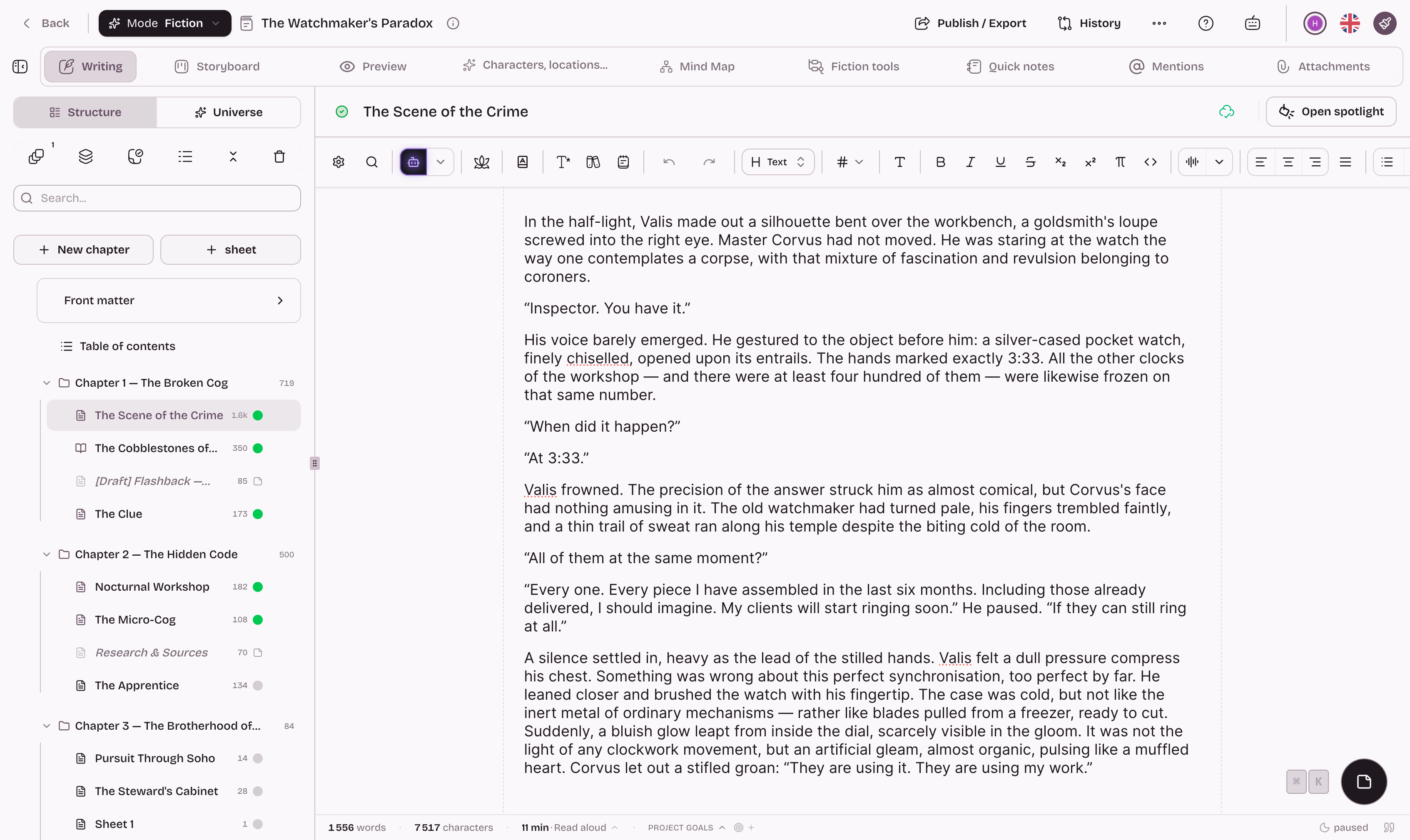
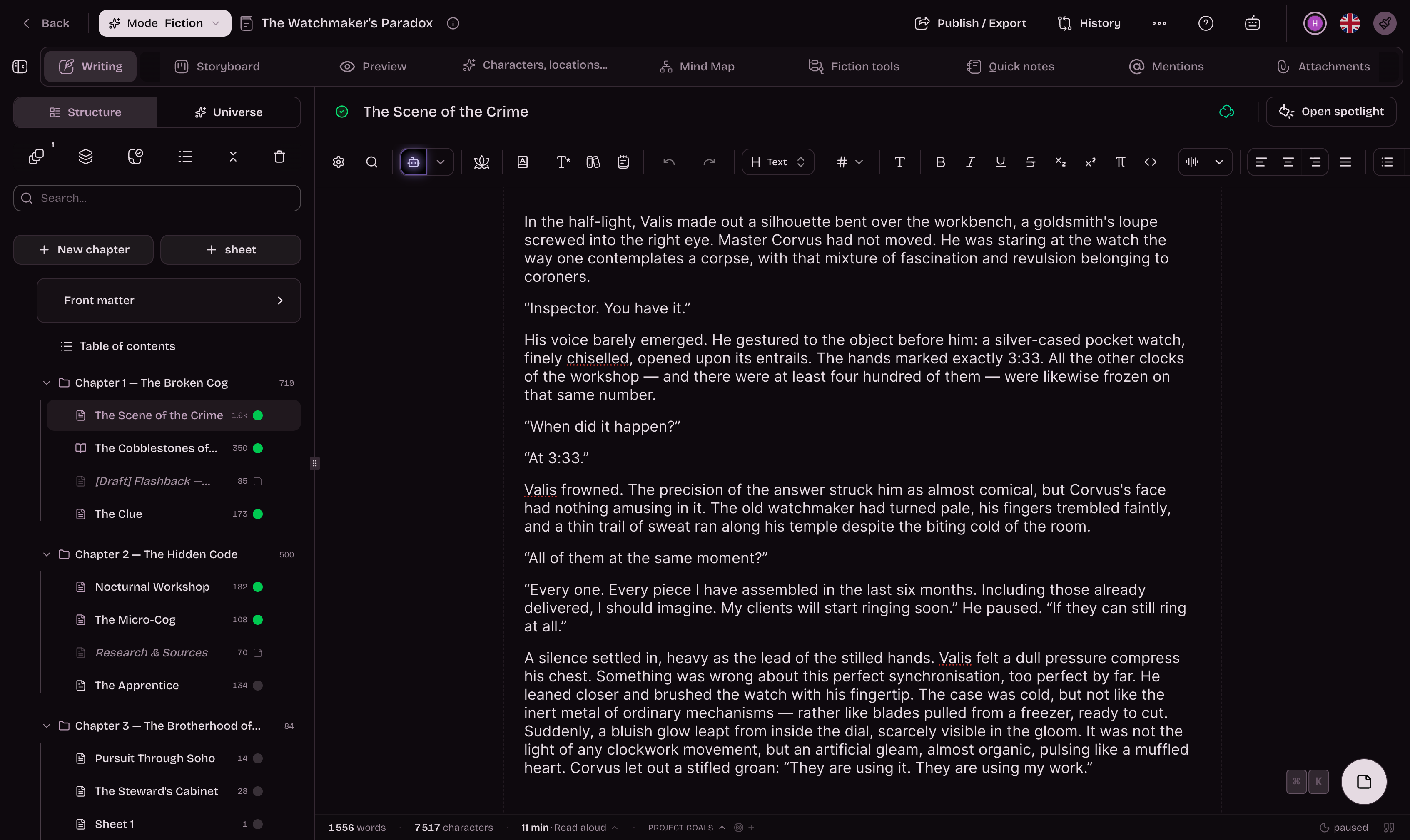
Your collection deserves better than a Word doc and a mental syllable counter.
Start with meter and language, add AI where it genuinely helps, and keep the whole work inside a space that respects the voice.
Going further
The pages of the studio that carry this subject on.
- Word and character counter
- The syllable counter
- The writing glossary
- All the writing guides
- The free writing tools
- The free writing app
And to hold the whole project: The software to write a book