For writers of fiction
A world that holds together from scene to scene, from the first chapter to the last.
Every character, place and object has its sheet, linked to the text by a simple mention. The timeline puts each event at its date, and a series’ sheets carry from one book to the next without copy and paste.
- Free to start, and to finish
- Go unlimited with Premium
- 50 free AI credits
From a haunted campus to a whole kingdom, keep your world within reach.
Choose the scale of your story. Custom sheets, relationships, scenes and series help you keep track of what makes it yours.
Build
Give your magic, your cities and your characters a shared history.
Epic fantasy, urban fantasy, gothic fiction or dark academia: keep the rules of a spell, the secrets of a campus and the price of a pact in linked sheets. In cozy fantasy, the bookshop and its regulars deserve just as much care as a kingdom.
- Categories and fields tailored to your world
- Relationships between profiles displayed on a map
- Photos, maps and PDFs attached to your profiles
Let a slow burn build one scene at a time.
Contemporary romance or romantasy, rivals or friends becoming lovers: arrange the encounters, setbacks and revelations on the scene board. Open two passages together to check what has changed between your characters.
- Each scene's summary and opening lines at a glance
- Scenes you can move between chapters
- Passages side by side to check transitions
Maintain

Follow every clue, alliance and promise back into the manuscript.
A supernatural mystery needs its clues; a found family needs time together. Mentions help you find the scenes where a character, place or object appears, so you can reread what you actually established.
- Names and nicknames recognized in your manuscript
- The distribution of mentions throughout your story
- A profile preview when you hover over a name
Carry your world from the first volume to the next.
A fantasy saga, connected romances, progression fantasy or LitRPG: bring recurring characters and shared lore into a series. Keep your own records of abilities, ranks and rules in custom sheets while each book has its own manuscript.
- Sheets shared across every book of a series
- Every chapter keeps its versions: rewrite without fear

From the first character to the book you can share.
Start with an encounter, a place or a scene. Develop the outline as you write, then prepare your story for its first readers.
- 1
Sheets
Characters, places, objects: the fields you want, linked together.
- 2
Outline
Three guided templates, and an analysis of the story's imbalances.
- 3
Scene Board
Your scenes as cards, movable, written in whatever order they come.
- 4
Writing
Type a name, its sheet is right there. Your research stays within reach.
- 5
AI, if you want it
Continue, rewrite, create a sheet — it only steps in when you call it.
- 6
Versions
Every chapter keeps its versions. Rewrite without fear.
- 7
Book pages
You write on the pages of your book, in the format of your PDF.
- 8
Export
Publisher-grade PDF, EPUB, DOCX, or publish on Extypis.

Already writing in another app?
Import your manuscript: Extypis splits it into chapters and scenes, and creates sheets for your characters, places and objects.
- DOCX
- EPUB
- Markdown
- HTML



- Badges
Milestones worth keeping
Earned badges join your profile. Each requirement is listed before you start.
- Writing goals
Writing goals
Set targets in words, pages or time and track your progress.
- Writing Pomodoro
Writing Pomodoro
Choose 1 to 180 minutes of zen writing, with no early cancellation.
- Zen mode
Zen mode
Hide secondary UI and keep only the writing surface.
- Mind map
Mind map
A free canvas for your hypotheses, your sketches and your notes, cards and chapters side by side.
- Story timeline
Story timeline
Every plotline on its own lane, every event at its date in the story.
- Reader comments
Reader comments
Let your readers comment and react to your published chapters.
- Book export
Your book in the format you are asked for
Word for your publisher, print-ready PDF, an e-book for e-readers, and a file at Amazon KDP’s exact dimensions, ready to upload. One manuscript, no re-formatting.
















And everything you expect from writing software
- Autosave
- Versions to compare and restore
- Chapters and scenes you can reorder
- Character, place and object cards
- Repetition detection
- Dictionary and thesaurus
- Notes in the margin
- Writing statistics
- Installable on desktop, tablet and phone
- Import a Word, PDF or EPUB manuscript
AI-free mode
Switch AI on. Switch it off whenever you like.
One switch removes every trace of AI: every button, every suggestion, every mention. You still have the full writing studio, with its outlining tools, scene board, profiles and exports. Some writers have to follow rules on original authorship; others simply prefer to write without AI. Either way, we've made room for you. It even costs less.
What about AI watermarks?
Since August 2026, AI models have embedded an invisible watermark in the text they generate, including the models we use. Anything you write yourself is never watermarked.
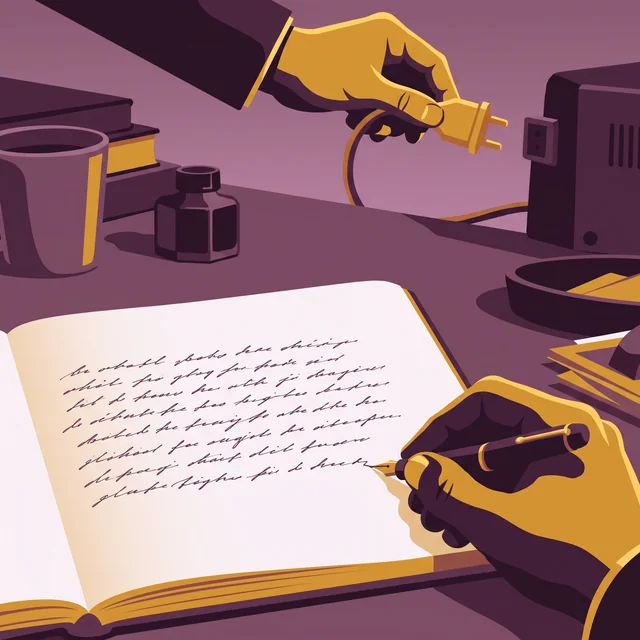

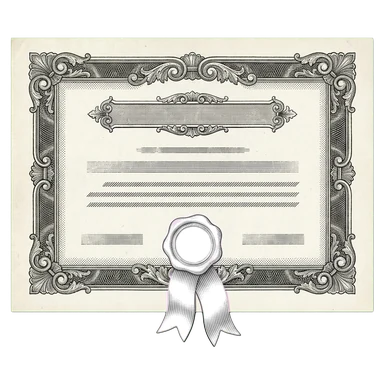
A “human origin” certificate if you want to attest that your book is authentic
AI detectors get it wrong too often. So Extypis uses another method to attest the human origin of your novel.
- Every character keeps its origin: typed, pasted and from which application, imported or written by Extypis' AI.
- The server timestamps your writing time, session after session.
- Your typing rhythm is read to spot mechanical input.
- You download a signed certificate, which a publisher or a jury checks with its QR code.
She closed the notebook and waited for the rain to stop. Far off, the bells of Saint-Malo were striking noon. She thought of her brother, gone three winters now, and of the letter he had never sent. The harbour smelled of salt and tar.
Start your novel with the free plan.
Write, organise and export within the free plan’s limits. See the plans below as your projects grow.
The tools behind your characters and their world.
Keep your worldbuilding close to the prose, from the relationship map to the finished EPUB.
Build a world you can keep writing in.
Characters, relationships, scenes and series stay connected to the manuscript.
Ask for help at the passage that needs it.
Use the project context to explore a rewrite or a continuation, with the final wording yours.
Estimates if you only use this feature. Credits are shared across every AI tool.
Return to your scene with the draft intact.
Focus, quick commands and saved versions support long writing sessions.
Reread what your characters actually do.
Mentions and repetition checks give you concrete starting points for revision.
Put the finished story in a reader’s hands.
Preview the book and export PDF, DOCX or EPUB.
Extypis versus the rest of the world.
One opponent at a time, comparing the free versions or the paid ones, and we are the ones keeping score, which should already make you wary. The rounds we lose stay on the board.
Extypis
The newcomer
Free, with no card needed
WriteControl
The neighbor
Free, with no time limit
How many books can I write, and how long?
Extypis
You get 1 project, and a project holds up to 15,000 words in 10 sheetsWriteControl
You write up to five books; each chapter or sub-chapter holds at most 10,000 words, and its site states no limit for the whole bookWhile I write, do I see the pages of my book?
Extypis
Yes, on a computer: you write in the pages, at the size, margins and font of your PDFWriteControl
No: layout happens at export, and the free version exports to Word, LibreOffice and HTMLWhere do I write the dedication, the preface, the copyright page and the back cover?
Extypis
On a computer, you write them on the pages of the book, in their place, and you type the publisher and the ISBN on the copyright pageWriteControl
The free version has no front matter pages, which require PremiumDo I get a PDF ready for the printer?
Extypis
Yes: Extypis typesets the PDF with LaTeX, in A4, A5 or Letter, up to 2 exports per monthWriteControl
No: the printer PDF requires Premium, and the free version exports to WordIf I name a character, even by a nickname, does the app find them?
Extypis
Yes, everywhere in the book, as soon as the nickname is on their sheet; a tab suggests the names in the text that have no sheet yetWriteControl
No: character detection requires PremiumCan I write with no AI at all?
Extypis
Yes: one setting removes every AI tool from the screen; only importing a manuscript still goes through an AIWriteControl
Yes: the free version has no AICan I show that I wrote my text myself?
Extypis
Yes, for the typing: the “human origin” certificate says what was typed, pasted or moved, and is shared by a link; it does not say where the ideas come fromWriteControl
None of the pages of its site that we read mentions such a certificateCan I publish my book in the app, so people read it online?
Extypis
Yes: the book has its reading page, open to everyone, and readers with an account comment paragraph by paragraphWriteControl
No: its FAQ says WriteControl is not an exchange networkCan I write on the train, with no network?
Extypis
Only in a tab that is already open: the text waits for the network to come backWriteControl
Yes: the site opens offline, if the book has already been opened on that computerDoes the app correct my spelling?
Extypis
Yes, with AI: the “Correct” action fixes the spelling, grammar and typography of the chosen passage, using the 300 free credits, given only onceWriteControl
No: its pricing grid keeps the spell checker for Premium
Its free version goes further in volume: it holds five books, and its site states no limit for the whole book, only 10,000 words per chapter or sub-chapter, where our free account stops at 1 project of 15,000 words. It also opens offline, on a computer where the book has already been opened.
Prices and features surveyed on October 5, 2026 on the vendors' websites, FAQs and documentation, with prices as shown to a visitor in France, in euros. On the free side, each app is compared on what it gives without paying; on the paid side, on its cheapest plan that answers the question. Lost rounds stay on the board, and the score counts them.
Before starting your next story
Can I build a fantasy magic system?
Yes. Create custom narrative sheets for spells, abilities, factions or places, and record their rules and limits. These are your worldbuilding notes, not an automatic game rules engine.
Does this also work for romance without fantasy?
Yes. Character sheets, relationship maps and the scene board work just as well for contemporary romance, a slow burn or a second-chance story.
Can several books share a world?
Series let you bring your books and recurring narrative elements together while keeping a manuscript for each volume.
Will AI write my book for me?
No. It stays quiet while you write and responds only when you ask. When you're deep in a chapter, it's easy to lose track of a character introduced three scenes ago or a detail you planted at the start. The AI keeps track: it knows your whole project and can offer suggestions, check details, rework a passage or help you get unstuck. You have the final say on every word. You can also switch it off completely.
Is my writing used to train AI?
No. Your writing is never sent to AI models for training. The providers Extypis uses only receive your content when needed to generate a response you request, and nothing is kept beyond what is strictly necessary.
Can I write a whole book for free?
Yes. You can use the writing app for free from start to finish. No stage requires a subscription: start your manuscript, write it, organize it and export it as PDF, DOCX or EPUB without reaching for your card. The free plan does have usage limits, which a subscription removes:
A subscription also gives you access to a more capable model for demanding writing tasks.
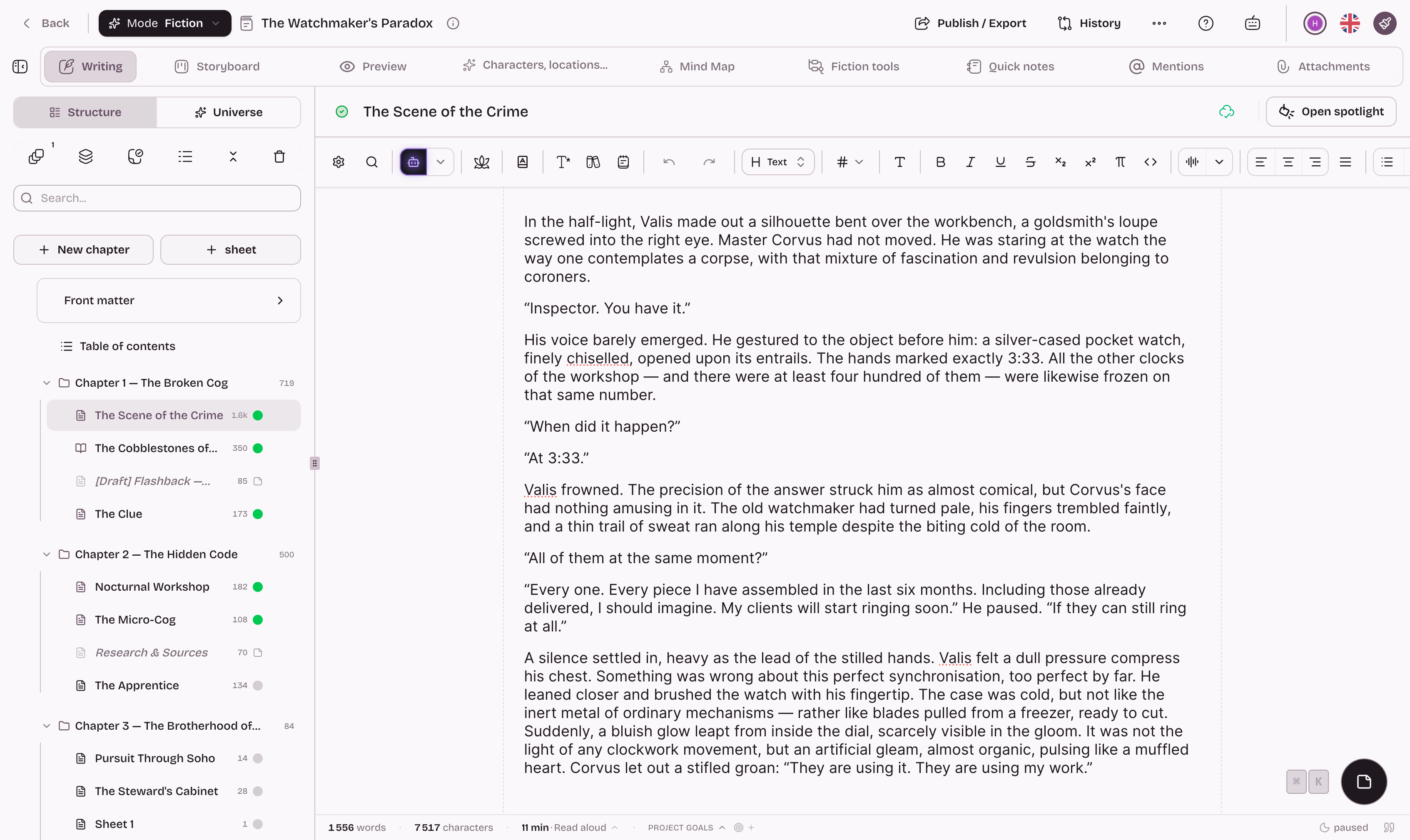
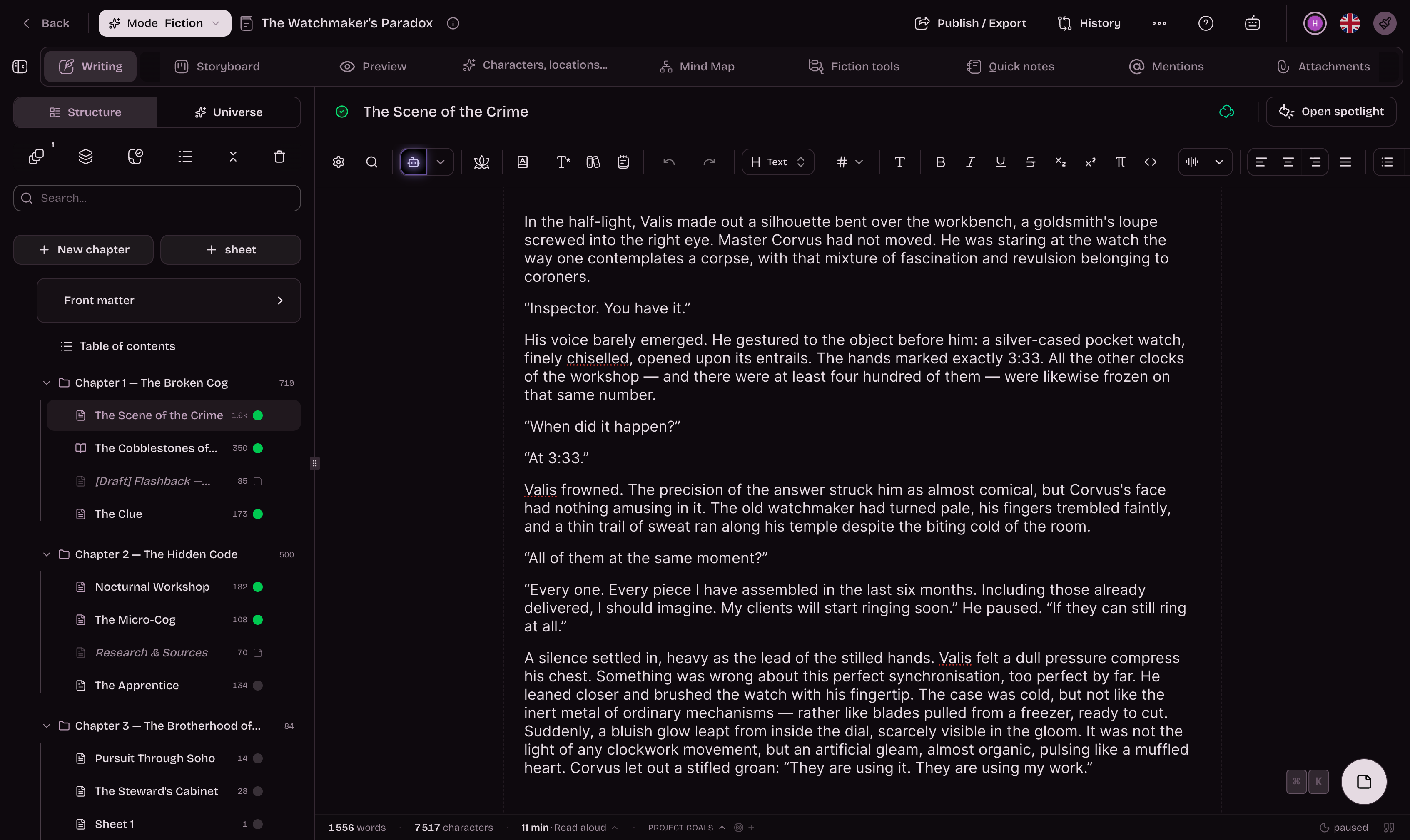

Your next world begins with a scene.
Create your project, introduce a character and start writing.
Hubert Giorgi
Going further
The pages of the studio that carry this subject on.
- Word and character counter
- Writing a novel synopsis
- How to write a novel's opening line
- Character name generator
- How to write a book
- How to create a character sheet
- Save the Cat and its 15 beats
- The Snowflake Method
- Writing fantasy
- The free writing app
And to hold the whole project: The software to write a book