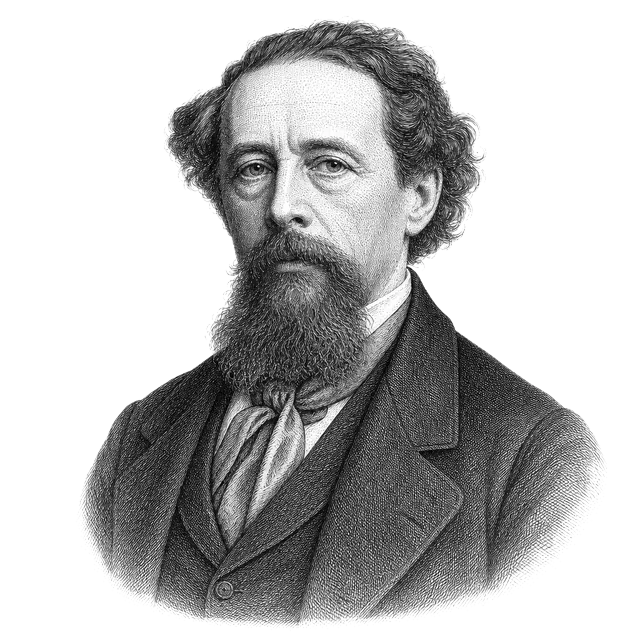
Charles Dickens
A parliamentary shorthand reporter turned novelist, he wrote nearly all his fiction in monthly parts, one number at a time.
- Born
- February 7, 1812
- Landport, Portsmouth, England
- Died
- June 9, 1870
- Gad's Hill, Kent, at 58
- First book
- Sketches by Boz
- 1836, at 24
- Success
- The Pickwick Papers
- 1836, at 24
A first book at 24, made of pieces already in print
Charles Dickens was born on 7 February 1812 at Landport, a suburb of Portsmouth; his father was a clerk in the Navy Pay Office. In 1827 he left school to work as an attorney's office boy and decided to become a journalist. By 1829 he was a freelance reporter at the Doctors' Commons courts, and by 1832 he was taking down Parliamentary debates in shorthand.
His first published story, "A Dinner at Poplar Walk", appeared in The Monthly Magazine on 1 December 1833. He was 21. In 1834 he took the pen name "Boz". On 8 February 1836, the day after his 24th birthday, his sketches of London life were collected by the publisher Macrone as Sketches by Boz, with a frontispiece by George Cruikshank. A second series followed on 17 December 1836.
A blacking factory at 12, and a serial that started at 400 copies
In 1824 his father was jailed for debt in the Marshalsea, and the family joined him there. Charles, aged 12, was sent to work at Warren's Blacking Factory. His father got him out, and he went back to school until 1827. The episode haunted him all his life; he spoke of it only to his wife and to his friend John Forster. In 1834 his father was arrested for debt again, and it was Charles who helped him.
Pickwick itself got off to a poor start. In 1836 he was hired to write text to go with Robert Seymour's illustrations. Seymour killed himself after the second number, and Dickens turned the commission into a novel, now illustrated by Phiz (Hablot K. Browne). The first instalments sold about 400 copies.
At 24, Pickwick and its 40,000 copies a month
The Posthumous Papers of the Pickwick Club began to appear in 1836, while Dickens, 24, was still a Parliamentary reporter. It came out in monthly parts until the final double number in November 1837. By the end, each part was selling nearly 40,000 copies.
That same year, 1836, he married Catherine Hogarth and became editor of Bentley's Miscellany. In 1837, with Pickwick still unfinished, he began Oliver Twist in monthly instalments in that magazine. From 1837 to 1839, at 48 Doughty Street in London, he finished Pickwick and wrote Oliver Twist and Nicholas Nickleby. According to the Charles Dickens Museum, these early books made him an international celebrity; even Queen Victoria was a reader.
« A temporary inability to sleep […] caused me to walk about the streets all night, for a series of several nights. »
How he wrote
Nearly all his novels came out first as serials, monthly or weekly: most in twenty monthly parts, Hard Times weekly in Household Words from April to August 1854. He often wrote on tight deadlines, finishing a number shortly before it was published, and his illustrators in turn worked at short notice, with little information about the chapters to come.
From Dombey and Son (1846) onwards he kept a plan for each number. He folded a sheet of about 7 by 9 inches in half: on the right, the title, the number and the chapter divisions; on the left, ideas, long-term plans and motifs. He went back to it before, during and after writing, ticking off questions, changing his mind, moving chapters. His manuscripts, written in iron-gall ink on sheets he tore in half before writing, are full of cancellations and corrections.
The Victoria and Albert Museum, which holds most of his manuscripts, says he could spend hours watching people in pubs and then walk the streets of London until dawn, letting his thoughts simmer. In "Night Walks", published in All the Year Round on 21 July 1860, he describes whole nights spent walking the streets because he could not sleep.
His life in brief
Between 1836 and 1870 Dickens wrote fifteen novels, among them Oliver Twist, Great Expectations and the short A Christmas Carol. He founded the Daily News, edited Household Words and, from 1859, the weekly All the Year Round. In 1858 he gave his first paid public readings in London and separated from Catherine. He settled at Gad's Hill in Kent in 1860. In 1865 he survived a railway accident; in 1867 and 1868 he made a reading tour of America while his health was failing.
On 8 June 1870, after a full day's work on The Mystery of Edwin Drood, he suffered a stroke at Gad's Hill. He died the next day, 9 June 1870, aged 58, and was buried in Westminster Abbey on 14 June. The last part of the unfinished Edwin Drood appeared in September.
What a writer today can take from it
- Publish short before you publish long: Dickens's first book collected sketches that had already run in magazines for two years.
- A slow start is not a verdict. The first parts of Pickwick sold 400 copies, the last ones nearly 40,000.
- Plan each chapter or part on a single page, divisions on one side and ideas on the other, and come back to it every session to tick off what is settled.
- When the idea will not come at the desk, go for a walk and watch people: Dickens studied pub customers and walked London until dawn.
The writing studio novelists were missing
Outline, characters, places and objects, the links between them, mind map, scene board, export: everything lives in one place. Plus an AI that knows your story, whenever you want one.
Free to write and to export. No credit card asked.
Sources
- Charles Dickens Museum, Who is Charles Dickens (read November 2, 2026)
- Charles Dickens Museum, Carte de visite (read November 2, 2026)
- Victoria and Albert Museum, Charles Dickens' manuscripts and proofs (read November 2, 2026)
- Victoria and Albert Museum, Charles Dickens (read November 2, 2026)
- Victoria and Albert Museum, Original manuscript of Oliver Twist, vol. 7 (read November 2, 2026)
- Victoria and Albert Museum (blog), How to turn a Charles Dickens manuscript into an immersive theatre experience for teenagers (read November 2, 2026)
- Dickens Journals Online, The Uncommercial Traveller [No. 12] ("Night Walks"), All the Year Round, 21 July 1860 (read November 2, 2026)
- Dickens Notes, General Introduction: Dickens and Serial Form (read November 2, 2026)
- The Victorian Web (David Cody), Dickens: A Brief Biography (read November 2, 2026)
- The Victorian Web, Charles Dickens: A Chronology of his Life (read November 2, 2026)
- The Victorian Web (Philip V. Allingham), A Comprehensive List of Dickens's Short Fiction, 1833-1868 (read November 2, 2026)
- The Victorian Web (Philip V. Allingham), "The Election for the Beadle", Cruikshank's illustration for Sketches by Boz (8 February 1836) (read November 2, 2026)
- Project Gutenberg, The Uncommercial Traveller, by Charles Dickens (read November 2, 2026)