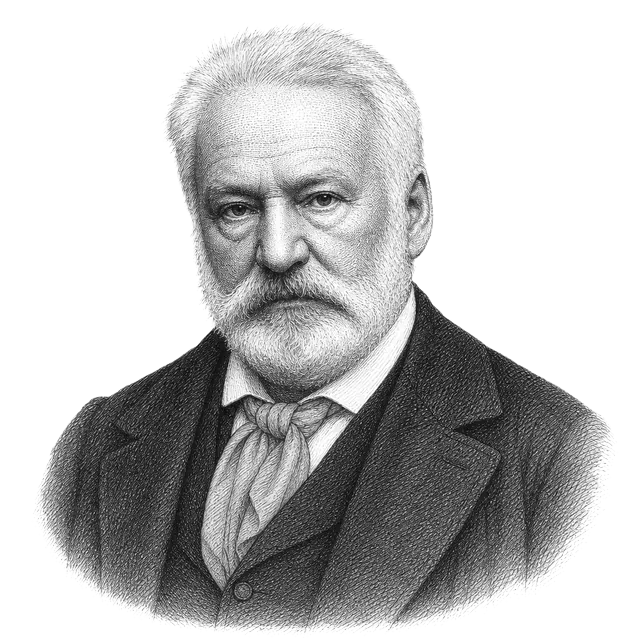
Victor Hugo
Poet, playwright and novelist, he wrote standing up, at dawn, facing the sea off Guernsey.
- Born
- February 26, 1802
- Besançon, France
- Died
- May 22, 1885
- Paris, at 83
- First book
- Odes et poésies diverses
- 1822, at 20
- Success
- Odes et poésies diverses
- First book
A first book at 20
Victor Hugo was born in Besançon on 26 February 1802. He started with poetry: the list of his works kept by the Académie française opens with an ode from 1819, Les Destins de la Vendée, written when he was 17.
His first collection, Odes et poésies diverses, came out in 1822, when he was 20, and it was already a success: Louis XVIII liked it enough to grant him a pension of a thousand francs. Novels and plays came later. Verse was where he served his apprenticeship, learning rhythm before he learned structure.
A late contract and an Academy that said no
In November 1828 Hugo signed with the publisher Charles Gosselin and promised a medieval novel within five months. He delivered in January 1831, more than two years late. That novel was Notre-Dame de Paris.
The Académie française kept him waiting too. A candidate from 1836, he lost to Dupaty, then to Mignet and Flourens. He was finally elected on 7 January 1841, with 17 votes out of 32. He was 38 and had already written Hernani and Notre-Dame de Paris.
On stage: Hernani, on his 28th birthday
Hernani opened at the Théâtre-Français on 26 February 1830, his 28th birthday. A year later, in March 1831, Notre-Dame de Paris came out from Gosselin in a first printing of 1,100 copies.
The great novel of his life came much later. He began what was still called Les Misères in Paris in late 1845 and stopped when the 1848 revolution broke out. He took the manuscript up again in exile on Guernsey in 1860 and finished it at Mont-Saint-Jean, near Waterloo, on 30 June 1861. Les Misérables was published in 1862, when Hugo was 60.
How he wrote
For Notre-Dame de Paris, Hugo began on 25 July 1830, then stopped for a month: the July Revolution, the birth of his daughter. Most of the novel was written in a rush, in four months, between September 1830 and January 1831. The 455-leaf manuscript is the only state of the text, with few corrections.
On Guernsey he had a glass room built on the roof of Hauteville House, the "look-out". According to Paul Stapfer, who knew him there, he rose early, swallowed two raw eggs and a cup of cold coffee, then worked up there, standing, until eleven. For Les Misérables, the Bibliothèque nationale holds more than ten different kinds of paper, used from 1845 to 1861.
His life in brief
Banished in 1851, Hugo took refuge on Jersey, which he had to leave in 1855 for Guernsey, where he stayed fifteen years. That is where he took up Les Misérables again and brought it close to the end.
He died on 22 May 1885, aged 83, the longest-serving member of the Académie française. His will left all his manuscripts and drawings to the national library in Paris, which is why his work can still be followed sheet by sheet. The Académie's list of his works runs to 59 entries.
What a writer today can take from it
- A missed deadline doesn't doom a book: Notre-Dame de Paris arrived two years late, then most of it was written in four months.
- A novel can sleep for a long time. Les Misérables, set aside in 1848, was picked up twelve years later and finished the next year.
- A fixed slot protects the work: on Guernsey, Hugo wrote from dawn until eleven, then stopped.
- Being turned down is not a verdict: the Académie rejected him several times before electing him at 38.
The writing studio novelists were missing
Outline, characters, places and objects, the links between them, mind map, scene board, export: everything lives in one place. Plus an AI that knows your story, whenever you want one.
Free to write and to export. No credit card asked.
Sources
- Gallia (Université d'Osaka), Article sur les Odes et poésies diverses de Victor Hugo, Gallia n° 54 (read November 1, 2026)
- Académie française, Victor Hugo (fauteuil 14) (read November 1, 2026)
- Bibliothèque nationale de France, Le manuscrit de « Notre-Dame de Paris » présenté lors du Festival de la BnF 2019 (read November 1, 2026)
- State Library Victoria, Guillaume Fau on Victor Hugo and the making of a national collection (read November 1, 2026)
- Priaulx Library (Guernsey), Victor Hugo and Guernsey: Victor Hugo and the Lookout (read November 1, 2026)
- Ville de Paris, Une balade romantique sur les pas de Victor Hugo (read November 1, 2026)