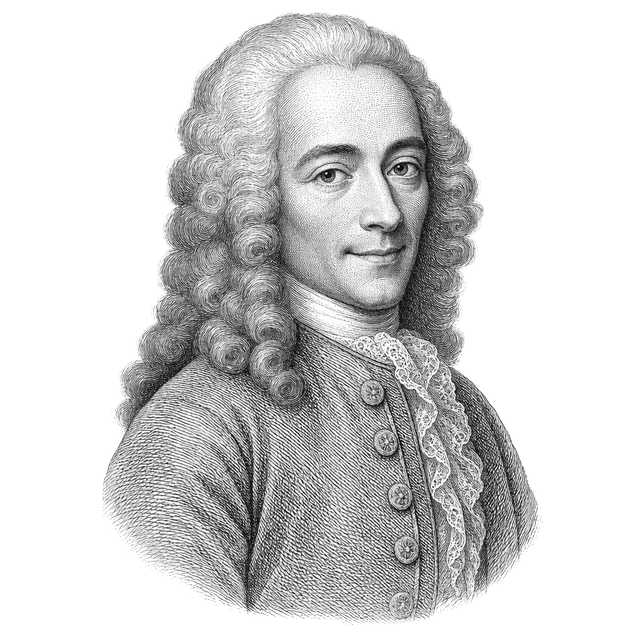
Voltaire
Playwright, poet, storyteller and letter writer, he wrote in prison, in exile and under censorship, and never stopped publishing.
- Born
- November 21, 1694
- Paris
- Died
- May 30, 1778
- Paris, at 83
- First book
- Oedipus (Œdipe)
- 1718, at 23
- Success
- Oedipus (Œdipe)
- First book
A first play begun in the Bastille
François-Marie Arouet was born in Paris on 21 November 1694, the son of a notary; he later disputed the date himself. From 1704 to 1711 he studied with the Jesuits at the Collège Louis-le-Grand, where pupils learned Latin, rhetoric and how to write verse. As a rhetoric pupil there he had an ode to Saint Genevieve printed, an imitation of his teacher Father Le Jay, which he later disowned. He then moved in literary salons and theatre circles and started out with light poetry: verse epistles, epigrams, madrigals.
In 1717, verses against the Regent, which he said he had not written, sent him to the Bastille for almost eleven months. There he worked on his tragedy Oedipus and sketched La Ligue, the first version of The Henriade. Oedipus opened on 18 November 1718. He was 23, and from then on he signed with a name he had made up: Voltaire.
Prison, exile and burned books
In 1726 a quarrel with the Chevalier de Rohan sent him back to the Bastille for four months, then to England until 1728. There he learned English, read Locke and Newton, and drew from it the Philosophical Letters. The English edition, Letters Concerning the English Nation, came out in London in 1733; the French edition of 1734 caused a scandal, the Paris parlement condemned it and had it burned, and Voltaire had to leave Paris.
The refusals went on. His first attempts to join the Académie française failed, as the religious party preferred Marivaux and the abbé de Luynes; he was elected only in 1746. Mahomet, first staged in Lille in 1741, was banned in Paris after three performances. Candide, in 1759, was banned in several countries. When he died, the archbishop of Paris refused him burial: his family had him buried quietly in Champagne, and he only entered the Panthéon in 1791.
Success at 23, with Oedipus
Oedipus, staged by the Comédie-Française from 18 November 1718, was his first major success. When it opened he was hailed as "the first of French poets". That same year he took the name Voltaire, so the success and the signature arrived together.
What followed was built in the theatre. Zaïre, in 1732, made him famous across Europe, and he wrote about fifty plays, up to Irène, his last tragedy, staged in 1778. The tales came late: he took them up past fifty, to entertain distinguished guests, and saw them as a pastime beside his serious work. Yet Zadig (1748) and Candide (1759) are what people still read; in 1759 alone, Candide ran to seventeen editions.
« These trifles sell better than a good book. »
How he wrote
At Cirey, the château of Émilie du Châtelet, where he lived from 1734 to 1749, he wrote on every front at once: science, poetry, drama, fiction. Later he worked with a secretary. Jean-Louis Wagnière, who entered his service in 1754, became his favourite secretary, his librarian and his steward until 1778; he took down Voltaire's dictation, and Voltaire could call on him day or night.
Candide shows the method. Voltaire began it in Lausanne in December 1757, with the plot already settled. In the summer of 1758 he had Wagnière make a fair copy of the finished chapters, which he read aloud to his host, the Elector Palatine. He completed the tale in October at Les Délices, near Geneva. The manuscript held by the Bibliothèque nationale is a copy in Wagnière's hand with corrections in Voltaire's, and he went on revising before handing it to his Geneva printers, the Cramer brothers. The book came out under a false name, in several cities at once, to throw off the police. And he wrote letters without pause: more than 24,000 have been found.
His life in brief
After Émilie du Châtelet died in 1749, Voltaire left for Prussia and the court of Frederick II, with whom he had corresponded since 1736. He stayed from 1750 to 1753, until they fell out. In 1755 he bought Les Délices, near Geneva, then settled at Ferney, just on the French side of the border, where he lived until 1778. He rebuilt the château, put up houses, a theatre and a church, and set up workshops for pottery, silk and watchmaking.
Ferney was also the base for his campaigns against intolerance: the Calas affair from 1762, the Treatise on Tolerance in 1763, the Philosophical Dictionary in 1764. In February 1778 he returned to Paris, which he had not seen for nearly thirty years, was celebrated at the Académie and the Comédie-Française, and died on 30 May.
What a writer today can take from it
- Confined time can still be useful: locked in the Bastille, he worked on Oedipus, which brought his first success a year later.
- Writing and revising are separate stages: Candide went through a fair copy, then handwritten corrections, then a last round before the printer.
- What you write for fun can outlast the rest: the tales Voltaire saw as a pastime are now his most-read books.
- Independence takes planning: Voltaire invested so as to depend on no one, which let him write what he wanted, banned or not.
The writing studio novelists were missing
Outline, characters, places and objects, the links between them, mind map, scene board, export: everything lives in one place. Plus an AI that knows your story, whenever you want one.
Free to write and to export. No credit card asked.
Sources
- Bibliothèque interuniversitaire de la Sorbonne (Biblissima), Imitation de l'ode du R. Père Le Jay. Sur sainte Geneviève (notice U 4= 60, pièce 160) (read November 2, 2026)
- Académie française, François-Marie Arouet, dit Voltaire (fauteuil 33) (read November 2, 2026)
- Bibliothèque nationale de France (Essentiels), François-Marie Arouet, dit Voltaire (read November 2, 2026)
- Bibliothèque nationale de France (Essentiels), Voltaire poète (read November 2, 2026)
- Bibliothèque nationale de France, Candide, l'édition enrichie : repères (read November 2, 2026)
- Voltaire Foundation (University of Oxford), About Voltaire (read November 2, 2026)
- Château de Ferney-Voltaire (Centre des monuments nationaux), Voltaire, les dates clés (read November 2, 2026)
- Château de Ferney-Voltaire (Centre des monuments nationaux), Sa vie, son œuvre (read November 2, 2026)
- Encyclopædia Universalis, Voltaire (repères chronologiques) (read November 2, 2026)
- Dictionnaire historique de la Suisse, Wagnière, Jean-Louis (read November 2, 2026)
- USC Digital Voltaire (University of Southern California), “V” is for Voltaire, sort of: Jean-Louis Wagnière and the Art of Letter Writing (read November 2, 2026)