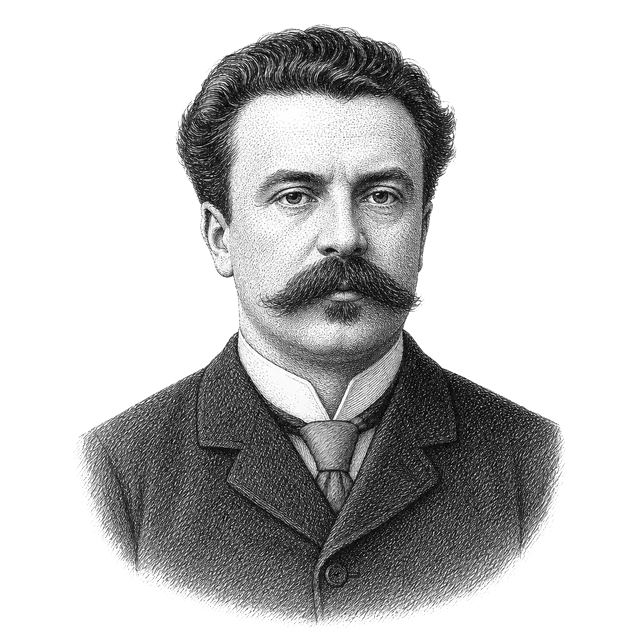
Guy de Maupassant
A storyteller and novelist trained by Flaubert, he wrote more than three hundred stories in about ten years, between newspaper columns.
- Born
- August 5, 1850
- Château de Miromesnil, near Dieppe, France
- Died
- July 6, 1893
- Paris (Passy), at 42
- First book
- Des vers
- 1880, at 29
- Success
- Boule de Suif
- 1880, at 29
A first book at 29
Guy de Maupassant was born on 5 August 1850 at the Château de Miromesnil, near Dieppe. He wrote his first verse as a teenager, during his years as a boarder at Yvetot, a school that expelled him in 1868.
His first appearances in print were quiet and under other names. In 1875 his first tale, La Main d'écorché, came out under the pseudonym Joseph Prunier, and three poems under the name Guy de Valmont. His first book of his own, the poetry collection Des vers, was published by Charpentier on 27 April 1880. He was 29, and the collection did not catch on. What made his name was a story that had appeared ten days earlier.
Eight years at a desk, with Flaubert as his teacher
In spring 1872 Maupassant joined the Navy Ministry as a supernumerary clerk, at first unpaid. In 1874 he became a fourth-class clerk on 1,800 francs a year. The work bored him, and in 1877 his superior described him as "soft, without energy". At the end of 1878, thanks to Flaubert, he moved to the Ministry of Public Instruction.
Flaubert, a friend of the family, took him in hand from 1873. He read his verse, tales and plays, corrected them, and held back publication for years. He also opened his salon to him, where Maupassant met Zola, the Goncourts, Turgenev and Daudet. In early 1880 one of his poems, "Au bord de l'eau", brought charges of offending public morals from the prosecutor at Étampes. Flaubert defended him in an open letter in Le Gaulois, and the affair made excellent publicity for the story that came out a few weeks later.
Boule de Suif, April 1880
On 17 April 1880 Les Soirées de Médan, a collective volume of stories, was published. Maupassant's contribution, Boule de Suif, was a resounding success and made him famous overnight. Flaubert hailed it as a masterpiece shortly before he died, on 8 May 1880.
The success changed his working life at once. On 31 May 1880 he became a regular contributor to Le Gaulois and left the ministry, first on leave; his resignation only took effect at the end of 1882. The collection La Maison Tellier followed in 1881, and his first novel, Une Vie, which he had been thinking about since 1877, came out in 1883.
« Realists of talent ought rather to be called Illusionists. »
How he wrote
In August 1876 Flaubert advised him to keep away from newspapers. Maupassant did the opposite, because he had a living to earn: from 1880 he wrote at least two long articles a week, for Le Gaulois, then from 29 October 1881 for Gil Blas under the pseudonym Maufrigneuse, and from April 1884 for Le Figaro.
Those columns fed his fiction. Often prompted by the news, he reused the same material from one piece to the next, and many columns turned into stories. In about ten years he published more than three hundred tales and stories, gathered in fifteen volumes, and six novels, from Une Vie (1883) to Notre Cœur (1890), with Bel-Ami (1885) and Pierre et Jean (1888) in between.
His life in brief
Maupassant contracted syphilis around 1875; it was diagnosed in 1877. The illness stayed with him throughout his career and sent him on repeated spa cures. His brother Hervé died of it in 1889. In 1891 his condition worsened and he left his novel L'Angélus unfinished.
In early January 1892, after a suicide attempt in Cannes, he was taken to Dr Blanche's clinic in Passy. He never left. He died on 6 July 1893, aged 42, a month before his birthday, and was buried in Montparnasse cemetery.
What a writer today can take from it
- An office job doesn't rule out an apprenticeship: Maupassant spent eight years in ministries while Flaubert trained him.
- A demanding reader is worth more than a quick debut. Flaubert corrected his work and made him wait years before publishing.
- One story can launch a career: it was Boule de Suif, not his poetry collection, that made him known at 29.
- What you write for a living can feed the rest: his weekly newspaper columns often turned into stories.
The writing studio novelists were missing
Outline, characters, places and objects, the links between them, mind map, scene board, export: everything lives in one place. Plus an AI that knows your story, whenever you want one.
Free to write and to export. No credit card asked.
Sources
- Bibliothèque nationale de France (Les Essentiels), Maupassant en 30 dates (read November 2, 2026)
- Bibliothèque nationale de France (Les Essentiels), Maupassant, une vie au fil de la plume (read November 2, 2026)
- Association des Amis de Flaubert et de Maupassant, Guy de Maupassant, biographie par Marlo Johnston (read November 2, 2026)
- Association des Amis de Flaubert et de Maupassant, Maupassant fonctionnaire de ministère (Bulletin n° 49, 1976) (read November 2, 2026)
- Larousse, Guy de Maupassant (Encyclopédie Larousse) (read November 2, 2026)
- Centre Flaubert, Université de Rouen, Lettre de Guy de Maupassant à Gustave Flaubert, 13 février 1880 (read November 2, 2026)
- Presses universitaires de Rouen et du Havre (OpenEdition), Marie-Claire Bancquart, « Maupassant journaliste », dans Flaubert et Maupassant (read November 2, 2026)
- Bibliothèque nationale de France (Les Essentiels), Pierre et Jean dans le texte (read November 2, 2026)