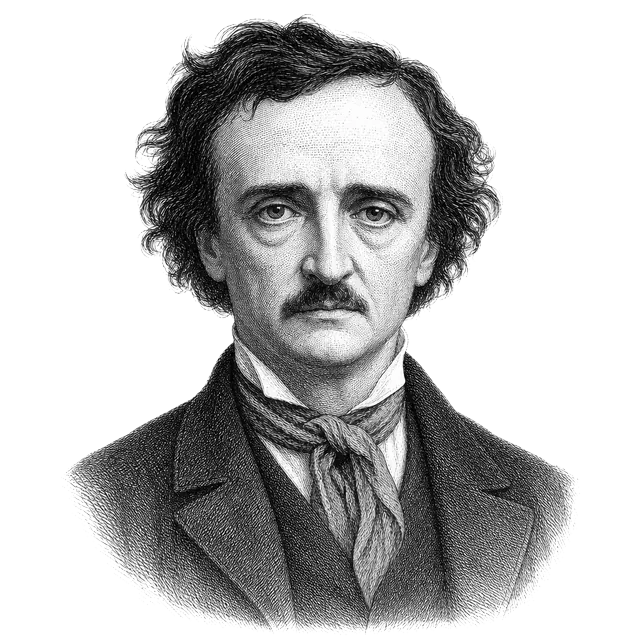
Edgar Allan Poe
Poet, storyteller and magazine critic, he lived by his pen on a few dollars a piece.
- Born
- January 19, 1809
- Boston, Massachusetts, United States
- Died
- October 7, 1849
- Baltimore, at 40
- First book
- Tamerlane and Other Poems
- 1827, at 18
- Success
- MS. Found in a Bottle
- 1833, at 24
A first book at 18, "By a Bostonian"
Edgar Poe was born in Boston on 19 January 1809, the son of two travelling actors. His mother died in Richmond on 8 December 1811; the boy was taken in by John and Frances Allan of Richmond, who never legally adopted him. His earliest surviving poem, two lines written around 1824, was never published in his lifetime.
In March 1827, after a quarrel with John Allan over $2,000 of gambling debts run up at the University of Virginia, he left home. That same year Tamerlane and Other Poems came out in Boston from Calvin F. S. Thomas. The author was named only as "A Bostonian". He was 18. The thin pamphlet sold perhaps 50 copies, many of them likely given away for reviews. Only twelve copies are known today.
Three books of poems, then tales paid by the piece
After enlisting in the army as Edgar A. Perry and being dismissed from West Point in 1831, he brought out two more books of poems, in 1829 and 1831. The Edgar Allan Poe Society of Baltimore sums up those years: little money and only minor critical success. Poetry remained his first love, but he saw he would need more than verse to make a living as a writer, and he turned to tales.
In July 1831 he sent several stories to a contest run by the Philadelphia Saturday Courier. He did not win; five of his tales were printed, without his name. By 1833 he had written eleven stories he hoped to publish as a set, Tales of the Folio Club. All his life his work paid little: $24 for "The Fall of the House of Usher", $10 for "The Tell-Tale Heart". The two magazines he dreamed of founding, The Penn and then The Stylus, never appeared for lack of capital.
At 24, a $50 prize that opened the door
The Baltimore Saturday Visiter, which had already printed four of his poems in the spring of 1833, ran a contest. On 7 October 1833 three judges, among them the writer John Pendleton Kennedy, met at one of their houses and gave the $50 prose prize to "MS. Found in a Bottle". Poe was 24. His poem "The Coliseum" came second.
Above all, the prize won him Kennedy's friendship, and Kennedy recommended him to Thomas W. White, owner of the Southern Literary Messenger in Richmond. Poe became its editor in 1835. Ten years later, on 29 January 1845, "The Raven" appeared in the New York Evening Mirror and became a sensation, reprinted everywhere. By family tradition it earned him about $15, but according to the Poe Museum in Richmond it made his name a household word, and lectures and public readings followed.
« Here then the poem may be said to have its beginning — at the end, where all works of art should begin. »
How he wrote
Poe earned his living in magazines, as editor and as critic. At the Southern Literary Messenger he wrote a great many reviews, frank enough to win him both praise and scorn, and printed his own poems and tales. At Graham's Magazine, where "The Murders in the Rue Morgue", the first modern detective story, appeared in April 1841, circulation rose from about 5,000 to nearly 37,000 subscribers during his time there. At the Evening Mirror, his employer N. P. Willis remembered him at his desk from nine in the morning until the evening paper went to press, invariably punctual and industrious.
In April 1846 he published "The Philosophy of Composition" in Graham's, claiming to take "The Raven" apart step by step. You start from an effect, not a plot. You set the length at what can be read in one sitting, about a hundred lines (the poem has 108). Then you write the last stanza first, the one "Nevermore" must answer. The Poe Society of Baltimore points out that this account is largely fictional, by Poe's own admission; the poem was most probably written in late 1844, on a farm in New York.
His life in brief
Raised in Richmond, with five years in England between 1815 and 1820, Poe later lived in Baltimore with his aunt Maria Clemm. On 16 May 1836, aged 27, he married his cousin Virginia, who was 13. The family moved to New York, then to Philadelphia in 1838, and back to New York in 1844. Virginia died of tuberculosis on 30 January 1847, in the cottage at Fordham.
On 3 October 1849 he was found in Baltimore in a condition that witnesses described in conflicting ways. He died in hospital on 7 October 1849, aged 40; the cause of his death remains unknown. Rufus Griswold's hostile obituary, published two days later, shaped his legend for decades. In France he is read above all in Baudelaire's translations, collected as Histoires extraordinaires.
What a writer today can take from it
- A first book that sells fifty copies is not the end: Poe published two more, then turned to tales.
- Contests are worth the people they bring you. The 1833 prize mostly brought him Kennedy, and through him an editor's job.
- Decide the effect and the ending before you write. Poe said he began with the last stanza, even if he dressed up his method.
- Fame does not pay for the piece: "The Raven" earned him about $15. He lived on editing and reviewing, not on his masterpieces.
The writing studio novelists were missing
Outline, characters, places and objects, the links between them, mind map, scene board, export: everything lives in one place. Plus an AI that knows your story, whenever you want one.
Free to write and to export. No credit card asked.
Sources
- Edgar Allan Poe Society of Baltimore, Chronology of the Life of Edgar Allan Poe (read November 2, 2026)
- Edgar Allan Poe Society of Baltimore, Edgar Allan Poe in Baltimore (read November 2, 2026)
- Edgar Allan Poe Society of Baltimore, Poe's Finances (read November 2, 2026)
- Edgar Allan Poe Society of Baltimore, Edgar Allan Poe's Problematic Biography (read November 2, 2026)
- Edgar Allan Poe Society of Baltimore, The Philosophy of Composition (Graham's Magazine, April 1846) (read November 2, 2026)
- Edgar Allan Poe Society of Baltimore, The "Ultima Thule" Daguerreotype (read November 2, 2026)
- The Poe Museum (Richmond), Edgar Allan Poe (read November 2, 2026)
- Project Gutenberg, Histoires extraordinaires, by Edgar Allan Poe (translated by Charles Baudelaire) (read November 2, 2026)