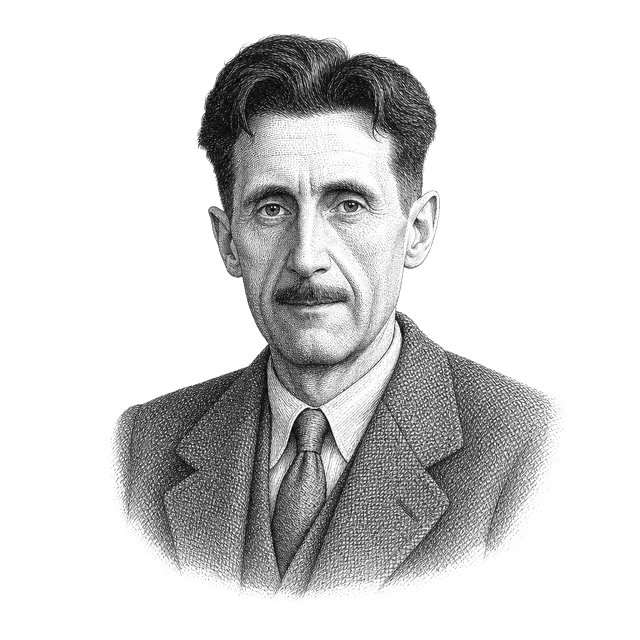
George Orwell
Novelist, essayist and journalist, he wrote from what he had seen for himself, from the slums of Paris to the trenches of Spain.
- Born
- June 25, 1903
- Motihari, Bengal, British India
- Died
- January 21, 1950
- London, at 46
- First book
- Down and Out in Paris and London
- 1933, at 29
- Success
- Animal Farm
- 1945, at 42
A first book at 29, under a borrowed name
Eric Arthur Blair was born on 25 June 1903 in Motihari, Bengal, where his father worked as an opium agent in the Indian Civil Service. A King's Scholar at Eton from 1917 to 1921, he did not go on to university: in 1922 he joined the Indian Imperial Police in Burma. He came home in June 1927, disillusioned with imperial rule, with the material for Burmese Days and several essays.
There followed years of odd jobs. He taught in private schools, lived in Paris, and lived among tramps in England by passing himself off as one. He began turning all this into a book after coming back from Paris in the winter of 1929. That book came out from Victor Gollancz in January 1933 as Down and Out in Paris and London. He was 29, and for the first time he signed himself George Orwell, a name he had taken shortly before publication. On publication day his family in Southwold showed little enthusiasm.
Three rejections for the first book, at least four for Animal Farm
The manuscript, then called A Scullion's Diary, was rejected twice by Jonathan Cape by the end of 1931. In February 1932 T. S. Eliot, a director at Faber & Faber, turned it down as well: he found it interesting but decidedly too short and too loosely built. Orwell then handed the typescript to his friend Mabel Fierz and asked her to destroy it and keep only the paperclips. She did nothing of the sort. She took it to the literary agent Leonard Moore in the Strand, pressed him to read it, and Moore sold it to Gollancz.
Twelve years later it happened again. Animal Farm, an idea he had carried since 1937, was written at the end of 1943 and ready in 1944. Russia was then Britain's ally, and at least four publishers turned the book down. One accepted it, then backed out after consulting the Ministry of Information, which advised against publication; that advice was later found to have been encouraged by a Soviet spy. On 13 July 1944 Eliot wrote another rejection for Faber. He praised the writing, but he and his fellow directors were not convinced this was the right point of view from which to criticise the political situation. Between those two refusals Orwell had brought out several more books without ever reaching financial security.
At 42, Animal Farm finally gave him security
The book at last found a home at Secker & Warburg, who published it on 17 August 1945 at six shillings. Orwell was 42. Three printings, 20,500 copies in all, came out before the cheap edition of 1949, and more than half a million copies were printed in the United States. According to the Orwell Society, those sales gave him financial security for the first time in his life. The book was quickly translated around the world, and Orwell gave up his royalties on copies meant for Ukrainian and Russian refugees.
It was also, as he wrote the following year in "Why I Write", the first book in which he had tried, fully aware of what he was doing, to fuse political purpose and artistic purpose into one whole. Nineteen Eighty-Four, published in June 1949, went on to enormous international success.
« Good prose is like a windowpane. »
How he wrote
Orwell almost always started from what he had lived through or gone to find out: Burma, poverty in Paris and tramping, the Hampstead bookshop where he worked, which fed into Keep the Aspidistra Flying, the tour of the industrial North that became The Road to Wigan Pier, and the Spanish Civil War, where a bullet wounded him in the throat, for Homage to Catalonia. He also wrote for a living, as a talks producer for the BBC's Eastern Service, a job he disliked, and from 1943 as literary editor of the weekly Tribune, where he wrote the column "As I Please". In "Why I Write" (1946) he sorted the reasons for writing into four motives: sheer egoism, aesthetic enthusiasm, historical impulse and political purpose. He did not set out, he said, to produce a work of art, but from a sense of injustice, a lie he wanted to expose or a fact he wanted noticed.
For Nineteen Eighty-Four he moved in 1946 to Barnhill, a remote farmhouse on the Hebridean island of Jura, found through David Astor. There was no electricity, light came from paraffin lamps, the nearest shop was 25 miles away and the post came on Thursdays. Visitors heard the clatter of his typewriter, which he spent some afternoons repairing himself. Ill with tuberculosis, diagnosed in 1947, he ended up writing in bed when he could no longer manage the desk, and put off leaving for a sanatorium for fear the doctors would take his typewriter away. The manuscript was finished in December 1948.
His life in brief
After Burma, Orwell lived on and off with his parents in Southwold, Suffolk; pneumonia put an end to his teaching. In London he married Eileen O'Shaughnessy, and they settled in a tiny cottage at Wallington in Hertfordshire. In 1937 he spent six months in Spain as a Republican volunteer with the POUM militia, and was in Barcelona when Soviet-backed groups attacked it; Homage to Catalonia came out in April 1938. Turned down for military service on health grounds, he worked at the BBC and then at Tribune during the war.
In early 1945 Eileen died of heart failure during a routine operation; they had adopted a son, Richard, whom Orwell brought up with help from his sister Avril. After Jura he was treated in a nursing home in the Cotswolds and then, from September 1949, at University College Hospital in London, where he married Sonia Brownell, an editorial assistant at Horizon. He died on 21 January 1950, aged 46.
What a writer today can take from it
- Do not throw away a rejected manuscript: the one Orwell wanted destroyed after three refusals became his first book because a friend took it to an agent.
- Read the reason behind a rejection. Eliot found the first typescript too short and badly built; in 1944 he no longer faulted the writing, only the political moment.
- Go out and find your material: the slums of Paris, a tour of the North and a war front gave Orwell half his books.
- Know why you write. Orwell started from an injustice or a lie he wanted to show, and aimed for prose as clear as a windowpane.
The writing studio novelists were missing
Outline, characters, places and objects, the links between them, mind map, scene board, export: everything lives in one place. Plus an AI that knows your story, whenever you want one.
Free to write and to export. No credit card asked.
Sources
- The Orwell Foundation, Orwell: Biography (read November 2, 2026)
- The Orwell Foundation, Why I Write (Gangrel, No. 4, Summer 1946) (read November 2, 2026)
- The Orwell Foundation, The Freedom of the Press (read November 2, 2026)
- The Orwell Society, Seventy Years Of Relevance: The Birth of Animal Farm (read November 2, 2026)
- Sotheby's (D. J. Taylor), George And Mabel: An Unlikely Romance (read November 2, 2026)
- Literary Hub (Toby Faber), When Faber & Faber's T.S. Eliot Passed on George Orwell (and More) (read November 2, 2026)
- A. M. Heath, Down and Out in Paris and London (read November 2, 2026)
- Penguin Books UK, George Orwell and Jura (read November 2, 2026)