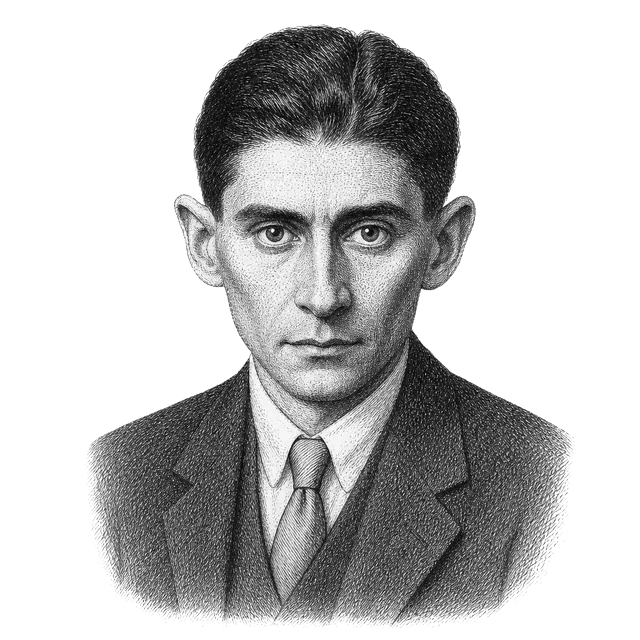
Franz Kafka
A lawyer at an accident insurance institute by day, he wrote at night and published only a few slim volumes in his lifetime.
- Born
- July 3, 1883
- Prague, Bohemia, Austria-Hungary
- Died
- June 3, 1924
- Kierling, near Vienna, at 40
- First book
- Contemplation
- 1912, at 29
- Success
- The Stoker
- 1913, at 29
A first book at 29, in 800 copies
Franz Kafka was born in Prague on 3 July 1883, the first child of Hermann Kafka, who kept a shop for fancy goods, and Julie Löwy. He studied law at the German University in Prague and took his doctorate in 1906. He met Max Brod in 1902, and Brod became his closest friend. His earliest surviving longer prose, "Description of a Struggle", dates from 1904-1905, and he destroyed much of his early work. In 1910 Brod saved that particular manuscript from destruction by its author.
His first steps into print were quiet ones. In 1908 the Munich magazine Hyperion printed eight short prose pieces under the title Betrachtung. Four years later the same title became his first book: eighteen pieces written between late 1906 and autumn 1912, printed in 800 copies and published in December 1912 by Ernst Rowohlt. Kafka was 29. Felice Bauer, to whom he sent it in mid-December, seems to have received it with bafflement.
The office by day, writing by night
In those years his obstacle was time. After a few months at Assicurazioni Generali, from October 1907 to July 1908, he joined the Workers' Accident Insurance Institute for the Kingdom of Bohemia in Prague at the end of July 1908. He stayed there until his early retirement on 1 July 1922. The same post exempted him from military service during the war.
On 1 November 1912 he described to Felice Bauer his timetable over the previous six weeks: the office from 8 until 2 or 2.30, then lunch, then sleep in the afternoon. He sat down to write at about 10.30, often not until 11.30, and kept going until one, two or three in the morning, once until six. When Felice urged him to give his nights to sleep, he flatly refused. He also needed a place: in 1914, for the first time, he could work outside his parents' flat, in rooms at his sisters'; in 1915 he rented a room of his own.
At 29, a novel fragment praised by Musil
A few weeks in the autumn of 1912 decided everything. In the night of 22 to 23 September he wrote "The Judgment" at one sitting; before the end of the month came "The Stoker", the first chapter of his American novel, The Man Who Disappeared. The Metamorphosis followed between 17 November and 6 December. On 4 December 1912 he read "The Judgment" in public in Prague.
The Stoker came out in May 1913 from Kurt Wolff in Leipzig. Kafka agreed to publish the stand-alone chapter on condition that it carried the subtitle "A Fragment". In August 1914 Robert Musil praised it in Berlin's Neue Rundschau, the most prominent review Kafka ever received. At the end of 1915 the playwright Carl Sternheim, who had won the Fontane Prize, passed the prize money on to him as a sign of recognition, and the Munich press took notice of the "young Prague storyteller" for the first time. It was recognition among insiders. In the words of Bodley's Librarian, his fame and literary success have been a phenomenon since his death.
How he wrote
"The Judgment" was the one text that seemed flawless even to him, and the reason was the way it had been written. His diary entry of 23 September 1912 describes the night: from ten in the evening to six in the morning, until the maid first walked through the anteroom. He later told Felice that he had sat down meaning to describe a war, and that everything turned beneath his hands. He drew a conviction from it: only in this way, in one coherent stretch, could writing be done. The scholar Manfred Engel notes that his manuscripts carry few corrections, most made in the flow of writing, and that when he did rework a text he often started again from the beginning.
That method suited long narratives badly, and Kafka knew it. He gave up The Man Who Disappeared in January 1913. For The Trial, begun in July 1914, he wrote the final chapter straight after the first, to fix a frame of one year in Josef K.'s life, and then filled in the middle. He also wrote wherever he found quiet: from November 1916 to May 1917, in a little house in Alchemists' Lane lent to him by his sister Ottla, he filled the "octavo notebooks" that produced most of the stories of A Country Doctor. In September 1922 he wrote to Brod that he had had to abandon The Castle, apparently for good.
His life in brief
Kafka met Felice Bauer at Max Brod's on 13 August 1912. He was engaged to her twice, in 1914 and 1917, and broke it off twice. In September 1917 he was diagnosed with tuberculosis and spent eight months in the country with his sister Ottla at Zürau. In 1920 he began corresponding with Milena Jesenská, his first Czech translator. In autumn 1921, and again on 29 November 1922, he wrote the two notes asking Brod, his literary executor, to destroy everything he left behind. On 24 September 1923 he moved to Berlin with Dora Diamant, who burned many manuscripts at his request.
He died on 3 June 1924 at the sanatorium in Kierling, near Vienna, aged 40, after correcting the proofs of his last book, A Hunger Artist. Brod overrode his wishes and published The Trial in 1925, then further works. In 1939 he fled occupied Prague with Kafka's papers in a suitcase. Most of those papers are now at the Bodleian in Oxford, where they arrived in 1961 in the boot of the Germanist Malcolm Pasley's Fiat; the manuscript of The Trial is in Marbach, and part of Brod's archive is at the National Library of Israel. His three sisters were murdered in the Holocaust.
What a writer today can take from it
- A full-time job does not rule out writing: Kafka wrote "The Judgment" and "The Stoker" after coming home from the office, between 10.30 at night and the small hours.
- Guard your writing hours, even against well-meant advice. He refused to give his nights back to sleep.
- For a long text, settle the ending early. Kafka wrote the last chapter of The Trial right after the first, then filled in the middle.
- A single chapter can stand on its own. The Stoker, published as "a fragment", earned him the most prominent review of his life.
The writing studio novelists were missing
Outline, characters, places and objects, the links between them, mind map, scene board, export: everything lives in one place. Plus an AI that knows your story, whenever you want one.
Free to write and to export. No credit card asked.
Sources
- Bodleian Libraries, University of Oxford, Kafka: Making of an Icon (news release, 2024) (read November 2, 2026)
- Bodleian Libraries, University of Oxford, Kafka: Making of an Icon (read November 2, 2026)
- Suhrkamp Verlag, Franz Kafka: Zeittafel (read November 2, 2026)
- Deutsches Historisches Museum (LeMO), Franz Kafka 1883-1924 (read November 2, 2026)
- S. Fischer Verlage (franzkafka.de), Betrachtung (read November 2, 2026)
- S. Fischer Verlage (franzkafka.de), Der Heizer (read November 2, 2026)
- S. Fischer Verlage (franzkafka.de), Die Verwandlung (read November 2, 2026)
- Cambridge University Press, Manfred Engel, "Writing", in Franz Kafka in Context (read November 2, 2026)
- The New York Review of Books, Kafka's Love Letters (letter to Felice Bauer, 1 November 1912) (read November 2, 2026)
- Perlentaucher / C.H. Beck, Peter-André Alt, Franz Kafka. Der ewige Sohn (Auszug, Teil 3) (read November 2, 2026)
- Münchner Beiträge zur jüdischen Geschichte und Kultur (LMU München), Dirk Heißerer, Kafka in München: Von den Scharfrichtern zur Strafkolonie (read November 2, 2026)
- Radio Prague International, Franz Kafka's never-before-seen manuscripts and drawings go online (read November 2, 2026)
- SRF, 100. Todestag: Der überraschende Franz Kafka (read November 2, 2026)
- Berliner Zeitung, Franz Kafkas Leben in der Berliner Staatsbibliothek: ein begehbares Familienalbum (read November 2, 2026)