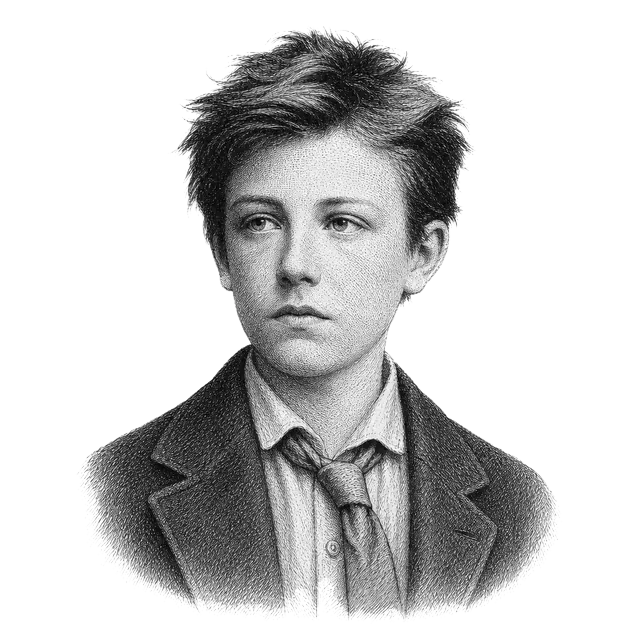
Arthur Rimbaud
A precocious poet who wrote everything in about five years, then left literature at around twenty for trade in Africa.
- Born
- October 20, 1854
- Charleville, Ardennes, France
- Died
- November 10, 1891
- Marseille, at 37
- First book
- A Season in Hell
- 1873, at 18
- Success
- Illuminations
- 1886, at 31
One book published by himself, at 18 and at his own cost
Arthur Rimbaud was born in Charleville, in the Ardennes, on 20 October 1854. His father, an army officer, left the family six years later; the boy grew up under a strict mother and won prize after prize at school, notably for his Latin verse, some of which was published in 1869. In January 1870, aged 15, he saw his first published poem in French, "Les Étrennes des orphelins", appear in La Revue pour tous. His new rhetoric teacher, Georges Izambard, noticed him and read his early attempts.
His first book came three years later. From late July to early September 1873, at the family farm in Roche, he wrote part of A Season in Hell (Une saison en enfer). He was 18. It was printed that year in Brussels at his own expense. Larousse notes that it was the only collection he ever had published himself, and that he lost interest in it at once.
Letters to poets, then a stock left at the printer's
The BnF puts it plainly: Rimbaud wanted to be a published poet, and he knocked on doors. On 24 May 1870 he sent Théodore de Banville, a leading figure of the Parnasse group, a statement of faith and three poems, "Ophélie" among them, hoping for a place in the Parnasse contemporain. He wrote that he was seventeen; he was fifteen. In September and October 1870, in Douai, he handed twenty-two poems to Paul Demeny, who co-ran a publishing house, the Librairie artistique. No book came of it. In late summer 1871 he sent poems to Paul Verlaine, who invited him to Paris.
In Paris he was admitted to the "Vilains Bonshommes" dinners, then thrown out for his provocations. According to the BnF, Paris publishers then stayed closed to him because of his scandalous reputation. A Season in Hell changed nothing: short of money, he collected only a few copies. The Encyclopædia Universalis adds that he never settled his account, so the printer kept most of the copies. A rumour long had it that Rimbaud burned the edition; the stock was found only in 1901, ten years after his death.
At 31, Illuminations came out while he was in Africa
Recognition came first through Verlaine. In February 1875, in Stuttgart, Rimbaud handed him the manuscript of Illuminations. In October 1883 Verlaine devoted a study to him in Les Poètes maudits ("The Accursed Poets"), published in the review Lutèce between August 1883 and January 1884, then as a book in 1884, alongside Tristan Corbière and Stéphane Mallarmé. Rimbaud held first place. "The Drunken Boat", written in 1871, was published only in 1883.
From May to July 1886 the review La Vogue, edited by Gustave Kahn, published Illuminations in Paris, then reissued A Season in Hell. Rimbaud was 31. He had long since left literature: he was trading arms in East Africa. The BnF speaks of a remarkable reputation won from the 1880s on, but one that came too late for the poet, some ten years after A Season in Hell. Larousse sums it up: he died just as his poetry was beginning to be recognised.
« I is another. »
How he wrote
Rimbaud wrote over about five years, from 1870 to 1875, and the BnF sees two phases. From 1870 to the summer of 1871 his verse followed the news: the war with Prussia, the fall of the Empire, the siege of Paris, the Commune, and broadsides against Napoleon III drawn from press caricature. On 13 and 15 May 1871, in the two so-called "seer" letters, he set out his programme: to Izambard, "I is another"; to Demeny, the poet must make himself a seer "by a long, immense and reasoned derangement of all the senses".
From late 1871 into 1872, rhyme gave way to assonance and freer verse, and many of these poems were written alongside Verlaine. Rimbaud threw nothing away: some later went into A Season in Hell, in different or prose versions, others into Illuminations. He worked in the quiet of the farm at Roche on the Season, and in London in 1874, with the poet Germain Nouveau, he made fair copies and probably wrote part of Illuminations. In the Season he describes the work himself: "I wrote silences, nights, I noted the inexpressible. I fixed vertigos."
His life in brief
In August 1870 Rimbaud ran away to Paris for the first time; arrested without a ticket, he was locked up at Mazas prison, then sent back to Charleville. In February 1871 he saw the Prussian troops enter Paris and the Commune begin. In September 1871 he settled in Paris near Verlaine. In July 1872 the two men left for Belgium, then London. On 10 July 1873, in Brussels, Verlaine shot at him with a revolver and wounded him; he was sentenced to two years in prison.
At around twenty Rimbaud stopped writing. He went to Stuttgart, Italy, Java, where he deserted the Dutch army in 1876, then Cyprus. On 7 August 1880 he settled in Aden, worked for a firm trading hides and coffee, was posted to Harar, and in 1885 went into the arms trade, delivering rifles to King Menelik. In 1891 a tumour in his knee brought him back to Marseille, where his right leg was amputated on 25 May. He died at the Hôpital de la Conception on 10 November 1891, aged 37. The day before, a collection of his poems, the Reliquaire, had come out, but a dispute between publishers kept it from circulating.
What a writer today can take from it
- Send your work to people who can publish it. At 15 Rimbaud wrote to Banville; that same year he gave twenty-two poems to a publisher; it was the letter to Verlaine that brought him to Paris.
- Printing is not enough. A Season in Hell, paid for by the author but never settled or distributed, sat at the printer's until 1901: plan how the book will reach readers before you print it.
- Leave a copy of your manuscript with someone who believes in you. The Illuminations manuscript, handed to Verlaine in 1875, became the 1886 book.
- An old poem can come back in a new form. Rimbaud reworked lines from 1872 into A Season in Hell, revised or turned into prose.
The writing studio novelists were missing
Outline, characters, places and objects, the links between them, mind map, scene board, export: everything lives in one place. Plus an AI that knows your story, whenever you want one.
Free to write and to export. No credit card asked.
Sources
- Bibliothèque nationale de France (Essentiels), Rimbaud en 30 dates (read November 2, 2026)
- Bibliothèque nationale de France (Essentiels), Les Poésies de Rimbaud (read November 2, 2026)
- Bibliothèque nationale de France (catalogue général), Notice de titre conventionnel « Les poètes maudits » (read November 2, 2026)
- Larousse, Arthur Rimbaud (read November 2, 2026)
- Encyclopædia Universalis, Une saison en enfer (fiche de lecture) (read November 2, 2026)
- Ministère de la Culture, POP (musée Arthur Rimbaud, Charleville-Mézières), Portrait photographique d'Arthur Rimbaud à 17 ans, d'après Étienne Carjat (1871) (read November 2, 2026)