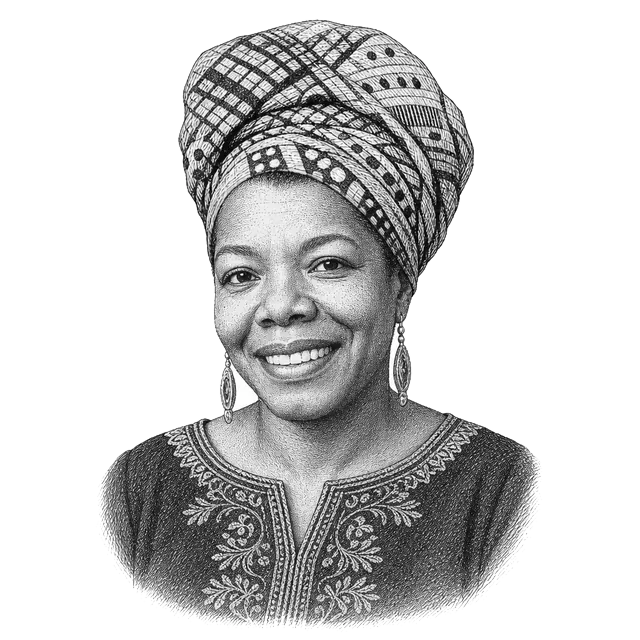
Maya Angelou
Singer, dancer, journalist and activist before she was a writer, she told her life in seven volumes of memoir.
- Born
- April 4, 1928
- St. Louis, Missouri, United States
- Died
- May 28, 2014
- Winston-Salem, North Carolina, at 86
- First book
- I Know Why the Caged Bird Sings
- 1969, at 41
- Success
- I Know Why the Caged Bird Sings
- First book
A first book at 41, written on a dare
Marguerite Johnson was born in St. Louis, Missouri, on April 4, 1928, and grew up between St. Louis and Stamps, Arkansas, where her paternal grandmother lived. Her older brother, Bailey, gave her the name "Maya." As a child she was already writing essays, poems and a journal, and she learned Shakespeare and Poe by heart.
In 1959 she joined the Harlem Writers Guild, a New York circle founded in 1950 to help Black authors get published, and became friends there with the novelist James Baldwin. In 1968 Baldwin took her to dinner at the cartoonist Jules Feiffer's, where she kept the table laughing with stories of her childhood. The next day Robert Loomis, an editor at Random House, got a call, and he asked her to write a memoir. She said no at first, since she thought of herself as a poet and playwright. Loomis answered that writing an autobiography that was also literature was nearly impossible, and she took up the challenge.
I Know Why the Caged Bird Sings came out from Random House in 1969, the year she turned 41. The title comes from a poem by Paul Laurence Dunbar, one of her favorite writers. The book tells her childhood, including the rape she suffered as a child and the years of silence that followed.
Rejections, odd jobs and forty years of other lives
During the war, her application to the Women's Army Corps was turned down because of the dance and drama classes she had taken at the California Labor School, which was said to have Communist ties. As a teenager she wanted to be a streetcar conductor in San Francisco; the company would not even give her an application because she was Black. She came back every day for three weeks, finally got one, and became the first African American woman to hold that job in the city.
After finishing high school in 1944 and giving birth to her son Guy, she took a string of odd jobs to support them both. In the 1950s she sang and danced calypso and cabaret in the United States, Europe and North Africa, and recorded albums. Then came the civil rights movement, where she served as northern coordinator of the Southern Christian Leadership Conference at Martin Luther King Jr.'s request, and journalism: associate editor of The Arab Observer in Cairo in 1961 and 1962, then an editor in Accra, Ghana, from 1964 to 1966. When Random House came to her, she had already had several careers and had not yet published a single book.
The first book was also the breakthrough
With I Know Why the Caged Bird Sings, Angelou rose to international prominence as an author in 1969, as the National Book Foundation puts it. The book was nominated for the National Book Award and stayed on the bestseller lists for two years. It has been translated into many languages and has sold more than a million copies.
It was also banned in many schools for its frank account of a child's rape, of racism and of sexuality. It is credited with helping other survivors of abuse tell their own stories, and it went on to be taught at universities around the world. Angelou wrote six more volumes of memoir, ending with Mom & Me & Mom in 2013, published when she was 85. Twenty-four years after the first one came out, the poem she read at Bill Clinton's inauguration in January 1993 sent it back onto the bestseller lists.
How she wrote
In every town where she lived, Angelou kept a hotel room, paid by the month, that she used only for writing. She had the paintings taken off the walls and let the staff in only to empty the wastebaskets. She arrived early in the morning on weekdays and stayed until early afternoon. She told the CBC in 1995 that she had to pull herself away from her everyday life in order to write.
She always brought the same things: a dictionary, Roget's Thesaurus, a Bible and a bottle of sherry. She wrote by hand, lying on the bed, on yellow legal pads, and played solitaire when she needed a break. Back home, she reread the day's work around five, had a quiet dinner, and went back the next morning. The typewriter stayed at home: the American Writers Museum shows a 1980 Adler Meteor 12 bought at her estate sale, and her grandson has said she never moved past the typewriter, the pen and the paper.
Her life in brief
After the rape at her mother's home, she stopped speaking for years and went back to live with her grandmother in Arkansas. Before the war she joined her mother in Oakland, California. In 1949 she married Tosh Angelos, an electrician in the Navy; they divorced in 1952, but she kept a form of his name.
Back in the United States in 1974, she wrote for stage and screen: in 1972 Georgia, Georgia made her the first African American woman to have her screenplay turned into a film. She also published poetry, including Just Give Me a Cool Drink of Water 'fore I Diiie (1971), nominated for the Pulitzer Prize. In 1982 she accepted a lifetime appointment as Reynolds Professor of American Studies at Wake Forest University in Winston-Salem. In 1993 she read "On the Pulse of Morning" at Bill Clinton's inauguration. Barack Obama awarded her the Presidential Medal of Freedom in 2010. She died in Winston-Salem on May 28, 2014, aged 86.
What a writer today can take from it
- A first book at 41 is not late: Angelou poured into it forty years of jobs, travels and struggles that no one else could tell.
- The stories you tell at dinner may be your book. It was hearing her talk about her childhood that got her asked to write it.
- Keep your writing place apart from the rest of your life. A bare room, the same tools every day and fixed hours carried her through seven volumes of memoir.
- Draft by hand, reread in the evening with a fresh head, and save the typewriter for revising.
The writing studio novelists were missing
Outline, characters, places and objects, the links between them, mind map, scene board, export: everything lives in one place. Plus an AI that knows your story, whenever you want one.
Free to write and to export. No credit card asked.
Sources
- Maya Angelou (official website), Biography (read November 2, 2026)
- National Women's History Museum, Maya Angelou (read November 2, 2026)
- Academy of American Poets (Poets.org), Maya Angelou (read November 2, 2026)
- National Book Foundation, Dr. Maya Angelou (read November 2, 2026)
- American Writers Museum, Typewriter Tuesday: Maya Angelou (read November 2, 2026)
- CBC Arts, Learn from a master: In 1995, the late, great Maya Angelou shared these writing tips (read November 2, 2026)
- Mental Floss, 11 Facts About I Know Why the Caged Bird Sings (read November 2, 2026)