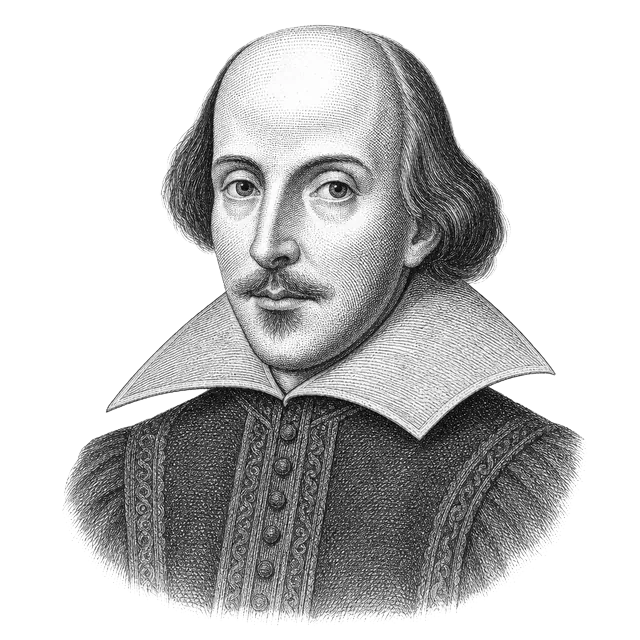
William Shakespeare
Actor, shareholder in his company and author of nearly forty plays, he still made his debut in print with a poem.
- Born
- 1564
- Stratford-upon-Avon, England
- Died
- April 23, 1616
- Stratford-upon-Avon, at 52
- First book
- Venus and Adonis
- 1593, at 29
- Success
- Venus and Adonis
- First book
A first book at 29, and it was a poem
Nobody knows the day he was born. The only record is the parish register of Holy Trinity in Stratford-upon-Avon, which notes his baptism in Latin on 26 April 1564; he was probably born a few days earlier, and by tradition his birthday is kept on 23 April. His father, John, was a glover who sat on the town council. William most likely attended Stratford's grammar school, where the teaching was mostly Latin, and left around 14 or 15.
His first book was not a play. On 18 April 1593 Richard Field, a Stratford-born printer working in London, entered Venus and Adonis in the Stationers' Register. By 12 June one Richard Stonley had noted in his diary that he had bought a copy. Shakespeare was 29. He dedicated the long narrative poem to the young Earl of Southampton and called it "the first heir of my invention". Only one copy of that first edition is known today.
Seven years without a trace, an attack, then the plague
In late 1582, aged 18, he married Anne Hathaway, who was 26 and pregnant with their daughter Susanna. The twins Hamnet and Judith were baptised on 2 February 1585. After that the trail goes cold. Nobody knows how he earned a living, when he left Stratford or how he got into the theatre, and biographers call the years from 1585 to 1592 the "lost years".
The first certain mention of him in London is an attack. In 1592 a pamphlet published under the name of the recently dead Robert Greene warned three playwrights against an actor turned writer, an "upstart Crow" who thought himself "the only Shake-scene in a country". The line mocks a verse from Henry VI, Part 3, so the play was already known to audiences. Henry Chettle, who had prepared the pamphlet, soon apologised to one of the writers it targeted and praised his honesty and his acting. Then, in 1593, plague closed the London theatres, and Shakespeare turned to poetry.
At 29, the most reprinted poem of his day
Shakespeare was already known in the theatre, but Venus and Adonis was what put his name into print. A second edition came out in 1594, a sign that the first had sold out or nearly so, and others followed in 1595, 1596 and 1599. No poetry in English went through more editions in his lifetime, and his contemporaries knew him first of all as the author of this poem. In 1594 he kept the promise made to the Earl of Southampton in his dedication, "some graver labour", with Lucrece.
That same year the first quarto editions of his plays appeared, and he became a founding member of the Lord Chamberlain's Men, at once actor, playwright and shareholder. In time his name became a selling point on title pages. In 1597, four years after his first book, he bought New Place, one of the largest houses in Stratford.
« The first heir of my invention. »
How he wrote
Shakespeare wrote for a company he part-owned, and for actors he knew: Richard Burbage, its leading man, played Richard III, Hamlet, Othello and Lear. According to the Shakespeare Birthplace Trust, he supplied it with about two plays a year for nearly twenty years. The company played at the Theatre, then from 1599 at the Globe, built from the first playhouse's timbers, and from 1609 in its own indoor theatre at Blackfriars. It also played at court, more often than any other company once it had become the King's Men under James I in 1603. His plots drew on what he had learned at school: Ovid, Terence, Plautus and Roman history.
He also wrote with others, as most playwrights of his time did. No manuscript of his plays survives, except perhaps a few pages of Sir Thomas More, a play by Anthony Munday and several collaborators. The British Library attributes to Shakespeare, "probably", the hand that wrote the insurrection scene, in which More pleads with a London crowd to spare the foreigners; you can watch him composing and correcting. The censor Edmund Tilney banned the play, which was probably never performed in its authors' lifetimes. Around 1613 Shakespeare also wrote The Two Noble Kinsmen with John Fletcher.
His life in brief
The eldest surviving child of John Shakespeare and Mary Arden, he grew up in the family house on Henley Street in Stratford. His son Hamnet died in 1596, aged 11. During his London years he seems to have lodged in the city on and off and travelled back and forth to Stratford, where he invested his money: New Place in 1597, 107 acres of land for £320 in 1602, a share in a lease of tithes for £440 in 1605. He retired to Stratford some time after 1611.
On 25 March 1616 he revised and signed his will, which left his wife his "second best bed". He died on 23 April 1616, aged 52 if the traditional birth date is right, of an unknown cause, and was buried in Holy Trinity Church. In 1623 two actors from his company, John Heminge and Henry Condell, gathered 36 of his plays in the First Folio. Eighteen were printed there for the first time, among them Macbeth, The Tempest and Julius Caesar; without that book they risked being lost.
What a writer today can take from it
- A first book can come late and by another road: Shakespeare had been writing for the stage for years when he published a poem at 29.
- If your usual outlet closes, try another form. When plague shut the theatres in 1593, he wrote the poem that became his first book.
- Write for voices you know. He knew which actor would play his parts, and he kept up a pace of two plays a year for his company.
- Leave your work with people who will stand up for it: without two actors from his company and the First Folio, half of his plays might not have survived.
The writing studio novelists were missing
Outline, characters, places and objects, the links between them, mind map, scene board, export: everything lives in one place. Plus an AI that knows your story, whenever you want one.
Free to write and to export. No credit card asked.
Sources
- Shakespeare Birthplace Trust, William Shakespeare Biography (read November 2, 2026)
- Folger Shakespeare Library, Shakespeare's life (read November 2, 2026)
- Royal Shakespeare Company, William Shakespeare's life and times (read November 2, 2026)
- Folger Shakespeare Library (Shakespeare Documented), Greenes, groats-worth of witte: First printed allusion to Shakespeare as a playwright (read November 2, 2026)
- Folger Shakespeare Library (Shakespeare Documented), Stationers' Register entry for Venus and Adonis (read November 2, 2026)
- Folger Shakespeare Library (Shakespeare Documented), Venus and Adonis, first edition (read November 2, 2026)
- Folger Shakespeare Library (Shakespeare Documented), Poetry in print (read November 2, 2026)
- Folger Shakespeare Library (Shakespeare Documented), Field, Richard, 1561-1616 (read November 2, 2026)
- Folger Shakespeare Library (Shakespeare Documented), Playwright, actor & shareholder (read November 2, 2026)
- Folger Shakespeare Library, Venus and Adonis: Dedication (read November 2, 2026)
- Folger Shakespeare Library, Shakespeare First Folio (read November 2, 2026)
- Folger Shakespeare Library (The Collation), Four states of Shakespeare: the Droeshout portrait (read November 2, 2026)
- British Library, Shakespeare's only surviving playscript now online (read November 2, 2026)