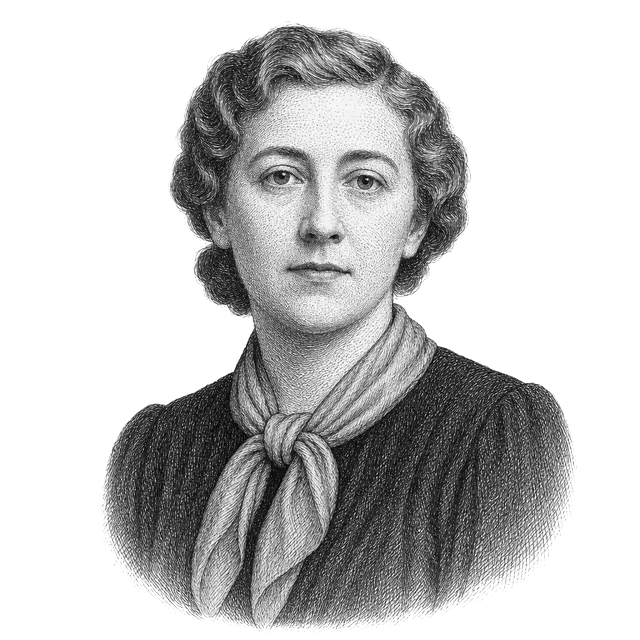
Agatha Christie
Novelist and playwright, she learned about poisons in a hospital dispensary and built every puzzle starting from its solution.
- Born
- September 15, 1890
- Torquay, Devon, England
- Died
- January 12, 1976
- Wallingford, Oxfordshire, at 85
- First book
- The Mysterious Affair at Styles
- 1920, at 30
- Success
- The Mysterious Affair at Styles
- First book
A first novel written in the dispensary, published at 30
Agatha Christie had been writing since childhood. Laid up in bed with influenza, she began, at her mother's suggestion, to write down the stories she liked to tell; at eleven a poem of hers appeared in a local newspaper, and by her late teens several of her poems had been published in The Poetry Review. She had also written a number of short stories.
During the First World War she nursed as a volunteer at the Red Cross hospital set up in Torquay Town Hall, and from 1915 she moved to the hospital dispensary. There she learned about poisons, and in 1917 she passed the examination of the Worshipful Society of Apothecaries. It was there, in the quiet hours, that she began a detective novel in 1916, the year she turned 26: her sister Madge had challenged her to write a mystery whose culprit the reader could not guess. The murder would be by poison, and her detective, Hercule Poirot, was suggested by the Belgian refugees then living in Torquay. When she found she could no longer concentrate, her mother advised her to take two weeks off, which she spent at the Moorland Hotel at Haytor on Dartmoor, where she finished the book. The Mysterious Affair at Styles came out in the United States in October 1920 and in Britain in January 1921. She was 30.
Several rejections, years of waiting, an ending to rewrite
Hodder & Stoughton sent the manuscript back. Other publishers turned it down in their turn (six in all, according to the Christie estate), and she ended up sending it to John Lane at The Bodley Head. Then nothing. By the time Lane finally asked to see her, the war was over, her husband Archie was home, and she had almost forgotten the book. Lane would publish it if she changed it: the last chapter had been a courtroom scene, and she agreed to rewrite it. An editor also insisted on spelling "cocoa" as "coco", and the beginner gave in. She signed the contract eagerly without paying much attention to its terms.
The book earned her £25 in all. Some four years had passed between finishing it and seeing it in print.
Noticed with the first book, established by Roger Ackroyd
The Mysterious Affair at Styles was well reviewed. One reviewer remarked that, though this might be Miss Christie's first published book, she already showed the cunning of an old hand. The novel introduced both Agatha Christie and Hercule Poirot to the literary world, and the Pharmaceutical Journal went on to review one of her books, a sign that her poisons held up. In 1935 it was among the first ten Penguin paperbacks.
The real turning point came six years after Styles. The Murder of Roger Ackroyd, in 1926, sold strongly and, according to the Christie estate, defined her career. It was also the first of her novels published in France, by Éditions du Masque, in 1927.
How she wrote
Christie started with the plot and built the characters around the solution. For Styles she "found" her murderer on a Torquay tram, and at the Moorland Hotel she acted out her chapters aloud on long walks. All her life she kept notebooks of ideas, plots and characters, along with what the newspapers said about poisons, drugs and swindles; she usually had about six on the go, more than a hundred in all, of which 73 survive. Most of the work happened in her head and in those notebooks before she wrote a word, and many plots never reached print. Ideas came to her anywhere, walking down the street or looking into a hat shop window.
She never shut herself away to write, her son-in-law recalled. She worked wherever she happened to be: on her second husband's archaeological digs she wrote in the mornings and helped with the finds in the afternoons, and at Nimrud a room was set aside for her. She dictated her books into a Dictaphone, a secretary typed them, and she corrected the typescript by hand. In the 1950s a novel took her about two months to write and one month to revise, and for tax reasons she aimed at roughly one novel a year. In the evenings she read finished chapters to family and guests, who tried to guess the culprit. The dispensary never left her: she once caught a pharmacist's dangerous dosing error, and that man, who carried curare in his pocket, gave her a character in The Pale Horse.
Her life in brief
Agatha Mary Clarissa Miller was born on 15 September 1890 in Torquay, Devon, and grew up at Ashfield, a Victorian villa. Her father taught her at home, and she taught herself to read at about five. He died in 1901, when she was eleven. After a short spell at a school in Torquay, her mother took her to Paris, where she attended several boarding schools and took piano and singing lessons; she came out in society in Cairo in 1910. On 24 December 1914 she married Archie Christie, whom she divorced in 1928. On 11 September 1930, in Edinburgh, she married the archaeologist Max Mallowan.
In 1934 the couple bought Winterbrook House in Wallingford, on the Thames, where many of her books and plays were written or finished. In 1938 she bought Greenway on the River Dart, a holiday home where she did not write but which inspired three of her novels. In the Second World War she worked again as a dispenser, at University College Hospital in London. As Mary Westmacott she published six non-detective novels from 1928, and the secret held for almost twenty years. The Mousetrap opened in Nottingham in October 1952 before moving to the West End; in 1954 she became the only playwright with three productions running there at once. She wrote Endless Night at 76 and kept writing until about a year before her death. She died at Winterbrook House on 12 January 1976, aged 85, and that day the West End theatres dimmed their lights for an hour. She left 66 detective novels and 14 short story collections.
What a writer today can take from it
- Write with what your job teaches you: the Torquay dispensary gave Christie her poisons, her first murder and a character in The Pale Horse.
- Start from the solution. Christie settled the culprit and the clues in her notebooks before writing the first line.
- Keep an ideas notebook open at all times: she had about six on the go, fed by news items, overheard names and shop windows.
- Read your text aloud to someone. Christie acted out her chapters on walks, then read them after dinner to people whose job was to guess the culprit.
The writing studio novelists were missing
Outline, characters, places and objects, the links between them, mind map, scene board, export: everything lives in one place. Plus an AI that knows your story, whenever you want one.
Free to write and to export. No credit card asked.
Sources
- Agatha Christie Limited, About Christie (read November 2, 2026)
- Agatha Christie Limited, How Christie Wrote (read November 2, 2026)
- Agatha Christie Limited, Book of the Month: The Mysterious Affair at Styles (read November 2, 2026)
- Agatha Christie Limited, The Mysterious Affair at Styles (read November 2, 2026)
- Agatha Christie Limited, 100 Facts about Agatha Christie (read November 2, 2026)
- Agatha Christie Limited, Christie's Devon (read November 2, 2026)
- Agatha Christie Limited, Christie's Wallingford (read November 2, 2026)
- English Riviera (Torbay tourism), Agatha Christie Literary Trail (read November 2, 2026)