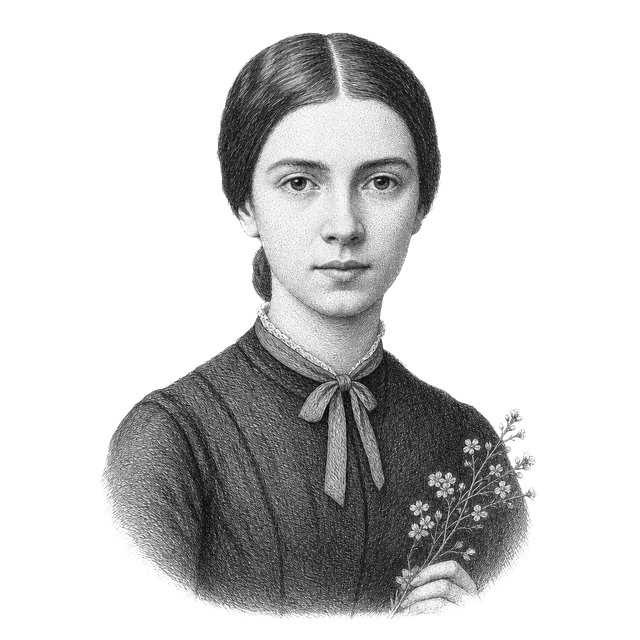
Emily Dickinson
A poet of Amherst who wrote almost 1,800 poems and saw only about ten in print, none under her name.
- Born
- December 10, 1830
- Amherst, Massachusetts, United States
- Died
- May 15, 1886
- Amherst, at 55
- First book
- Poems
- 1890, published posthumously
- Success
- Poems
- First book
A first book four years after her death
Emily Dickinson was born on 10 December 1830 in the family Homestead on Main Street in Amherst, Massachusetts, the middle of the three children of Edward Dickinson, a lawyer and politician. She spent about seven years at Amherst Academy, then a year at Mount Holyoke Female Seminary from 1847. In her early twenties writing grew more and more important to her: in a letter to her brother Austin, who was trying his hand at verse, she joked that he was infringing her patent.
Her first printed pieces were two valentines, published without her name: a letter in The Indicator, the Amherst College student paper, in February 1850, and a poem in the Springfield Daily Republican on 20 February 1852. In her lifetime ten poems in all appeared in newspapers, all anonymous and, scholars believe, without her consent. Only one reached a book, an anonymous anthology in 1878. Her first collection, Poems, came out from Roberts Brothers in Boston on 12 November 1890. She had been dead four years; she would have been 59.
Advice to wait, and a poet who did not want to print
In April 1862 Thomas Wentworth Higginson published "Letter to a Young Contributor" in the Atlantic Monthly, encouraging beginners to write and publish. On 15 April Emily Dickinson, aged 31, sent him four poems and a single question: was her verse alive? Higginson suggested she delay publishing. On 7 June she replied that she smiled at the idea, publishing being as foreign to her thought "as Firmament to Fin", and asked him to be her "Preceptor". He remained one, without ever pressing her to publish.
In later years others insisted. The writer Helen Hunt Jackson wrote that she was a great poet and that it was a wrong to the day she lived in that she would not sing aloud; she managed to slip "Success is counted sweetest" into A Masque of Poets, an anonymous anthology published by Roberts Brothers in 1878. Its publisher, Thomas Niles, then raised the idea of a collection. She avoided giving an answer. No one knows why she would not publish; the Emily Dickinson Museum notes that her few comments on the subject are negative, like the phrase calling publication "the auction of the mind".
Forty booklets found after her death, and a success in 1890
When she died in 1886, Emily Dickinson was unknown as a poet outside a small circle. She left almost 1,800 poems and no instructions. Among her papers her sister Lavinia found forty sewn booklets she had never mentioned, and resolved that the poems must be published. She turned first to their sister-in-law Susan, then to Higginson, and finally gave the work to Mabel Loomis Todd, the wife of an Amherst College professor, who persuaded Higginson to co-edit.
Poems came out from Roberts Brothers on 12 November 1890. The editors had regularized the punctuation, added titles and sometimes altered words to improve rhyme or sense. The book was well received by critics and the public alike, and that success settled what came next: a second series on 19 November 1891, two volumes of letters in 1894, a third series in 1896. Only in 1955, with Thomas H. Johnson's edition, did readers get all the poems as she had written them, taken from the manuscripts.
« Are you too deeply occupied to say if my Verse is alive? »
How she wrote
She jotted down ideas wherever they came, in the kitchen or outdoors, on envelopes and scraps of paper, in pen or in pencil. The formal writing was done in her bedroom, the southwest corner room on the second floor of the Homestead, at a small work table with a single drawer, often late into the night. Her niece Martha also remembered her writing at the little table in the dining room, from which she could watch the plants in her conservatory. Her cousin Louisa recalled hearing her read poems in the pantry while she skimmed the milk.
Between 1858 and 1865 she wrote hundreds of poems: by 35 she had composed more than 1,100. She copied about 800 of them into forty small booklets she made herself, folded sheets stacked, pierced with two holes on the left side and tied with string. She showed them to no one. Instead she shared some 500 poems in letters with more than forty correspondents, over 250 of them to her sister-in-law Susan and about 100 to Higginson. Later she stopped assembling booklets and left mostly loose sheets and fragments.
Her life in brief
Emily Dickinson lived almost her whole life in Amherst. At nine she moved with her family to a house on North Pleasant Street, near the town cemetery; in late 1855 they returned to the Homestead, which her father had bought back. In 1856 her brother Austin married her friend Susan Gilbert, and the couple built the house next door, The Evergreens. In 1864 and 1865, under treatment in Boston for an eye condition, she boarded with her Norcross cousins; those were her last trips. Afterwards she rarely left the grounds, though she received a few visitors, among them Higginson, on 16 August 1870 and again on 3 December 1873. She never married.
Her last years were marked by loss: her father in 1874, her mother in 1882, her nephew Gilbert in 1883, Judge Otis Lord, whom she had considered marrying, in 1884. She died at home on 15 May 1886, aged 55. Her death certificate gives Bright's disease; recent research points instead to severe hypertension. Her manuscripts are held today mainly at Amherst College and at Harvard University's Houghton Library.
What a writer today can take from it
- Keep what you write where you can find it again. Her forty sewn booklets are what let her sister publish the poems four years after her death.
- Catch the idea where it comes, even on an envelope, then work it at your desk. Dickinson did both, and kept her bedroom for the real work.
- To get useful feedback, ask a precise question. She asked Higginson only whether her verse was alive, and the bond lasted to the end.
- Keep your manuscripts: in 1955 it took a return to the originals to read her poems without her first editors' changes.
The writing studio novelists were missing
Outline, characters, places and objects, the links between them, mind map, scene board, export: everything lives in one place. Plus an AI that knows your story, whenever you want one.
Free to write and to export. No credit card asked.
Sources
- Emily Dickinson Museum, 1830-1855: Childhood and Youth (read November 2, 2026)
- Emily Dickinson Museum, 1855-1865: The Writing Years (read November 2, 2026)
- Emily Dickinson Museum, 1865-1886: The Later Years (read November 2, 2026)
- Emily Dickinson Museum, The Poet at Work (read November 2, 2026)
- Emily Dickinson Museum, The Manuscripts (read November 2, 2026)
- Emily Dickinson Museum, Publications in Dickinson's Lifetime (read November 2, 2026)
- Emily Dickinson Museum, The Publication Question (read November 2, 2026)
- Emily Dickinson Museum, The Posthumous Discovery of Dickinson's Poems (read November 2, 2026)
- Emily Dickinson Museum, FAQs (read November 2, 2026)
- Emily Dickinson Museum, Thomas Wentworth Higginson (read November 2, 2026)
- Emily Dickinson Museum, Dickinson at Sixteen (daguerreotype, 1847) (read November 2, 2026)
- Amherst College Archives and Special Collections, Emily Dickinson Collection, finding aid and chronology (read November 2, 2026)
- Dickinson Electronic Archives, Letter 260 to Thomas Wentworth Higginson, 15 April 1862 (read November 2, 2026)
- Dickinson Electronic Archives, Letter 265 to Thomas Wentworth Higginson, 7 June 1862 (read November 2, 2026)