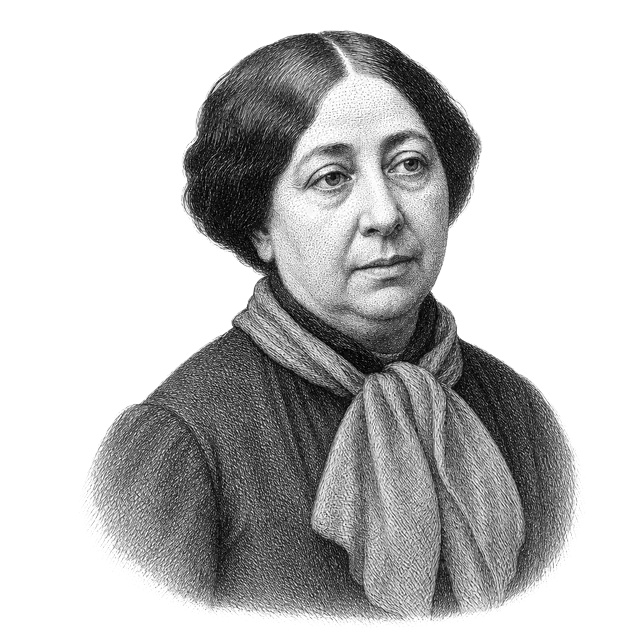
George Sand
Novelist, journalist and letter writer, she lived by her pen and wrote through the night for years.
- Born
- July 1, 1804
- Paris
- Died
- June 8, 1876
- Nohant, France, at 71
- First book
- Rose et Blanche
- 1831, at 27
- Success
- Indiana
- 1832, at 27
A first novel written with someone else, at 27
Aurore Dupin was born in Paris on 1 July 1804 and grew up at Nohant, in the Berry, in her grandmother's house. Married in 1822 to Baron Casimir Dudevant, she left Nohant for Paris in 1831 with her lover, the writer Jules Sandeau. She needed an income and thought of painting snuffboxes, or of living by her pen.
With Sandeau she wrote Rose et Blanche, which came out in December 1831 under a shared pseudonym taken from his surname. She was 27. The book caught the critics' attention. In February 1832 she told her mother that she had not written it alone, and that she had let some jokes through to please the publisher, who wanted something a little racy.
A manuscript called implausible, seven francs a column
On 4 March 1831 she wrote to Jules Boucoiran that she had had "no success". The readers she had shown her first manuscript to found it implausible, too moral to please the public. The Revue de Paris accepted her but kept her waiting, with established names going first. In a January letter she had already explained that the review's editor would not hear of women, and that Sandeau's name would appear there instead.
Meanwhile she had to eat. Henri de Latouche took her onto Le Figaro, where she wrote pieces at seven francs a column, shut in the office from nine in the morning to five in the afternoon. Latouche cut her copy as he saw fit. She put up with it, because the paper fed her and taught her to observe.
Indiana, the first book she wrote alone
In February 1832 she told her mother that the book she was now writing would owe nothing to her collaborators except the name. That book was Indiana, published in May 1832 by Roret and Dupuy. She was 27. The pen name George Sand was born with this first novel written alone, and she kept it for everything that followed.
The success caught her off guard. "The success of Indiana frightens me a great deal," she wrote to Charles Duvernet on 6 July 1832: she had thought she was working without consequence. Now she had to keep up. Valentine came out the same year and Lélia in 1833, three novels in fifteen months that made her famous, and the third caused a scandal.
« The success of Indiana frightens me a great deal. »
How she wrote
Her letters say it plainly. To her son Maurice in December 1835: "I work every night until seven in the morning." In August 1841, behind with her editor Buloz, she kept herself awake on coffee and cigarettes to finish her stint around three in the morning. In September 1845 she wrote that she had given up night work six months earlier for her health, while missing the deep calm that reigns from midnight to four.
She wrote most of her work at Nohant, bound by contract to newspapers, reviews and publishers. In 1856, her hand stiff with fatigue, she changed her handwriting in the middle of a letter, to a more upright, rounder script that let her write faster. She only put down her pen in June 1876, on the eve of her death.
Her life in brief
She first came to Nohant aged four, in 1808, the year her father died, and inherited it in 1821 when her grandmother died. She had two children, Maurice (1823) and Solange (1828), and obtained a legal separation from her husband in 1836. Frédéric Chopin was her companion for nine years, and Liszt, Balzac, Delacroix and Flaubert all stayed at Nohant. She threw herself into the 1848 revolution, published Story of My Life in 1854 and had a triumph at the Odéon in 1864 with Le Marquis de Villemer.
She died at Nohant on 8 June 1876, aged 71, and is buried in the family cemetery beside the garden. She left more than seventy novels, plays, essays and thousands of letters. The French state took ownership of the house in 1952.
What a writer today can take from it
- A day job can pay for the novel: Sand wrote for Le Figaro at seven francs a column while a review kept her waiting.
- A first book written with someone else can be an apprenticeship: the next one, written alone, gave her a name.
- Protect a stretch of quiet: she wrote from midnight to dawn, then changed her hours when her health demanded it.
- Fit the tool to the body: in 1856 she changed her handwriting to spare her hand and write faster.
The writing studio novelists were missing
Outline, characters, places and objects, the links between them, mind map, scene board, export: everything lives in one place. Plus an AI that knows your story, whenever you want one.
Free to write and to export. No credit card asked.
Sources
- Centre des monuments nationaux (Maison de George Sand à Nohant), Histoire du domaine de George Sand (read November 2, 2026)
- Centre des monuments nationaux (Maison de George Sand à Nohant), Les multiples talents de George Sand (read November 2, 2026)
- Centre des monuments nationaux (Maison de George Sand à Nohant), Qui était George Sand ? (dates clés) (read November 2, 2026)
- Encyclopædia Universalis, SAND George (1804-1876) : les apprentissages littéraires (read November 2, 2026)
- Ville de Paris, Une balade sur les pas de George Sand (read November 2, 2026)
- Project Gutenberg, George Sand, Correspondance 1812-1876, tome 1 (lettres du 19 janvier 1831, 4 mars 1831, 22 février 1832, 6 juillet 1832, 10 décembre 1835) (read November 2, 2026)
- Project Gutenberg, George Sand, Correspondance 1812-1876, tome 2 (lettres du 13 août 1841 et du 12 septembre 1845) (read November 2, 2026)
- Delphi Classics, Collected Works of George Sand (extrait : présentation d'Indiana) (read November 2, 2026)
- France Today, Celebrating George Sand (read November 2, 2026)