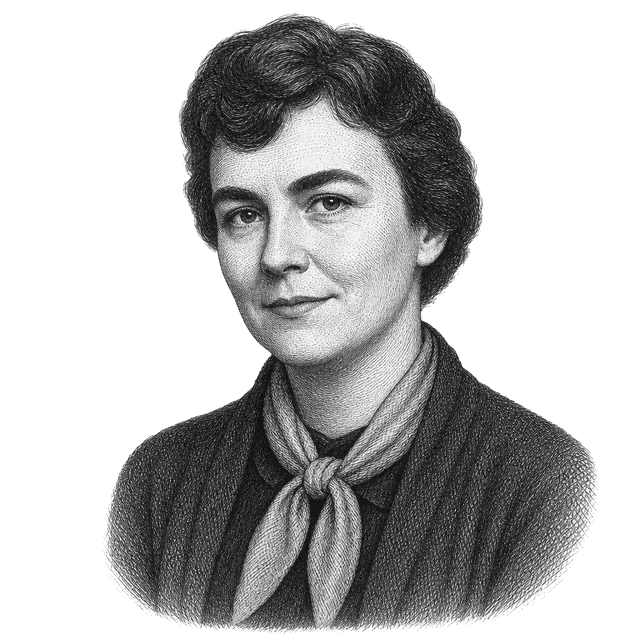
Harper Lee
A novelist of one book in her lifetime, which she rewrote for about two years before it won the Pulitzer Prize.
- Born
- April 28, 1926
- Monroeville, Alabama, United States
- Died
- February 19, 2016
- Monroeville, Alabama, at 89
- First book
- To Kill a Mockingbird
- 1960, at 34
- Success
- To Kill a Mockingbird
- First book
A first novel at 34, after years of odd jobs
Nelle Harper Lee was born on April 28, 1926, in Monroeville, Alabama, the youngest of four children of Amasa Coleman Lee, a lawyer who also published the town newspaper, and Frances Finch. Her first name was her grandmother's spelled backward. Her childhood neighbor was Truman Capote: when Nelle's father gave them an old Underwood typewriter, the two children began writing stories of their own. In high school an English teacher, Gladys Watson Burkett, gave her demanding books to read and taught her the discipline of writing well.
At the University of Alabama she went into law, which she loathed, and found a home at the campus paper instead; she became editor-in-chief of the Rammer Jammer, a humor quarterly. In 1949 she left without a degree and moved to New York. She worked briefly in a bookstore, then as an airline reservations clerk, and she wrote at night. The only novel she published in her lifetime, To Kill a Mockingbird, came out from J. B. Lippincott on July 11, 1960. She was 34. For the cover she chose "Harper Lee" so that no one would call her "Nellie".
A year given as a gift, then drafts written and torn up
Her airline job left her little time off, not even enough to go home to Alabama for Christmas. On Christmas Day 1956, at the New York apartment of her friends Michael and Joy Brown, she found an envelope with her name on it tucked in the tree. It held enough money for her to quit her job and write full time for a year. Lee told the story of that Christmas in an essay published by McCall's in December 1961.
Things then moved quickly: she found an agent, Maurice Crain, finished a manuscript, and by June 1957 J. B. Lippincott had taken it. The novel was not ready yet. According to the National Endowment for the Arts' Big Read, it still read more like a string of stories than the novel she had in mind. Her agent and her editor, Tay Hohoff, recommended revisions, and there began what she later described to The New York Times as a period of writing the novel over and over again. The deaths of her mother and then her brother interrupted the work. Writing in 1967, Tay Hohoff remembered an author living on next to nothing, in real physical discomfort, writing and tearing up pages for months without a word of complaint. The manuscript was finished in 1959.
At 34, a first novel that won the Pulitzer Prize
Even before publication on July 11, 1960, four national mail-order book clubs had chosen the novel for their readers, which the National Endowment for the Arts calls unprecedented. Reviews were highly favorable; the book climbed the bestseller lists fast and stayed there for well over a year and a half. In 1961 it won the Pulitzer Prize for fiction.
The film version opened on Christmas Day 1962, with Gregory Peck as Atticus Finch, and won three Academy Awards. Lee had turned down an offer to write the screenplay, saying she wanted to work on new fiction. The novel has since sold more than thirty million copies in forty languages, and half a century after it came out it was still selling nearly a million copies a year.
How she wrote
In her ticket-desk years Lee wrote at night, after a day job that asked little of her mind. The novel grew from what she knew: Maycomb is modeled on Monroeville, her hometown. Before he turned to title law, A. C. Lee had unsuccessfully defended two Black men, a father and son, accused of murdering a white storekeeper; both were hanged. For a long time the book in progress was called Atticus, after a friend of Cicero known for his wisdom.
The real work was rewriting. An early version, Go Set a Watchman, showed Scout as an adult coming home to Maycomb. Tay Hohoff asked her to tell the story from the child's point of view, and Lee rebuilt the book around the children. That set-aside draft was published, unrevised, on July 14, 2015, the year before her death. Lee said she wanted to chronicle the vanishing life of small Southern towns, the way Jane Austen had chronicled her own world.
Her life in brief
After Huntingdon College in Montgomery (1944–1945) and the University of Alabama, Lee lived in New York from 1949. In 1959 she went with Truman Capote to Kansas to help him report on the murder of the Clutter family; In Cold Blood, published in 1966, is dedicated to her. In the early 1960s she published a few essays, then almost nothing more: she later said the first book had taken enough of her life and her family's. By 1966 she had stopped speaking to the press.
She received the Presidential Medal of Freedom in 2007 and the National Medal of Arts, presented in 2011. After a stroke in 2007 she moved to an assisted living residence in Monroeville. She died there on February 19, 2016, aged 89, and is buried in Hillcrest Cemetery. The Old Courthouse in Monroeville, a National Historic Landmark since 2021, now houses the Monroe County Heritage Museum, with one exhibit on Harper Lee and another on Truman Capote.
What a writer today can take from it
- A day job that leaves your mind fresh keeps your evenings free: Lee wrote for years after her shifts at the ticket desk.
- If you are given time, or can give it to yourself, put a limit on it. Her friends' year was enough to find an agent, finish a manuscript and sign with a publisher.
- A contract is not the end of the work. After Lippincott took the book in June 1957, it still took about two years of rewriting to make it a novel.
- When a story will not hold together, try another point of view. Telling it through the child's eyes instead of the adult's turned a string of episodes into a book.
The writing studio novelists were missing
Outline, characters, places and objects, the links between them, mind map, scene board, export: everything lives in one place. Plus an AI that knows your story, whenever you want one.
Free to write and to export. No credit card asked.
Sources
- Encyclopedia of Alabama, Harper Lee (Nancy G. Anderson, Auburn University at Montgomery) (read November 2, 2026)
- National Endowment for the Arts (NEA Big Read), Reader Resources: To Kill a Mockingbird by Harper Lee (read November 2, 2026)
- PBS, American Masters, Harper Lee: Hey, Boo (press biography) (read November 2, 2026)
- WNYC (New York Public Radio), Harper Lee And The Gift That Saved 'To Kill A Mockingbird' (read November 2, 2026)
- Publishers Weekly, Harper Lee to Publish Sophomore Novel (read November 2, 2026)
- Monroe County Heritage Museum (Monroeville), Monroe County Museum (read November 2, 2026)