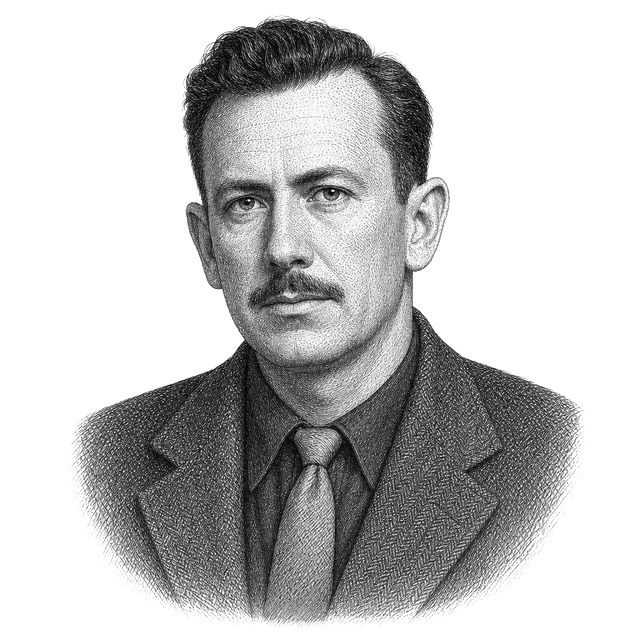
John Steinbeck
Novelist of the Salinas Valley and of farm workers, he kept a working journal beside his novels all his life.
- Born
- February 27, 1902
- Salinas, California, United States
- Died
- December 20, 1968
- New York City, at 66
- First book
- Cup of Gold
- 1929, at 27
- Success
- Tortilla Flat
- 1935, at 33
A first novel at 27, written through the winters at Lake Tahoe
John Steinbeck was born in Salinas, California, on 27 February 1902, the third of four children and the only son. His father managed a flour mill, later ran a feed store and became Monterey County treasurer; his mother was a former schoolteacher who steered her children toward books. At 14 he decided to be a writer and spent hours writing stories and poems in his upstairs bedroom. In high school a teacher read his work aloud to the class as an example, which embarrassed him as much as it encouraged him.
At Stanford, which he entered in 1919, he took only the courses he cared about: literature, writing and some science. He read his stories at the English Club, dropped out at times to work on ranches, and left in 1925 without a degree. He went to New York, worked as a construction laborer and briefly as a reporter for the New York American. He could not make a living as a freelance writer and went back to California. In the late 1920s, as caretaker of an estate on Lake Tahoe, alone in his cabin through the long winters, he wrote several drafts of a novel about the pirate Henry Morgan. Cup of Gold came out in August 1929 from Robert M. McBride in New York. He was 27.
Three books, three publishers, and a borrowed cottage
The following summer, working at a fish hatchery on Lake Tahoe, he met Carol Henning. They married on 14 January 1930 and lived in Los Angeles until the money ran out. Then they moved, rent-free, into the Steinbeck family's small summer cottage in Pacific Grove. Carol took one secretarial job after another to support them while he wrote as much as he could. The National Steinbeck Center sums up those years: poverty, and a sense that his career as a writer might never happen.
Each of his next books went to a different house. The Pastures of Heaven came out in October 1932 from Brewer, Warren and Putnam; To a God Unknown, his second novel written but third published, appeared in September 1933 from Robert O. Ballou. His mother died in February 1934, his father in May 1935. Carol did more than pay the bills: she edited his prose, made him cut the Latinate phrases, typed his manuscripts, suggested titles and ways to restructure a book.
At 33, Tortilla Flat and an editor for life
On 28 May 1935 Tortilla Flat came out from Covici-Friede in New York. These comic tales of Monterey's paisanos, built on the pattern of the Arthurian legends though most readers missed it, were his first popular success. Steinbeck was 33. The Nobel Foundation's biography notes that this was the book that first made him widely known. Money started to come in, and the critics followed. It was also his first book with Pascal Covici, who remained his editor and friend until Covici's death in 1964, When Covici-Friede went bankrupt, Covici joined Viking, which published Steinbeck's books from then on.
Things moved fast after that. In Dubious Battle came out in 1936, Of Mice and Men on 6 February 1937, and the play made from it ran for 207 performances on Broadway. The Grapes of Wrath, published by Viking in April 1939, sold out an advance printing of 19,804 copies by mid-April, was selling 10,000 a week by early May, and won the Pulitzer Prize in 1940. It was attacked as well: Kern County, California, banned it well into the war years.
How he wrote
Steinbeck kept a working journal beside his books, from To a God Unknown to the end of his life. For The Grapes of Wrath he spent two years on research trips among migrant workers, then wrote the novel in a single burst, from June to October 1938. The journal he kept while writing it was published in 1989 as Working Days. He liked to call his books "experiments": Of Mice and Men was designed both as a short novel and as the script of a play.
For East of Eden, from 29 January to 1 November 1951, he wrote in a large notebook: on the left-hand page, every working day, a letter to his editor Pascal Covici; on the facing right-hand page, the novel. The letters were his warm-up before the day's writing, the way a pitcher loosens his arm before a game. In them he wrote about his sons, about the plot, about trial runs at craft, and even about the quality and durability of his pencils. They were published after his death, in 1969, as Journal of a Novel.
His life in brief
Steinbeck separated from Carol in 1941; the divorce became final in 1943, the year he married Gwyn Conger, with whom he had two sons, Thom (1944) and John (1946). That same year, 1943, he went to Europe and North Africa as a war correspondent for the New York Herald Tribune. On his return he wrote Cannery Row (1945). In 1948 his friend the marine biologist Ed Ricketts died in an accident, and Gwyn asked for a divorce. He married Elaine Scott in December 1950 and lived with her in New York.
East of Eden came out in September 1952. In 1960 he toured the United States with his poodle Charley, which gave Travels with Charley (1962). He was awarded the Nobel Prize in Literature in 1962. He died at home in New York City on 20 December 1968, aged 66.
What a writer today can take from it
- Keep a journal beside the manuscript. A few lines before you start, on what you mean to write today, are enough to get you going, as Steinbeck's letters to Covici did.
- Three books that went unnoticed, with three publishers, did not stop Steinbeck writing a fourth: success came at 33, with a lighter book than the ones before.
- Find a first reader who cuts. Carol made him drop the inflated phrases and typed his pages; Covici remained his editor until his death in 1964.
- Do the research before the draft. Two years of research among migrant workers let Steinbeck write The Grapes of Wrath in five months.
The writing studio novelists were missing
Outline, characters, places and objects, the links between them, mind map, scene board, export: everything lives in one place. Plus an AI that knows your story, whenever you want one.
Free to write and to export. No credit card asked.
Sources
- Martha Heasley Cox Center for Steinbeck Studies, San José State University, Chronology of Steinbeck's Life (read November 2, 2026)
- Martha Heasley Cox Center for Steinbeck Studies, San José State University, John Steinbeck, American Writer (Susan Shillinglaw) (read November 2, 2026)
- Martha Heasley Cox Center for Steinbeck Studies, San José State University, Homes and Locations (read November 2, 2026)
- National Steinbeck Center (Salinas), Learn: John Steinbeck Bio (read November 2, 2026)
- Stanford University Libraries, Special Collections (Online Archive of California), Wells Fargo Steinbeck Collection, 1892-1981 (read November 2, 2026)
- NobelPrize.org, John Steinbeck – Biographical (read November 2, 2026)
- Penguin Random House, Journal of a Novel: The East of Eden Letters (read November 2, 2026)
- Penguin Random House Canada, Working Days: The Journals of The Grapes of Wrath (read November 2, 2026)
- Kirkus Reviews, Journal of a Novel, by John Steinbeck (read November 2, 2026)