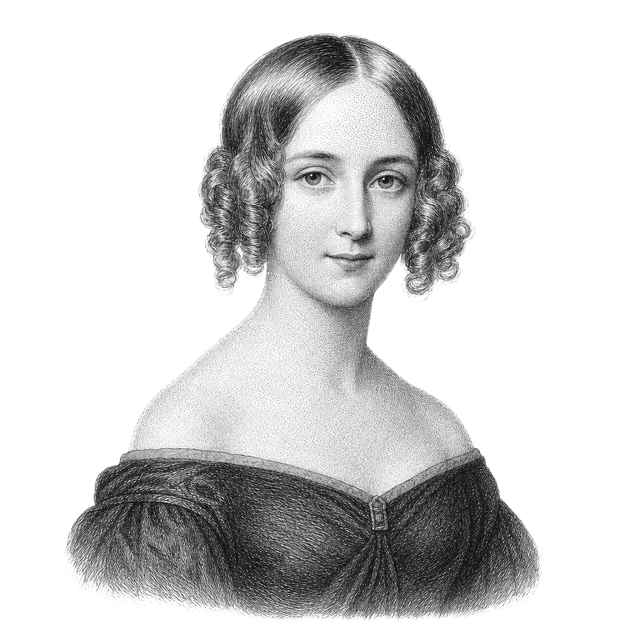
Mary Shelley
Novelist, biographer and editor, she began her first novel at 18 for a ghost-story contest.
- Born
- August 30, 1797
- London
- Died
- February 1, 1851
- London, at 53
- First book
- History of a Six Weeks' Tour
- 1817, at 20
- Success
- Frankenstein; or, The Modern Prometheus
- 1818, at 20
A first book written with Percy Shelley, drawn from a travel journal
Mary Wollstonecraft Godwin was born in London on 30 August 1797. Her parents were two famous writers, the philosopher William Godwin and Mary Wollstonecraft, who died a few days after her daughter's birth. Godwin and his second wife ran a children's bookshop and press, the Juvenile Library; the Victorian Web credits her with a comic poem it published, Mounseer Nongtongpaw.
In July 1814, aged 16, she left for the Continent with the poet Percy Bysshe Shelley, who was married, and her stepsister Claire Clairmont. The journey lasted six weeks, through France, Switzerland, Germany and Holland, and she kept its journal. Three years later she made a fair copy, added the letters written from Geneva in 1816, and the book came out on 6 November 1817 from Thomas Hookham and Charles and James Ollier: History of a Six Weeks' Tour, a work the Shelleys prepared together. She was 20. Her novel was already at the printer's.
Two publishers said no, the third took the novel for a third of the profits
The manuscript of Frankenstein, fair-copied in May 1817, went first to John Murray, Byron's publisher. On 26 May Mary noted in her journal that Murray liked it. He did not buy it, on the advice of his reader William Gifford, and the manuscript came back in June. On 3 August Percy Shelley sent it to his own publisher, Charles Ollier, presenting it as the work of "a friend" he did not name. Three days later he wrote that "Poor Mary's book came back with a refusal".
Lackington, a house that published books on the occult and on ghosts, accepted the novel in August or September 1817. Shelley asked for half the profits and settled for a third. Frankenstein came out early in 1818, with no author's name, in three volumes and an edition of 500 copies. Sixteen went to reviewers, six to the author. Once printing costs were deducted the profit came to £125, a third of which, £41 13s 10d, was due to the Shelleys.
A novel praised in 1818 under another name, then a stage hit in 1823
Reviewers were divided. In March 1818 Walter Scott praised it in Blackwood's Edinburgh Magazine as a tale of uncommon imagination written in plain and forcible English, but he credited it to Percy Shelley. The Quarterly Review called it a tissue of horrible and disgusting absurdity. On 14 June 1818 Mary wrote to Scott to set him right: it was a youthful attempt of her own, which she had left unsigned because of her age.
Real recognition came from the stage. On 28 July 1823 Richard Brinsley Peake's Presumption; or, The Fate of Frankenstein opened at the Lyceum in London and ran for 37 performances, and other adaptations followed that year. Godwin at once had a new edition of 500 copies printed, this time under the name Mary Wollstonecraft Shelley, with all the profits for her. Back from Italy on 25 August 1823, she went to see the play and wrote to Leigh Hunt, "lo & behold! I found myself famous!" She was 26.
« What terrified me will terrify others; and I need only describe the spectre which had haunted my midnight pillow. »
How she wrote
In June 1816, on Lake Geneva, rain kept the Shelleys and their holiday neighbours indoors: Byron, at the Villa Diodati, and his doctor John Polidori. Byron proposed that each of them write a ghost story. For several days Mary came up with nothing. According to her 1831 introduction, one night, after a talk on the principle of life, she saw in a waking dream a student kneeling beside the creature he had put together. The next day, around 17 June, she began with the words "It was on a dreary night of November". In the draft those words do not open the novel: they come later, in the chapter where the creature wakes. The short story of that summer grew into a novel.
The draft filled two large notebooks, from August or September 1816 to 17 April 1817; the fair copy for the printer then took less than a month. She poured her own life into it: a storm described in a letter from Geneva, the excursion to Chamonix recorded in her journal, Percy's diary of the boat trip on the lake. Percy read, corrected and added, more than 4,000 words according to the edition of the notebooks, and he wrote the preface. The idea and the first draft were hers.
After Percy drowned in 1822 she lived by her pen in England: journalism, travel writing, biography and five more novels, from Valperga (1823) to Falkner (1837). In 1839 she brought out the first edition of Shelley's poems, in four volumes, deciphering notebooks full of half-illegible fragments.
Her life in brief
Mary married Percy Shelley on 30 December 1816, after his first wife's suicide. Of the four children she bore between 1815 and 1819, only Percy Florence, born in Florence on 12 November 1819, survived: a premature daughter died soon after birth in 1815, Clara in Venice in 1818, William in Rome in 1819. In 1822 Percy set sail in his boat, the Don Juan, with Edward Williams; both men were found drowned.
She returned to England in 1823 and raised her son on a meagre allowance from her father-in-law, Sir Timothy Shelley, who threatened to stop it if she published more of his son's writings or an account of his life. In 1831 she revised Frankenstein for Colburn and Bentley's Standard Novels and added the introduction in which she tells the story of the summer of 1816. She died in London, at Chester Square, on 1 February 1851, aged 53.
What a writer today can take from it
- Start with the scene that haunts you, even if it is not the opening. Her first sentence was the creature waking, and the rest of the novel was built around it.
- A short story can turn into a novel. Hers, written for a game among friends in June 1816, filled three volumes ten months later.
- Keep your letters and notebooks: the storm, Chamonix and the lake in Frankenstein come straight from her travel journal.
- Two refusals say nothing about the book. Murray liked it and passed, Ollier sent it back within days, and the third publisher brought it out.
The writing studio novelists were missing
Outline, characters, places and objects, the links between them, mind map, scene board, export: everything lives in one place. Plus an AI that knows your story, whenever you want one.
Free to write and to export. No credit card asked.
Sources
- Bodleian Libraries (Shelley's Ghost, archived), Frankenstein: the origins, composition and publication of Mary Shelley's celebrated novel (read November 2, 2026)
- Bodleian Libraries (Shelley's Ghost, archived), Mary Shelley in England, 1822-51 (read November 2, 2026)
- Bodleian Libraries (Shelley's Ghost, archived), Mary Shelley, Editor (read November 2, 2026)
- Shelley-Godwin Archive, Charles E. Robinson: Introduction to The Frankenstein Notebooks (Garland, 1996) (read November 2, 2026)
- Shelley-Godwin Archive, Frankenstein Chronology (read November 2, 2026)
- Bodleian Libraries (Shelley's Ghost, archived), William Godwin & Mary Shelley (read November 2, 2026)
- Rare Books & Special Collections, University of Notre Dame, Recent Acquisition: First Edition Frankenstein (1818) (read November 2, 2026)
- The Victorian Web, Mary Wollstonecraft Shelley: A Biography (Charlotte Pabst-Kastner) (read November 2, 2026)