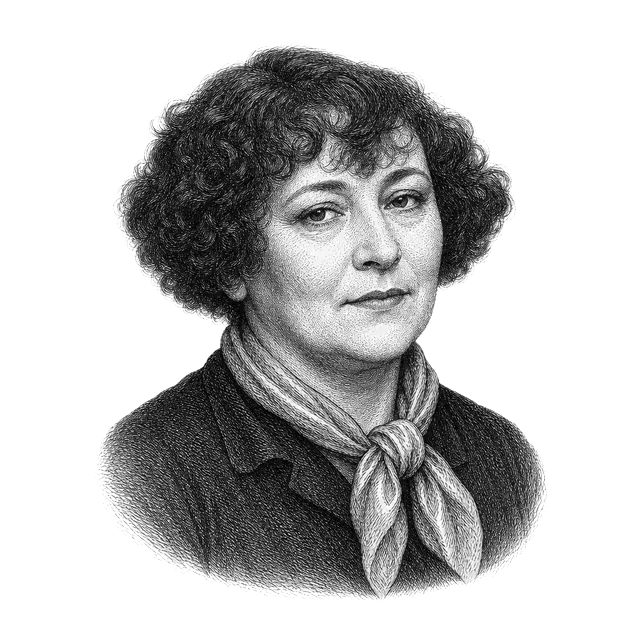
Colette
Novelist, journalist and mime, she wrote her first success under another man's name before making her own.
- Born
- January 28, 1873
- Saint-Sauveur-en-Puisaye, France
- Died
- August 3, 1954
- Paris, at 81
- First book
- Claudine at School
- 1900, at 27
- Success
- Claudine at School
- First book
A first novel signed by her husband
Sidonie Gabrielle Colette was born on 28 January 1873 in Saint-Sauveur-en-Puisaye, in Burgundy. She spent her first eighteen years there, until the family, in debt, moved to Châtillon-sur-Loing in the autumn of 1891. On 15 May 1893, aged 20, she married Henry Gauthier-Villars, known as Willy, a well-known music critic who also put his name to books written by others.
A year or eighteen months after the wedding, as she tells it in My Apprenticeships (1936), Willy suggested she write down her memories of school, racy details included, because money was short. That is how she wrote Claudine at School; the manuscript was reportedly finished in January 1896. The book went on sale around 20 March 1900 under Willy's name alone. Colette was 27.
A manuscript in a drawer, rights sold without her
The manuscript waited almost four years. According to Colette's own account, Willy put it away in a drawer and came across it again at the end of 1899; he is then said to have offered it, without success, to several publishers before Ollendorff brought it out.
The book sold, but it did not carry her name. In 1907 Willy sold the rights to the Claudine books to their publishers, and Colette only found out on 25 February 1909. On 19 March, after a two-hour conversation with him, it was agreed that the volumes would carry both signatures from then on, with a note to readers.
The Académie Goncourt kept her waiting a long time. Her name came up as early as 1917, and she received votes in 1924, 1926, 1929 and 1937 without being elected. Newspapers backed away too: the serialisation of The Ripening Seed in Le Matin in 1923, and of Ces plaisirs… in the weekly Grimoire in 1931, were both stopped after readers complained.
A success in 1900, her name later
Claudine at School was a great success from 1900, and the sales earned Willy enough to buy an estate near Besançon, Les Monts-Boucons. Three sequels followed in three years, from Claudine in Paris in March 1901 to Claudine and Annie in March 1903. Adapted for the stage, Claudine à Paris ran for 123 consecutive performances at the Bouffes-Parisiens from 22 January 1902.
Recognition under her own name came step by step. In March 1904, at 31, she signed Dialogues de bêtes, a short book of animal dialogues, as "Colette Willy"; it had a small print run but caught the eye of several critics, among them the poet Francis Jammes. In 1910 The Vagabond, written during her divorce, was noticed by the Goncourt jury, which gave that year's prize to Louis Pergaud. She did not sign her books with the name Colette alone until the early 1920s.
How she wrote
Colette wrote first of all from what she had lived. Claudine at School draws on the school at Saint-Sauveur, whose teacher, Olympe Terrain, became Mademoiselle Sergent. The Claudine manuscripts held by the Bibliothèque nationale show the two hands of Colette and Willy at work. For Break of Day (1928), she took her mother Sido's letters and reworked them.
She also wrote for the press, to fixed dates. On 2 December 1910 she gave Le Matin a first story signed only with a drawing of a mask, and dropped the anonymity on 27 January 1911. From December 1919 she was also its drama critic, going to opening nights once or twice a week. Chéri began as a play, around 1919, before she chose the novel, which let her paint its world more closely. For Pour un herbier (1949), the Lausanne publisher Mermod sent her flowers every week for a year, and she wrote a portrait of each.
From late 1938, arthritis of the hip gradually immobilised her. She went on writing from her flat at the Palais-Royal: The Blue Lantern, written from 1947 to 1949, was her last book.
Her life in brief
After separating from Willy in November 1906, Colette earned her living on stage, in mime, music hall and touring shows, while publishing La Retraite sentimentale (1907) and Les Vrilles de la vigne (1908). The divorce was granted on 21 June 1910. On 19 December 1912 she married Henry de Jouvenel, one of the editors of Le Matin; their daughter was born on 3 July 1913. They divorced in 1925, the year she met Maurice Goudeket, whom she married in 1935.
In January 1938 she moved into the first floor of 9 rue de Beaujolais, at the Palais-Royal in Paris, and never left. Elected unanimously to the Académie Goncourt on 2 May 1945, at 72, she became its president on 1 October 1949. She died on 3 August 1954, aged 81. She was given a state funeral without religious rites, the Church having refused them, and was buried at Père-Lachaise.
What a writer today can take from it
- A manuscript can sleep without being lost: Claudine at School, finished around 1896, sat in a drawer until 1900.
- Know who owns your rights: Willy sold those of the Claudine books in 1907, Colette found out two years later and had to negotiate to get her name on the cover.
- Your material is often right in front of you: her school, her childhood home, the music hall and her mother's letters all became books.
- Writing to fixed deadlines trains the hand: years of stories and reviews for Le Matin made her write short and write regularly.
The writing studio novelists were missing
Outline, characters, places and objects, the links between them, mind map, scene board, export: everything lives in one place. Plus an AI that knows your story, whenever you want one.
Free to write and to export. No credit card asked.
Sources
- Société des amis de Colette, Biographie (read November 2, 2026)
- Société des amis de Colette, Chronologie (read November 2, 2026)
- Société des amis de Colette, Dialogues de bêtes (read November 2, 2026)
- Société des amis de Colette, La Vagabonde (read November 2, 2026)
- Société des amis de Colette, Chéri (read November 2, 2026)
- Société des amis de Colette, Le Fanal bleu (read November 2, 2026)
- Société des amis de Colette, Lieux de vie (read November 2, 2026)
- La Maison de Colette (Saint-Sauveur-en-Puisaye), Une maison-livre (read November 2, 2026)
- Bibliothèque nationale de France, Les mondes de Colette (exposition) (read November 2, 2026)
- Livres Hebdo, Une exposition « Les mondes de Colette » à la BnF (read November 2, 2026)
- Ville de Paris, Une balade sur les pas de Sidonie devenue Colette (read November 2, 2026)