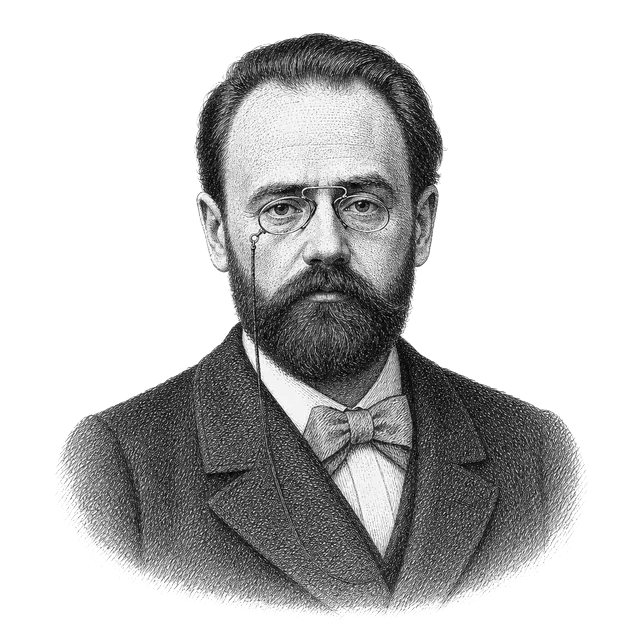
Émile Zola
Novelist and journalist, he prepared every book with an investigation and wrote it in the mornings, three hours a day.
- Born
- April 2, 1840
- Paris
- Died
- September 29, 1902
- Paris, at 62
- First book
- Stories for Ninon
- 1864, at 24
- Success
- Thérèse Raquin
- 1867, at 27
A first book written alongside a job
Émile Zola was born in Paris on 2 April 1840 and grew up in Aix-en-Provence, where his father, an engineer, was to build a canal. His father died in 1847 and the family fell on hard times. At the Collège Bourbon the boy became friends with Paul Cézanne. His first poems and stories appeared in 1859 in La Provence, the year he failed his baccalauréat.
Back in Paris, he gave up his studies and looked for a job that would leave him time to write. In 1862 he joined the publisher Hachette in a junior post and soon ran its publicity department, where he met Taine and Littré. During those years he published his first book, Contes à Ninon (Stories for Ninon), in 1864. He was 24, and the stories were still Romantic in spirit.
Lean years, a cut serial and a closed Academy
Before Hachette, around 1860, Zola lived a hand-to-mouth bohemian life, with no degree and no steady job. He left the publisher in 1866 to live by his pen, writing for several newspapers. Security only came in 1872, when the publisher Georges Charpentier offered him a long-term contract for his great cycle.
The setbacks kept coming. When L'Assommoir ran as a serial in Le Bien public in 1876, readers were outraged and publication stopped after the sixth chapter; it resumed in a literary review, La République des lettres. On stage, Les Héritiers Rabourdin was a half-failure in 1874 and Le Bouton de rose a complete flop in 1878. As for the Académie française, he stood nineteen times between 1890 and 1898 and was never elected.
Thérèse Raquin at 27, then L'Assommoir
Recognition came with Thérèse Raquin in 1867, his third novel, first serialised in L'Artiste and then published in book form by Lacroix. Zola was 27. The book found a wide readership and made him famous, but critics were split: in Le Figaro, Louis Ulbach called it "putrid literature". A year later Zola answered with a preface claiming a "scientific aim".
The real triumph came ten years later. L'Assommoir, the seventh volume of Les Rougon-Macquart, was published by Charpentier on 24 January 1877 amid success and scandal. It made Zola the leader of naturalism and gave him financial ease: in May 1878 he bought a house at Médan, on the Seine, for 9,000 francs.
« Literature paid for this modest country refuge. »
How he wrote
Zola wrote no line of a novel without a file. Each began with a sketch, the "ébauche", in which he worked out the plot by talking to himself ("I want", "don't forget"), followed by outlines, a sheet for each character, drawings of the places and investigation notes. The file for La Fortune des Rougon runs to 112 leaves, Germinal to 953, La Débâcle to 1,250. For L'Assommoir he walked the Goutte-d'Or district in the autumn of 1875; for Germinal he went down a mine shaft at Anzin.
His day was fixed: three hours of writing in the morning, the afternoon for journalism and letters. At Médan he had a tower built with a large study, and on the fireplace he had his motto painted, Nulla dies sine linea, "not a day without a line". The pace held: the twenty Rougon-Macquart novels came out between 1871 and 1893, about one a year.
His life in brief
Naturalised French on 31 October 1862, Zola married Alexandrine Meley on 31 May 1870. He conceived the Rougon-Macquart cycle, "the natural and social history of a family under the Second Empire", as early as 1868 and published its first volume in 1871. Médan, where he hosted Maupassant and Huysmans, gave its name to Les Soirées de Médan in 1880.
On 13 January 1898 he published "J'accuse…!" in L'Aurore in defence of Captain Dreyfus. Convicted of libel, he went into exile in England to avoid prison. He died of asphyxiation at home in Paris on the night of 28 to 29 September 1902, aged 62. His remains were moved to the Panthéon on 4 June 1908.
What a writer today can take from it
- A day job can feed the writing: at Hachette, Zola learned publicity, met authors and published his first book without leaving his post.
- Prepare before you draft: a sketch, a sheet per character, notes taken on the spot, and then the novel is written from that file.
- Three hours every morning were enough to keep up a novel a year for more than twenty years.
- A rejection doesn't stop a book: outraged readers cut short the serial of L'Assommoir, and the novel in book form made his fortune.
The writing studio novelists were missing
Outline, characters, places and objects, the links between them, mind map, scene board, export: everything lives in one place. Plus an AI that knows your story, whenever you want one.
Free to write and to export. No credit card asked.
Sources
- Larousse, Émile Zola (encyclopédie, personnage) (read November 2, 2026)
- Bibliothèque nationale de France, Émile Zola : chronologie (dossier pédagogique, Classes BnF) (read November 2, 2026)
- Bibliothèque nationale de France, Émile Zola : art de l'écrivain, art du peintre (dossier pédagogique, Classes BnF) (read November 2, 2026)
- BnF Essentiels, La méthode de Zola, écrivain naturaliste (read November 2, 2026)
- BnF Essentiels, L'Assommoir (read November 2, 2026)
- BnF Essentiels, Comment Zola écrit-il ? (vidéo) (read November 2, 2026)
- Maison Zola – Musée Dreyfus, Histoire de la maison (read November 2, 2026)
- Encyclopædia Universalis, Thérèse Raquin, Émile Zola (fiche de lecture) (read November 2, 2026)