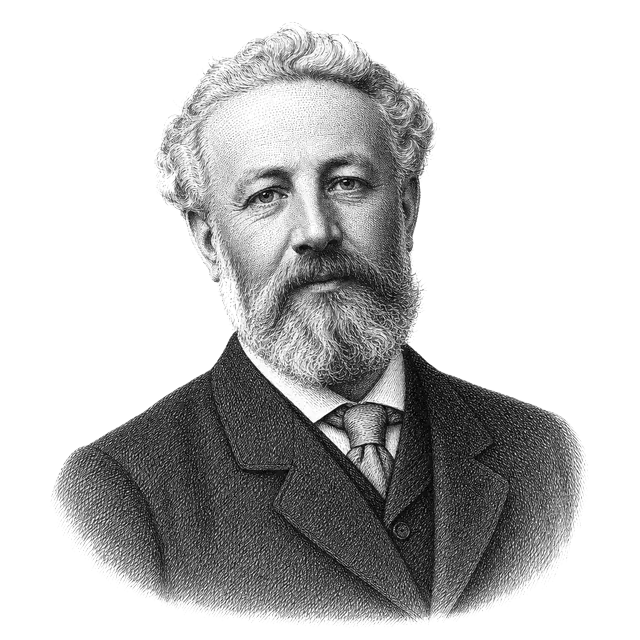
Jules Verne
Author of the Extraordinary Voyages, he wrote from five to eleven in the morning and corrected each novel over seven or eight sets of proofs.
- Born
- February 8, 1828
- Nantes, France
- Died
- March 24, 1905
- Amiens, at 77
- First book
- Five Weeks in a Balloon
- 1863, at 34
- Success
- Five Weeks in a Balloon
- First book
A first novel at 34, after the theatre
Jules Verne was born in Nantes on 8 February 1828, the son of a lawyer. As a teenager he filled two notebooks with poems that he kept all his life, and he later said he always had a pencil on him. When he went to Paris to finish his law degree, he already knew he would not take over his father's practice.
The theatre took him in first. Thanks to Alexandre Dumas, his verse comedy Les Pailles rompues was staged in Paris on 12 June 1850, when he was 22, and the text was printed the same year. Stories followed in the magazine Musée des familles from 1851, along with songs written for his friend, the composer Aristide Hignard. His first novel came twelve years later. On 23 October 1862 he signed with the publisher Pierre-Jules Hetzel, whom he had reached through the novelist Alfred de Bréhat, for a manuscript still called Voyage en l'air. It came out in January 1863 as Five Weeks in a Balloon. Verne was 34.
Years of odd jobs and a rejected novel
Before Hetzel, Verne lived on a small allowance from his father and on jobs taken for the money. His letters home mention the ragged shirts he wore to Paris salons. In 1852 he became secretary of the Théâtre-Lyrique, and in 1856 he joined a stockbroker, Eggly. By his own account he tried a few speculations on the Bourse and made no fortune.
Success did not end the refusals. Right after Five Weeks in a Balloon he wrote Paris in the Twentieth Century. Hetzel read it and turned it down, with harsh notes in the margin. Verne never reworked that manuscript and moved on to Journey to the Centre of the Earth. The text was found by his great-grandson Jean Verne in a family house in Toulon and published more than a century later. Even in 1893, at the height of his fame, Verne told the journalist Robert Sherard that his greatest regret was that, in his own view, he did not count in French literature.
Five Weeks in a Balloon, then one book after another
Five Weeks in a Balloon was an immediate success. The first printing was 2,000 copies; in Verne's lifetime it sold 76,000, a figure only Around the World in Eighty Days would beat, with 108,000.
Hetzel organised what came next. In 1864 Verne signed a contract committing him to two volumes a year, then three from 1865. He also became co-editor of the Magasin d'éducation et de récréation, the magazine where many of his novels first appeared. In July 1866 the series of Extraordinary Voyages was launched as a common title for his novels, past and future: it would run to 62 novels and 18 stories. Verne, who saw himself first as a playwright, also adapted Around the World, Michael Strogoff and The Children of Captain Grant for the stage, where they filled the Châtelet and the Porte-Saint-Martin for months.
How he wrote
In June 1893 Verne described his day to Robert Sherard: up before five, a little later in winter, he was at his desk by five and worked until eleven. He wrote slowly, until each sentence took the shape he wanted, and said he always had at least ten novels ahead in his head. His workroom in Amiens was a small bedroom with a camp bed and a table by the window, with the library next door. In the afternoon he read newspapers and reviews at a club in town.
Most of the work came afterwards, on the proofs. He asked for at least seven or eight sets and corrected each one, so that the last kept almost nothing of the first manuscript. His surviving manuscripts bear this out: the Bibliothèque nationale notes that they are covered in corrections, rewrites and revisions. Hetzel's pace weighed on him. Newly settled in Picardy, he signed a letter to his publisher "Votre bête de Somme", a pun on "beast of burden".
His life in brief
On 10 January 1857 Verne married Honorine, a young widow from Amiens he had met the year before, the mother of two daughters. Their son Michel was born on 3 August 1861. As soon as he could afford it, Verne bought a boat, the Saint-Michel, then two more; between 1878 and 1885 he cruised the Mediterranean aboard the Saint-Michel III.
After twenty years in Nantes and more than twenty in Paris, he settled in Amiens in 1871. Elected to the town council in 1888, he looked after the theatre. Hetzel died in 1886 and his son carried on publishing the Extraordinary Voyages; the contracts signed between the Vernes and the Hetzel house from 1862 to 1906 are now kept at the library in Amiens. Struck by cataracts in 1902, Verne went on writing. He died in Amiens on 24 March 1905, aged 77, leaving several novels unpublished.
What a writer today can take from it
- A first novel can come late: Verne published Five Weeks in a Balloon at 34, after twelve years of plays, stories and odd jobs.
- A pace written into a contract helps you produce: his committed him to two, then three volumes a year, and the series grew to 62 novels.
- The book is made in revision: Verne corrected over seven or eight sets of proofs, until the first draft had almost disappeared.
- A rejected manuscript does not stop a career: Hetzel turned down Paris in the Twentieth Century, and Verne moved on to Journey to the Centre of the Earth.
The writing studio novelists were missing
Outline, characters, places and objects, the links between them, mind map, scene board, export: everything lives in one place. Plus an AI that knows your story, whenever you want one.
Free to write and to export. No credit card asked.
Sources
- Musée Jules Verne de Nantes, Repères biographiques (read November 2, 2026)
- Cité des sciences et de l'industrie, « Jules Verne en 80 jours » : textes du site de l'événement (chronologie et entretiens) (read November 2, 2026)
- Cité des sciences et de l'industrie, Jules Verne : l'intégrale des œuvres romanesques (read November 2, 2026)
- Bibliothèque nationale de France (CCFr), Contrats entre Jules, Michel et Honorine Verne et la maison Hetzel, 1862-1906 (read November 2, 2026)
- Bibliothèque nationale de France, Jules Verne : ressources en ligne (read November 2, 2026)
- Jules Verne Collection (ibiblio), R. H. Sherard, « Jules Verne chez lui » (McClure's Magazine, janvier 1894), traduit par William Butcher (read November 2, 2026)