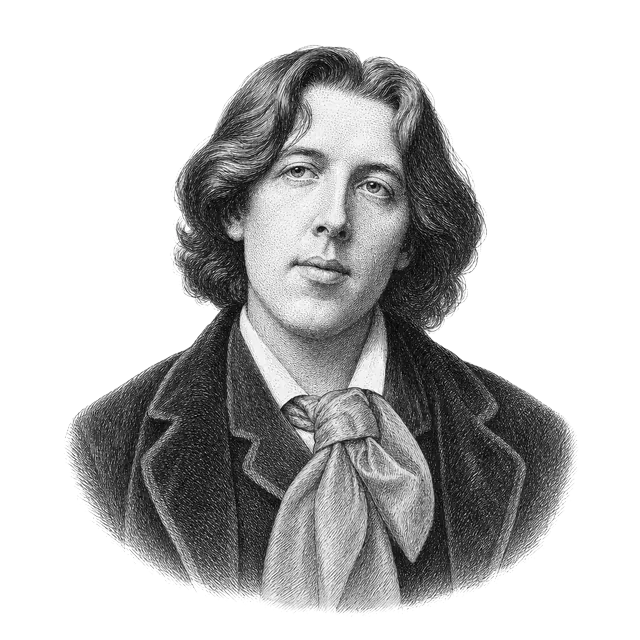
Oscar Wilde
Poet, storyteller, critic and writer of comedies, he paid to print his first book and only made money in the theatre.
- Born
- October 16, 1854
- Dublin, Ireland
- Died
- November 30, 1900
- Paris, at 46
- First book
- Poems
- 1881, at 26
- Success
- Lady Windermere's Fan
- 1892, at 37
A first book at 26, paid for out of his own pocket
Oscar Wilde was born on 16 October 1854 at 21 Westland Row, Dublin. His father, William Wilde, was a leading eye and ear surgeon; his mother, Jane, published poetry as Speranza and held a salon at 1 Merrion Square. He read classics at Trinity College from 1871 to 1874, winning the Berkeley Gold Medal, then spent four years at Magdalen College, Oxford, where his poem Ravenna won the Newdigate Prize in 1878.
Settled in London from 1879, he lived on lectures and articles. In May 1881 he wrote to the publisher David Bogue, and his Poems came out at the end of June, printed at his own expense. He was 26. The book was made as an object: handmade Dutch paper, white vellum binding scattered with gilt prunus blossoms. All 750 copies were printed at once, then released in three batches of 250 presented as three successive editions. In August he sent an inscribed copy to the Prince of Wales.
Fierce reviews and ten years of odd jobs
English critics gave Poems a cold welcome. The Saturday Review of 23 July 1881 found it marred everywhere by imitation, insincerity and bad taste, and Punch put it in a line: the poet was Wilde, but his poetry was tame. At the Oxford Union, which had asked him for a copy for its library, the undergraduate Oliver Elton argued that the poems belonged to better-known authors, and the society turned the book down by 188 votes to 180. Readers bought it anyway: the first batch sold out, and in New York a reviewer hailed a new English poet.
Poetry still did not pay. In 1882 he spent the whole year lecturing in the United States and Canada, on a tour set up to promote Patience, the comic opera that mocked the aesthetic movement. Back home he toured the English provinces with the same lectures. In Paris in 1883 he wrote a verse drama, The Duchess of Padua, which was not published until 1908. From 1885 he reviewed for the Pall Mall Gazette, and from 1887 to 1889 he edited the monthly The Woman's World. In 1890 The Picture of Dorian Gray drew a barrage of hostile notices; Wilde said he had received 216 and answered only three.
At 37, success came from the stage
His first book of prose, the fairy tales of The Happy Prince and Other Tales, came out from David Nutt in 1888 with pictures by Walter Crane and Jacomb Hood. But it was a theatre manager who changed his life. On 20 February 1892 George Alexander opened Lady Windermere's Fan at the St James's Theatre in London, playing in it himself alongside Marion Terry and Lily Hanbury. Wilde was 37.
Arthur Ransome, writing in 1912 with help from Wilde's literary executor Robert Ross, puts it plainly: the plays brought him his first financial success, and his income suddenly rose to several thousand pounds a year. A Woman of No Importance followed on 19 April 1893 at the Haymarket, An Ideal Husband on 3 January 1895 at the same theatre, then The Importance of Being Earnest on 14 February 1895, back with Alexander. A few weeks later, at the height of his success, he lost his libel action against the Marquess of Queensberry.
« There is no such thing as a moral or an immoral book. Books are well written, or badly written. That is all. »
How he wrote
At Oxford, Walter Pater asked him why he always wrote poetry, when prose was so much more difficult. Wilde took years to follow the advice. He trained in magazines, first as a reviewer, then as editor of The Woman's World, a post he accepted only if the title The Lady's World was changed. He wrote himself to the women whose articles he wanted; the British Library holds seventeen of those letters. Ransome observed that his stories read like brilliant talk set down on paper, and that he told Salome in Paris drawing rooms, reciting fragments, before writing it in French at the end of 1891.
Dorian Gray began as a commission. On 30 August 1889, at the Langham Hotel, Joseph M. Stoddart of Lippincott's Monthly Magazine who was looking for British authors, dined with Wilde and Arthur Conan Doyle; Doyle left with a commission, and so did Wilde. Wilde's version appeared on 20 June 1890 in the July issue: thirteen chapters, about a hundred pages. The copyright came back to him after three months, and he went back to the text. The 1891 book from Ward, Lock & Co. had twenty chapters: six were new and the last was cut in two, with a preface first printed in the Fortnightly Review in March 1891. The man who told André Gide that writing bored him could also stand firm: in 1878 he had listened to the Oxford professor of poetry's corrections to Ravenna, taken notes, and then had the poem printed without changing a word.
His life in brief
In 1884 Wilde married Constance Lloyd and settled at 16 Tite Street, Chelsea, where their sons Cyril and Vyvyan were born in 1885 and 1886. He met Lord Alfred Douglas in 1891. In 1892 the censor banned Salome while Sarah Bernhardt was rehearsing it in London.
In 1895 he sued Douglas's father, the Marquess of Queensberry, for criminal libel and lost. Arrested in turn, he was convicted of "gross indecency" and sentenced to two years' hard labour, served at Pentonville, Wandsworth and Reading, and he was declared bankrupt. Released in 1897, he took the name Sebastian Melmoth and went into exile on the Continent. The Ballad of Reading Gaol came out in 1898 under the signature "C.3.3.", his cell number. Constance died the same year. He died of meningitis in Paris on 30 November 1900, aged 46. First buried at Bagneux, he has lain in Père Lachaise since 1909.
What a writer today can take from it
- Paying to print your first book need not stop it being a calling card: Wilde made it a fine object, sent it to the Prince of Wales and posed with it for his photographer.
- A savage review does not tell you what readers think. Poems was panned and refused by the Oxford Union, and the first batch sold out anyway.
- A published text can still grow. The thirteen chapters of Dorian Gray in the magazine became twenty in the book a year later.
- If one form does not pay, try another. A poet at 26 and a teller of fairy tales in 1888, Wilde only made money at 37, in the theatre.
The writing studio novelists were missing
Outline, characters, places and objects, the links between them, mind map, scene board, export: everything lives in one place. Plus an AI that knows your story, whenever you want one.
Free to write and to export. No credit card asked.
Sources
- Royal Collection Trust, Oscar Wilde (1854-1900) - Poems (read November 2, 2026)
- Magdalen College, Oxford, The First Edition of Oscar Wilde's Poems (1881) (read November 2, 2026)
- The Public Domain Review, On Oscar Wilde and Plagiarism (Joseph Bristow and Rebecca N. Mitchell) (read November 2, 2026)
- The Oscar Wilde Society, Biography (read November 2, 2026)
- Dublin UNESCO City of Literature, Oscar Wilde (read November 2, 2026)
- Trinity College Dublin, Oscar Wilde Centre, Oscar Wilde (read November 2, 2026)
- Academy of American Poets, Oscar Wilde (read November 2, 2026)
- British Library, Fashioning the feminine: Wilde's editorial vision and the New Woman (read November 2, 2026)
- University of Birmingham, Cadbury Research Library, Programme for Lady Windermere's Fan, St James's Theatre, 1892 (read November 2, 2026)
- The Arthur Conan Doyle Encyclopedia, Lippincott's Monthly Magazine (read November 2, 2026)
- Project Gutenberg, Oscar Wilde: Art and Morality, a Defence of "The Picture of Dorian Gray" (ed. Stuart Mason, 1912) (read November 2, 2026)
- Project Gutenberg, Oscar Wilde: A Critical Study, by Arthur Ransome (1912) (read November 2, 2026)
- Project Gutenberg, The Picture of Dorian Gray, by Oscar Wilde (1891 text) (read November 2, 2026)
- Oscar Wilde in America, Sarony Photographs of Oscar Wilde, 1882 (read November 2, 2026)